Showing posts with label Daniel very dangerous China’s communists. Show all posts

Thursday, October 30, 2014

Russian Orthodox Church harshly condemns Halloween for its cult of death


The Russian Orthodox Church expressed its concerns in connection with the modern tradition to celebrate Halloween. “Times have changed a lot nowadays. The innocent amusement has been replaced with the entertainment industry, which tends to take dark and mystical coloring,” an article by Mikhail Dudko, a priest of the Uspensky Cathedral in London said.
Speaking about the modern tradition to celebrate Halloween, the cleric said that normal piety has been replaced with commercial dismay. “Our ancestors would think that Europe disavowed Jesus Christ and started worshipping Satan,” the priest wrote.
“Old Christian nations of the continent used to entertain themselves with the contrast of their children’s innocent faces and pumpkins which only symbolized the evil defeated by Christ. Nowadays the true evil gradually comes to a reign,” Mikhail Dudko wrote.
 
To exemplify his point of view, the priest resorts to the film titled Halloween. The film tells of a little boy, who murdered his six-year-old sister on the eve of Halloween and then became a blood-thirsty killer.
“Confessions of mad people have become quite ordinary. They acknowledge that the roots of their pathological aggressiveness lie in their passion for pop culture, computer games and cinema. Who knows how many mentally unstable people this film will push to committing a crime,” the priest wrote in his article.

Mikhail Dudko also said that in Great Britain, where Halloween originally appeared, many people who have not lost their reason, begin to express their deep anxiety because of Halloween. Local clergymen, for example, asked trading networks to make Halloween a kinder holiday. “One has to be aware of the liberalism of the Anglican Church to understand the reason for such an address – the evil has gone too far,” the priest wrote.
 
In the meantime, spokespeople for the Depart of Education in Moscow say that Russian schools must not organize any events devoted to Halloween. “The position of the department remains unchanged since 2003, when the administration signed a letter to headmasters of Moscow schools asking them not to hold any events devoted to Halloween,” the press secretary of the Department of Education, Alexander Gavrilov said.
The official said that such decision was made in connection with religious aspects of the holiday – the cult of death, gloating over death, the personification of evil spirits, etc. which contradicts to the secular character of education of state-run schools in Russia. “It is destructive for the psychological and moral health of schoolchildren,” Gavrilov said.
 
The term Halloween (and its alternative rendering Hallowe'en) is shortened from All-hallow-even, as it is the eve of "All Hallows' Day", which is now also known as All Saints' Day. Some modern Halloween traditions developed out of older pagan traditions, especially surrounding the Irish holiday Samhain, a day associated both with the harvest and otherworldly spirits. Irish and Scottish immigrants carried versions of the tradition to North America in the nineteenth century. Other western countries embraced the holiday in the late twentieth century. Halloween is now celebrated in several parts of the Western world, most commonly in Ireland, the United States, Canada, Puerto Rico, and the United Kingdom and occasionally in parts of Australia and New Zealand.
 
Many European cultural traditions, in particular Celtic cultures, hold that Halloween is one of the liminal times of the year when spirits can make contact with the physical world, and when magic is most potent, according to Wikipedia.
 
Halloween did not become a holiday in the United States until the 19th century, where lingering Puritan tradition restricted the observance of many holidays. American almanacs of the late 18th and early 19th centuries do not include Halloween in their lists of holidays. The transatlantic migration of nearly two million Irish following the Irish Potato Famine (1845-1849) finally brought the holiday to the United States. Scottish emigration from the British Isles, primarily to Canada before 1870 and to the United States thereafter, brought the Scottish version of the holiday to each country.
 
Translated by Dmitry Sudakov
Pravda.ru
 
....
 

Thursday, August 7, 2014

North Korea rejects offer to attend Mass given by Pope Francis in Seoul


North’s Korean Catholics Association said visit would be ‘agonising’ and cites Seoul’s refusal to cancel a joint military drill with US forces for its decision
 
North Korea has apparently declined an invitation to send Catholic believers to a mass celebrated by Pope Francis in Seoul later this month, a South Korean Church official said.
In a letter, the North’s state-run Korean Catholics Association (KCA) cited Seoul’s refusal to cancel an upcoming joint military drill with US forces as the main reason for its decision.
 
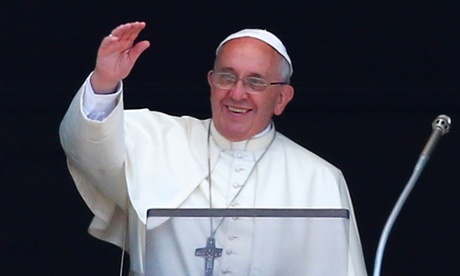
Pope Francis waves during a Sunday Angelus prayer in Saint Peter's square at the Vatican.
Pope Francis waves during a Sunday Angelus prayer in Saint Peter’s square at the Vatican. Photograph: Tony Gentile/Reuters

Pope Francis is to conduct a special Korean reconciliation mass in Seoul on the last day of his visit to South Korea between 14-18 August, and church officials in the South had sent several requests to Pyongyang to send a group of Catholics to attend.
But the day of the mass coincides with the launch of the annual Ulchi Freedom Guardian joint military drill, which the North has condemned as a rehearsal for nuclear war.
“Under these circumstances, coming to Seoul would be an agonising step,” the KCA letter said.
“We interpret this as meaning the North finds it difficult to accept the invitation,” said an official at the South Korean Catholic Bishops’ Conference.
The Catholic Church, like any other religion, is only allowed to operate in North Korea under extremely tight restrictions, and within the confines of the state-controlled KCA.
It has no hierarchical links with the Vatican and there are no known Catholic priests or nuns.
The KCA claims 3,000 followers in the North but outside estimates put the figure at around 800. Some analysts believe the organisation is intended to give the impression that North Korea allows religious freedom, which defectors say does not exist in the secretive state.
A recent comprehensive report compiled by a UN Commission of Inquiry into human rights in North Korea concluded that practising Christianity outside the state-sanctioned church amounted to a “political crime”.
The Pope’s final mass, to be held in Seoul’s Myeongdong cathedral, will focus on a message of peace and reconciliation for the Korean peninsula.
 

  • The Guardian,
 

Monday, July 14, 2014

Were the New Testament Magi Zoroastrians?


Our recent post,

Magi’s Star of Reference to Life of Jesus Christ
 
at :
http://westerncivilisationamaic.blogspot.com.au/2014/07/magis-star-of-reference-to-life-of.html?showComment=1405056099955has drawn the following from good friend, John R. Salverda (July 10, 2014 at 10:21 PM):

 
What? No mention of my favorite extra-Biblical source for the visit by the famous Astrologers. Allow me my two cents on the subject;

The Magi are the well known priests of Zoroaster. We learn of the role that the Magi played in the birth of Cyrus (another Hebrew "Messiah" Isa. 45:1-4 and presumably an adherent of the religion of Zoroastrianism) from Herodotus ("Histories." Book 1, Pages 107-129). Zoroaster is also credited with predicting the birth of Christ in the Apocryphal first Gospel of the INFANCY of JESUS CHRIST, Chapter III, Verse 1. ("And it came to pass, when the Lord Jesus was born at Bethlehem, a city of Judea in the time of Herod the King; the wise men came from the East to Jerusalem, according to the prophecy of Zoradascht [Zoroaster], and brought with them offerings: namely, gold, frankincense, and myrrh, and worshiped him, and offered to him their gifts." This gospel was attested to and used by the Gnostics as early as the second century AD.) Certainly this (Zoroaster's) Magi priesthood, who adored the "King of the Jews," helped to direct the event, just as surely as the LORD held the right hand of his Messiah Cyrus, to subdue the nations. (Compare also the role of Merlin the "Magi-cian" in the birth of king Arthur, the archetypal "King of Kings" among the Britons.)


AMAIC Response:


You John, surprisingly,with your penchant for detecting Jewish (Hebrew/Israelite) originals underlying many western myths and legends, the theme also of this very site of ours:


Lost Cultural Foundations of Western Civilisation


with its corresponding eastern version:


Lost Cultural Foundations of Eastern Civilisation


do not appear to be impressed with – as mentioned in our Magi article - those Syro-Arabic legends according to which Zoroaster was the biblical Jewish scribe, Baruch, a friend of the prophet Jeremiah. According to this handy piece from Wikipedia on the matter (http://en.wikipedia.org/wiki/Baruch_ben_Neriah):


Baruch ben Neriah


Some Christian legends (especially from Syria and Arabia) identify Baruch with Zoroaster, and give much information concerning him. Baruch, angry because the gift of prophecy had been denied him, and on account of the destruction of Jerusalem and the Temple, left Palestine to found the religion of Zoroaster. The prophecy of the birth of Jesus from a virgin, and of his adoration by the Magi, is also ascribed to Baruch-Zoroaster.[24] It is difficult to explain the origin of this curious identification of a prophet with a magician, such as Zoroaster was held to be, among the Jews, Christians, and Arabs. De Sacy[25] explains it on the ground that in Arabic the name of the prophet Jeremiah is almost identical with that of the city of Urmiah, where, it is said, Zoroaster lived. However, this may be, the Jewish legend mentioned above (under Baruch in Rabbinical Literature), according to which the Ethiopian in Jer. xxxviii. 7 is undoubtedly identical with Baruch, is connected with this Arabic–Christian legend. As early as the Clementine "Recognitiones" (iv. 27), Zoroaster was believed to be a descendant of Ham; and, according to Gen. x. 6, Cush, the Ethiopian, is a son of Ham. According to the "Recognitiones",[26] the Persians believed that Zoroaster had been taken into heaven in a chariot ("ad cœlum vehiculo sublevatum"); and according to the Jewish legend, the above-mentioned Ethiopian was transported alive into paradise,[27] an occurrence that, like the translation of Elijah,[28] must have taken place by means of a "vehiculum." Another reminiscence of the Jewish legend is found in Baruch-Zoroaster's words concerning Jesus: "He shall descend from my family",[29] since, according to the Haggadah, Baruch was a priest; and Maria, the mother of Jesus, was of priestly family.


If Baruch were a wise (see Baruch 4, “Wisdom is the book of God's commandments, the Law that will last forever. All who hold onto her will live, but those who abandon her will die”, etc.) Jewish scribe, in Babylon (Baruch 1:3 “Baruch read the words of this book to Jeconiah son of Jehoiakim, king of Judah … and to all the people, small and great, all who lived in Babylon by the river Sud”), contemporaneous with the prophet Daniel, as we know he was, then he may well have known about Daniel’s “Messianic Prophecy”(Daniel 9:24-27), which Magi Star seekers invariably suggest was an extra factor assisting the New Testament Magi. This Daniel, we have tentatively identified, in turn, with the Benjaminite high official at Susa, Mordecai, in:


Belshazzar’s Feast in the Book of Esther?


Now, given Baruch’s obvious importance, his wisdom, and his contemporaneity with Daniel, and his sometime Babylonian location, then it is not beyond the realms of possibility that Baruch-was-Daniel-was-the-receiver-of-the-Messianic-prophecy,“predicting the birth of Christ”. If this be the case, then it would no longer be “difficult to explain the origin of this curious identification of a prophet with a magician, such as Zoroaster was held to be”, given that Daniel had been placed over all of the wise men in Babylon (Daniel 2:48): “[Nebuchednezzar] made [Daniel] ruler over the entire province of Babylon and placed him in charge of all its wise men”.


The Lost Cultural Foundations apparently extend to the East, as well as to the West.

Thursday, May 8, 2014

Book of Daniel “very dangerous” for China’s Communist leaders

China on course to become ‘world’s most Christian nation’ within 15 years

The number of Christians in Communist China is growing so steadily that it by 2030 it could have more churchgoers than America

 
Christian congregations in particular have skyrocketed since churches began reopening when Chairman Mao's death in 1976Christian congregations in particular have skyrocketed since churches began reopening when Chairman Mao’s death in 1976 Photo: ALAMY
 
….
The 5,000-capacity Liushi church, which boasts more than twice as many seats as Westminster Abbey and a 206ft crucifix that can be seen for miles around, opened last year with one theologian declaring it a “miracle that such a small town was able to build such a grand church”.
The £8 million building is also one of the most visible symbols of Communist China’s breakneck conversion as it evolves into one of the largest Christian congregations on earth.
“It is a wonderful thing to be a follower of Jesus Christ. It gives us great confidence,” beamed Jin Hongxin, a 40-year-old visitor who was admiring the golden cross above Liushi’s altar in the lead up to Holy Week.
“If everyone in China believed in Jesus then we would have no more need for police stations. There would be no more bad people and therefore no more crime,” she added.
 
Christian congregations in particular have skyrocketed since churches began reopening when Chairman Mao’s death in 1976 signalled the end of the Cultural Revolution. Less than four decades later, some believe China is now poised to become not just the world’s number one economy but also its most numerous Christian nation. “By my calculations China is destined to become the largest Christian country in the world very soon,” said Fenggang Yang, a professor of sociology at Purdue University and author of Religion in China: Survival and Revival under Communist Rule. “It is going to be less than a generation. Not many people are prepared for this dramatic change.” China’s Protestant community, which had just one million members in 1949, has already overtaken those of countries more commonly associated with an evangelical boom. In 2010 there were more than 58 million Protestants in China compared to 40 million in Brazil and 36 million in South Africa, according to the Pew Research Centre’s Forum on Religion and Public Life. Prof Yang, a leading expert on religion in China, believes that number will swell to around 160 million by 2025. That would likely put China ahead even of the United States, which had around 159 million Protestants in 2010 but whose congregations are in decline. By 2030, China’s total Christian population, including Catholics, would exceed 247 million, placing it above Mexico, Brazil and the United States as the largest Christian congregation in the world, he predicted. “Mao thought he could eliminate religion. He thought he had accomplished this,” Prof Yang said. “It’s ironic – they didn’t. They actually failed completely.” Like many Chinese churches, the church in the town of Liushi, 200 miles south of Shanghai in Zhejiang province, has had a turbulent history. It was founded in 1886 after William Edward Soothill, a Yorkshire-born missionary and future Oxford University professor, began evangelising local communities. But by the late 1950s, as the region was engulfed by Mao’s violent anti-Christian campaigns, it was forced to close. Liushi remained shut throughout the decade of the Cultural Revolution that began in 1966, as places of worship were destroyed across the country. Since it reopened in 1978 its congregation has gone from strength to strength as part of China’s officially sanctioned Christian church – along with thousands of others that have accepted Communist Party oversight in return for being allowed to worship. Today it has 2,600 regular churchgoers and holds up to 70 baptisms each year, according to Shi Xiaoli, its 27-year-old preacher. The parish’s revival reached a crescendo last year with the opening of its new 1,500ft mega-church, reputedly the biggest in mainland China. “Our old church was small and hard to find,” said Ms Shi. “There wasn’t room in the old building for all the followers, especially at Christmas and at Easter. The new one is big and eye-catching.” The Liushi church is not alone. From Yunnan province in China’s balmy southwest to Liaoning in its industrial northeast, congregations are booming and more Chinese are thought to attend Sunday services each week than do Christians across the whole of Europe. A recent study found that online searches for the words “Christian Congregation”and “Jesus” far outnumbered those for “The Communist Party” and “Xi Jinping”, China’s president. Among China’s Protestants are also many millions who worship at illegal underground “house churches”, which hold unsupervised services – often in people’s homes – in an attempt to evade the prying eyes of the Communist Party. Such churches are mostly behind China’s embryonic missionary movement – a reversal of roles after the country was for centuries the target of foreign missionaries. Now it is starting to send its own missionaries abroad, notably into North Korea, in search of souls. “We want to help and it is easier for us than for British, South Korean or American missionaries,” said one underground church leader in north China who asked not to be named. The new spread of Christianity has the Communist Party scratching its head. “The child suddenly grew up and the parents don’t know how to deal with the adult,” the preacher, who is from China’s illegal house-church movement, said. Some officials argue that religious groups can provide social services the government cannot, while simultaneously helping reverse a growing moral crisis in a land where cash, not Communism, has now become king. They appear to agree with David Cameron, the British prime minister, who said last week that Christianity could help boost Britain’s “spiritual, physical and moral” state. Ms Shi, Liushi’s preacher, who is careful to describe her church as “patriotic”, said: “We have two motivations: one is our gospel mission and the other is serving society. Christianity can also play a role in maintaining peace and stability in society. Without God, people can do as they please.” Yet others within China’s leadership worry about how the religious landscape might shape its political future, and its possible impact on the Communist Party’s grip on power, despite the clause in the country’s 1982 constitution that guarantees citizens the right to engage in “normal religious activities”. As a result, a close watch is still kept on churchgoers, and preachers are routinely monitored to ensure their sermons do not diverge from what the Party considers acceptable. In Liushi church a closed circuit television camera hangs from the ceiling, directly in front of the lectern. “They want the pastor to preach in a Communist way. They want to train people to practice in a Communist way,” said the house-church preacher, who said state churches often shunned potentially subversive sections of the Bible. The Old Testament book in which the exiled Daniel refuses to obey orders to worship the king rather than his own god is seen as “very dangerous”, the preacher added. Such fears may not be entirely unwarranted. Christians’ growing power was on show earlier this month when thousands flocked to defend a church in Wenzhou, a city known as the “Jerusalem of the East”, after government threats to demolish it. Faced with the congregation’s very public show of resistance, officials appear to have backed away from their plans, negotiating a compromise with church leaders. “They do not trust the church, but they have to tolerate or accept it because the growth is there,” said the church leader. “The number of Christians is growing – they cannot fight it. They do not want the 70 million Christians to be their enemy.” The underground leader church leader said many government officials viewed religion as “a sickness” that needed curing, and Prof Yang agreed there was a potential threat. The Communist Party was “still not sure if Christianity would become an opposition political force” and feared it could be used by “Western forces to overthrow the Communist political system”, he said. Churches were likely to face an increasingly “intense” struggle over coming decade as the Communist Party sought to stifle Christianity’s rise, he predicted. “There are people in the government who are trying to control the church. I think they are making the last attempt to do that.”
 
….