Sunday, January 29, 2012

Similarities of Ancient Hebrew and Greek Religion


[The AMAIC considers the Middle East – West comparisons of John R. Salverda as interesting, with some of them we think being very likely. But we do not necessarily agree with all of the following]


Olympus: [AMAIC. Mount Meru perhaps for Hinduism]


The Council of the gods

The contention here being that Greece was colonized largely from Israel, let us look among the Israelites for the origin of the Olympian concept. We won't have to search Israelite theology for long to find such a thing as the Greek "Olympus," the idea of a heavenly council of the gods, who spoke with one voice from a certain sacred mountain, these concepts surely did not originate in Greece. Not only did the Israelites have such a mountain based heavenly council of the gods, but they even called it by the same name! The term that was used among the Israelites for "the gods," was "Ha Elohim." The Greeks borrowed the Hebrew word, and it wasn't just the word that they borrowed.
 
In the Hebrew scriptures, the gods are not called the Olympians, they are the Elohim, but to the Greeks Olympus was more than just the gods, it was the kingdom of the gods, the Heavenly Kingdom itself. The actual circle of the heavens is naturally divided into its twelve sections by the number of months in a year, because animal shaped gods have been assigned to each section of the sky, it has been called the Zodiac (zoo-dial). Accordingly, the Greeks have twelve members of their heavenly kingdom, Olympus (like the Hebrew tribes, the list of Olympians sometimes changes, but the number always stays at twelve). The nation of Israel is also known as the Kingdom of Heaven, thus there is also the requisite twelve part division, the tribes. Many have made this connection between the tribes and the Zodiacal signs already, (with varying degrees of failure and success,) by conveying a sign of the Zodiac to each of Jacob's inheritors using the poetic language of each individual tribal blessing, (Gen. 49) where indeed it can be said that some animal comparisons are drawn (Judah is a lion, Issachar is an ass, Dan is a serpent, Naphtali is a hind, Benjamin is a wolf.). The point is, that the Olympian gods were like the tribes of Israel, not only in that there happen to be twelve of each, but also because they share the same reason for being so divided, they each stood for the dozenized Kingdom of Heaven. Both groups of twelve were the children and grandchildren of a single patriarch, Israel for the tribes, and Kronos for the Olympians. Kronos and Israel have been identified elsewhere.

Both kingdoms were divided amongst the siblings by lot. Also, it is not insignificant to note, that in each case, the twelve are set up so that one of them is king over the other eleven. The gods of Olympus, like the Elohim of Israel, spoke with one voice, it can therefore be said, that for the Greeks, "Olympianism," was an obvious step toward monotheism. The same thing could be said about the effects of "Elohimism" on Israel, for the term obviously retains its original plural form. It is not unreasonable therefore, to conclude that the Greek term, "Olympus" derives directly from the Hebrew word Elohim, (appending the usual Greek "-us" of course,) meaning, "the gods." Another correlation that becomes apparent when we compare the Hebrew Elohim, with the Greek Olympus, is the fact that they both shared the same serpentine antagonist.

The Idea that there was a great dragon/serpent opponent to the Most High is not foreign to the Hebrew Scriptures, the Biblical dragon, was named "Rahab," and this was apparently the same monster that was also called, "Leviathan." The Hebrew name Rahab, means "storm," and it is perhaps worth mentioning that storm is also what the name of the Greek dragon "Typhon" means. The name Typhon probably derives directly from the Hebrew name of a mountain called "Baal-Tsephon," that was located at the Red Sea crossing, where the Pharaoh met his death (Ex.14:9). There is also extrabiblical evidence for equating Tsephon with Typhon for the name can be recognized amongst the Ras-Shamra texts that were found at the site of ancient Ugarit. There we find that Mount Tsephon is the place from where Baal rushes out to defeat his serpentine foe, whose name we also recognize even in its Canaanite form "Lotan." The name Leviathan, was probably known as well to the Greeks, although altered slightly in form. The name "Python," of the contender with Apollo, if it did not derive from the usual Hebrew word for a cobra, "pe'then," is probably just a clipped version of the Hebrew name, Le-"viathan," (There is also "Phaethon," who was likewise shot down by Jove amidst a similar traumatic geological upheaval, he was not a dragon, but he was, like the Pharaoh of Egypt, the son of the Sun god Helios, after whom the Egyptian city of Heliopolis gets its name.) the Greeks also had the serpent Ladon. The Greek Ladon was a many headed serpent that guarded the way to the tree of the valued fruit in the ancient garden of Hesperidies, the Greek Typhon too, was many headed. According to Psalm 74, verses 13 and 14, the Biblical serpent, there called Leviathan, also has several heads. We learn something more from Psalm 74, for the Arabic Targums here use the phrase, "the strong ones of Pharaoh," in the place where, "the heads of Leviathan," usually appears.

Obviously the Hebrews did not believe in real dragons, the story of God's battle against the great dragon was typical Hebrew poetic symbolism, and in this case it was used in association with the exodus of the twelve tribes from Egypt. The Targums also substitute the phrase, "the Egyptians," for the name "Rahab," at Psalm 87 verse 4. Isaiah even symbolizes the Pharaoh and his Egyptian army as the great serpent Rahab, at chapter 51 verses 9 and 10, also at Isa. 30:7. Well, most of us know what the Bible says, but did you realize that the Greeks and Romans probably did not believe in real dragons either, and that they knew that their great dragon contender with god was, in reality, named after an actual ancient Pharaoh of Egypt? So says the Roman Pliny in book 2, section 91, of his great work, written in 77 AD, and entitled "Natural History." Now, how many ancient Egyptian Pharaohs, who were symbolized as a great dragon, and had a battle with the highest G/god, were there? Surely these two stories were referring to the same event.

The heavenly twelve were in the land of Egypt at the time that Zeus battled Typhon, they had, according to the myth, fled there to hide from the dragon, and while the twelve tribes had gone to Egypt merely to avoid a famine, in each case it was a forced exile with the hope of finding haven among the Egyptians. The twelve had to remain in their Egyptian exile, until the final defeat of the serpentine antagonist by G/god, at which time, both groups of twelve, the Olympians and the tribes, were able to come up out of the land of Egypt.

The Greek variant that mentions the Egyptian exile of the heavenly twelve, has considerable antiquity and has been attributed by others to a lost work by Pindar, a Greek who wrote as early as about 500 BC. Herodotus wrote a book that wasn't lost, in his "Histories," near the beginning of book three, written almost as long ago, about 450 BC., he locates the burial place of Typhon, under the water of a great lake (called Lake Serbonis) at the Syrian border with Egypt. Herodotus also notes that these "Syrians," the Syrians of Palestine as he calls them, wore the sign of the circumcision. Take note, that this is not simply in the same geographical area, but just as the Scriptural Pharaoh of the Egyptian Exodus lies buried under water, so lies this Typhon in the Greek myth about the Olympian exodus from Egypt. That area of the world was well known in ancient times as the location of Typhon's defeat, the Greek geographer Strabo, in book VII of his, "The Geography," even refers to the Egyptian shore of the Red Sea as "Typhonia." Apollodorus and Ovid both tell this story of the Olympian's Egyptian sojourn, the story was fairly well known and wide spread, but the most recent versions of the myth, always seem to mention one weird detail of the story, namely, that the gods took on the shapes of animals while they were in Egypt.

Much of the Greek myth conforms nicely to the Hebrew story of the Exodus, but the Idea that the, usually human shaped, gods had a metamorphoses into animal shapes, seems too crass for a rational explanation. Modern scholars have called this part of the story an etiology, a clumsy attempt, they say, by later mythographers, to explain the origin of the animal shapes in the zodiac. These emphasize that Pan became Capricorn the fish-goat, and that Venus and Cupid became the two fish of Pisces. Others claim that the myth is an attempt to explain the animal companions that attended many of the Greek gods, these cite the raven of Apollo for example, or the goat of Dionysus. Still others say, that the story shows how the animal headed gods of Egypt originated, these point out that Zeus became a ram and then equate Zeus with Ra-Ammon, and also, that Hera became a cow and then equate Hera with Hathor or Isis. I consider the last of these three theories to be the most accurate, however, I don't think that the "animal gods" part of the myth was a later addition, but rather, that it was as ancient as, and was part of, the original story, for the Hebrew scriptures, which I believe has a source in common with the Greek myth, includes a very similar tale.

Human sacrifice was widely practiced in the pre-Exodus times, and also after that, Abraham, the grand patriarch of Israel, had preached against sacrificing the son of man, the image of God, and in favor of animal substitutes, such as, the Abrahamicly authorized ram. It is certainly no mere coincidence that the main god of the Egyptians, Ra-Ammon, was zoopomorphized by them, as the same animal that was suitable for an Abrahamic sacrifice, the ram. It won't surprise us to find that the Egyptians, having lived with the Israelites for several generations, and having witnessed the lessons of the Exodus first hand, should have learned something about the practice of the true religion. Accordingly, Herodotus tells us that the Egyptians didn't engage in human sacrifices, he says that even for the animal sacrifices, which they did perform, the sheep and bulls, first had to be rigorously inspected by the priestly class, having to pass certain tests for cleanness.

The eminent mythologist, Sir James George Frazer shows, in his most renown work entitled, "The Golden Bough," that the sacrificial victim of those ancient rites, was originally meant to represent "the god himself" (Ch.XLIX,4,Pg.551). Perhaps the idea that the highest God would accept animal substitutions for human sacrifices was at first ridiculed by some, as changing the "image" of god. Thus the introduction of the Abrahamic religion into Egypt may have given rise to the Greek myth, a lampoon as it were, where, in Egypt, the gods took on the shapes of animals. Still, it was no lampoon to the Egyptians themselves, who, most reverently it seems, assigned an animal head to practically every god they had. An even closer parallel to the Greek myth can be drawn from the story of the Hebrews themselves. Consider this, the twelve members of the Kingdom of Heaven (the tribes not the Olympian gods,) had an anthropomorphic God when they went into Egypt, while there, they took up representing Him as an animal, thus the calf god. They stayed in Egypt until God "crushed the heads of Leviathan," where upon they came up out from the land of Egypt and abandoned their bovine image of God. Now, read the Greek "myth" about the divine metamorphoses again and wonder no longer as to its origin.

Numerous Biblical scholars, examining the use of the name "Elohim" in the Pentateuch, have concluded that the source of this, "Elohimism," was an author, or authors, who lived during the Omri dynasty about 850 BC., in the area of Samaria the capitol of the northern ten tribes. Elohimism, so say these scholars, was the theological point of view of the house of Israel, as opposed to the house of Judah. With this, I must concur, but only partially. I do find it very likely that the Elohimistic view was, at least codified at that time and place, perhaps even by King Omri himself, who as we know from the Scriptures, (Mic.6:16) wrote at least one work, therein referred to as, "The Statutes of Omri." However, the religious system of Israelite Elohimism had its origin long before the days of Omri. A study of the Greek myths will make it evident, that Elohimism was most likely set up back in the days when Moses and Joshua destroyed the Amorites, at which time it directly superseded the older Amorite religious system, for the error of the Amorites had come to completion (Gen.15:13-16).
 
To the Greeks, the battle between god and the dragon, their Zeus verses Typhon, was the religious turning point of the Greek religion, it was the establishment of Olympianism. The Olympians had to defeat the giants, whom they called "the Titans" before they could establish their own suzerainty, and Typhon fought on behalf of the giants. The battle between Zeus and Typhon, was considered by some to be the final defeat of the giants. The fact that the Greeks have many names for the giants, (besides the Titans there were the Earthborn, and the Aloeids) and several versions of their final defeat, should not deter the biblical scholars from an identification between the Greek giants and the Hebrew giants, on the contrary, this apparent confusion is just another thing that both sources have in common. The Scriptures have, the Nephilim, the Rephaim, the Zamzammim, the Emim, and the Anakim; the first were destroyed in Noah's flood but apparently not entirely. The Rephaim, the Zamzammim, and the Emim were wiped out by the Elamite King Chedorlaomer in the days of Abraham at the battles of Ashtoroth-Karnaim, Shaveh-Kiriathaim, and Ham (Gen.14:5), except for Og (and apparently his brother Sihon) who was called the last of the Rephaim when he was killed by Moses seven generations later. The Anakim were destroyed by Caleb after the death of Moses, and yet there were still a few giants left in the days of David for him to him to earn the Messianic attribute of giant killer. Enumerating the Greek confusion in this regard is equally as complicated; the Titans, like the Nephilim, were confined to Tartarus but were released and then re-confined. The Earthborn Giants revolted against Olympus on behalf of the Titans, their brothers, but were summarily defeated. Then Typhon was born in order to avenge the giants on the Olympians but he was killed as well. The Aloeids were a pair of gigantic brothers, like Og and Sihon, but the Olympians thwarted their rebellion also. Suffice it to say that, in both cases, the war against the giants lasted many years and involved several battles before Olympianism, or in the case of the Israel, Elohimism, could be firmly established.

Furthermore, the Greek kingdom of heaven was represented by a mountain, in much the same way that Israel is represented by Mount Zion. To say that Olympus is like Zion is to emphasize the obvious, and may seem to be an insignificant point, after all they were both mountains and many diverse nations had holy mountains. Perhaps an ancient memory of Mount Ararat is responsible for such a wide dispersal of the "holy mountain" motif. Mountains are awe inspiring, they are closer to the heavens and therefore seem "sacred" automatically, especially to worshippers of the god of heaven. But beyond this, the Scriptures tell us much more about the intricate theological symbolism connected to Mount Zion. It’s not just a mountain, it's God's abode, it's His people, it's their city, it's the bride of God, and she even has a daughter. Its location is no less ethereal than its symbolism is esoteric. There is a Heavenly Zion as well as an Earthly one, the prophets have it rising above all other mountains in the latter days, while the evangelists have it coming down from the Heavens to establish itself at the end times. Mount Zion had a cosmogonical existence as well as an apocalyptic one. God had a "Holy Mountain" even before David established it at Mount Zion. The Garden of Eden was in God's Holy Mountain, there was Mount Sinai, and Mount Moriah, even the Amorites had their own holy mountain, which the Hebrews called, "Mount Herman," but others, perhaps even the Amorites themselves, called it Mount "Sion."

We know a bit less about Mount Olympus, but what we do know is no less enigmatic. It was the abode of the gods, the bronze floored mansion of Zeus, the mansions of the Muses and all the "shining mansions of the gods" were imagined to be upon the snowy peak of Olympus. Of course, the Greeks knew that there were no real mansions on the actual mountain that they called Olympus, the concept of "Olympia" was not confined to a mere mountain. In Homer, Zeus threatens to pull Olympus up with a golden chain and hang Heaven and Earth from it. Homer usually had the gods living upon the mountain but sometimes he locates them in the sky, which he often distinguishes from Olympus. The concept of Olympus was an abstraction, like the concept of Zion, the literal mountain was only a symbol. Many nations, in order to justify their suzerainty, claimed their own Mount Olympus. There were rivals to Zion as well, and it is apparent that the direct prototype for the Greeks was not Mount Zion at Jerusalem itself, (Athens was already named after Zion,) but a more direct predecessor to Olympianism was the Elohimism from one of the famous rivals to Mount Zion, Mount Gerizim at Shechem.
 
Nothing in all of Israelite history resembles the Greek story, about the establishment of Olympian order over the Titanic chaos, quite like the account of the convocation at Joshua 8:30-34. Moses directed Joshua to assemble the twelve tribes at Shechem for the convocation, a kind of ceremony of confederation, where blessings for obedience were read to six of the tribes who were gathered together upon Mount Gerizim, and curses for disobedience were read to the other six who were gathered upon Mount Ebal. The spectacle of the twelve tribes taking their places at the Shechem mountains, from which they could look North and see the mountain of the defeated giants, the Amorite's Mount Herman, has everything that the Greek myth needs. Shechem became the capitol of Israel at least four generations before King David captured the Jebusite stronghold of Salem. However, the Shechemites incurred the malediction that was outlined in the very same "convocation of the tribes," that argues for their precedence. (Deut. 11:29; 29:26-28) The Shechemites worshipped foreign gods, and not only Baal-Berith either. A study of the Greek myths about the establishment of Olympianism makes it evident that the Israelites of Shechem had set up a system whereby each of the twelve tribes of Israel was represented by a god, or a goddess, and all agreed to abide by the word of one voice.

Like the Hebrew city/mountain of Zion, there was a Greek city also that was named after their mountain and called "Olympia," while this city wasn't in the vicinity of any mountain, it was none the less, founded to portray the abode of the gods. Here was the Temple of Zeus, with its famous statue by Phidias, one of the seven wonders of the ancient world. Here too the Olympian games were celebrated, this was due largely, we are told in the Greek myths, to the efforts of Pelops himself, after whom the whole "Peloponnesus" was named. The Achaeans of Pelops, these were the champions of Olympianism in ancient Greece.
 
-John R. Salverda

For more articles by John R. Salverda on the Hebraic Connections of Greek Mythology, see:

"Helleno-Yishurin. The Hebrew Origin of Greek Legends"


.... Across cultures mountains have been revered as abodes of the (g)ods; dwelling places of strange beings. In the Book of Enoch, Mount Hermon is said to be the place where the Grigori (Watchers, or Fallen angels) fell to earth and dwelled for a time thereafter. Jesus is said to have transfigured on one of the summits of Mt. Hermon. God himself once came down to walk on Mt. Sinai.

In Hindu mythology there is Mount Meru, the mountain at the center of the Universe. It too was the home of the (g)ods and many depictions of it can be seen today at such sites as Angkor Wat and various Hindu temples.
 
Did such a place exist? Is it possible that maybe our ancestors derived the idea of the pyramids from such mountains. A Pyramid is in essence a perfect representation of a mountain, with a peak, a slope and a summit.
 
In Greek mythology we have Mount Olympus, also a dwelling place of the (g)ods. The pattern is undeniable. Mountains and (g)ods have an apparent connection. But why? Mount St. Helens is associated with the (g)ods as well. Gods at war were used to explain Mt. St. Helens unpredictable eruptions. Mount Shasta was the home of a Chief/ God who descended from heaven.
 
Over and over the story repeats itself. ....

More on Moses as Hermes (Indra?)


Moses, Hermes, and Io

 
by

John R. Salverda


Background:


John R. Salverda shows how certain aspects of Greek Mythology owed their inspiration to Hebrew prototypes. This is of value in itself for we may sometimes glean hints of historical realities from these stories. The heroine Io for instance (as shown below) was identified by the Greeks themselves of a later age with the People of Phoenicia and with the Jews. The wanderings of Io may in fact refer to the peregrinations of the Lost Ten Tribes whose identify was transposed by the Greeks to the People of Judah and Phoenicia since these were the closest thing still in the neighborhood to what the Ten Tribes had once been.
 
The most ancient of all the Greek city-states that we have any history from is that of the city of Argos and its surrounding state called Argolis. The Greek city of Mycenae, after which the Mycenaean civilization itself was named, is considered to be but an offshoot from the city-state of Argolis, these preceded the Ionians of Athens, the Boeotians, the Corinthians, and the Dorians of Sparta, by several generations. Accordingly the myths about the founding of Argos represent the oldest of all Greek mythology. The founder and first king of Argos was called Inachus, and the first narrative myth with any kind of storyline from the founding of Argos, involved his daughter Io. This myth was often referred to as the story of Hermes 'Argiophontes,' so called after the hero of the tale, Hermes the 'Argus killer.'
 
Now, Io was identified with Isis among the Egyptians and the Syrian city of Antioch, formerly called Iopolis, had claimed to be her burial place, while Hermes, was identified with the Egyptian Thoth, the Babylonian Nebo, had a planet (Mercury) and a day of the week (Wednesday) named after him. It is a severe stretch of the imagination to believe that international characters such as Io and Hermes are the invention of the aboriginal pre-civilized Greeks without any outside influence, and became incorporated, fully formed by them, into the foundation myths of their first city-state Argolis. Therefore you must realize that this, earliest of civilizations known to the ancient Greeks, did not originate in Greece itself but obviously came as a colony from elsewhere, bringing with them a developed mythology, to settle there in Argolis. But from where?
 
It was the opinion of some of the ancient historians that the Argolian royal family had come up out of the land of Egypt. Perhaps these Argolian colonists from Egypt knew about the story of Moses, this would certainly go a long way toward explaining why Hermes is so much like Moses. Moses, like Hermes, was the messenger of God, and both were sent by God to free, each their own, chosen ones from their respective captivities. As the 'Psychopompus' Hermes is divinely commissioned as 'leader of the souls' to the promised land, an attribute that is easily derived from the job of Moses. Furthermore Hermes is famed as the god of travelers just as Moses is the leader of those who wandered. According to the Scriptures, Moses and his followers had a lot of trouble with poisonous serpents, people were sick and dying of snakebite, and so God had bestowed upon Moses a copper serpent that was to be attached to a stick and used for curative purposes, while the mythical Greek character Hermes carried a serpent stick called the 'Caduceus' which was also divinely bestowed upon him and became the worldwide symbol of the medical profession. Some will argue that although the Caduceus did eventually become the symbol of the medical profession, to Hermes himself it was merely the badge of his office as the messenger of god, but of course, it is also true that Moses had another 'serpent stick' which he carried on his missions to bring God's messages to the Pharaoh. We are told by Jewish sources such as the writer Eupolemus, who wrote about 150 BC, that the alphabet was invented by Moses, while according to Greek sources the same alphabet was invented by Hermes. The Egyptian Hermes, whom they called 'Thoth,' is credited with inventing hieroglyphic writing, while the Babylonian Hermes, whom they called 'Nebo,' is credited with inventing cuneiform writing. Nebo, a word that means, the 'Prophet,' was a common nickname for Moses, and when Moses died he was buried upon Mount Pisgah which is also called, no doubt in memory of Moses, Mount Nebo. Needless to say Moses was a prolific writer of sacred texts, in this regard Hermes was apparently no slouch either. So-called Hermetic books dealing with the religion of Egypt were mentioned by Clement of Alexandria, Tertullian, Porphyry, and Jamblichus. Clement even says that the books of Hermes were carried by the Egyptians in religious processions, one wonders indeed if they were kept in an ark like the law of Moses during the religious processions of the Israelites. However well known these Hermetic writings were in ancient times, it wasn't until the middle of the 15th century that some of these previously lost Hermetic texts had supposedly been found in the libraries of the Byzantine Empire. Suspect though they are, these books are accredited to the semi-mythical figure named Hermes Trismegistus (thrice greatest) whom the Gnostics insist, while not being Moses himself, was a contemporary of his.
 
The preceding has been a list of several obvious parallels between Moses and Hermes, however there are quite a few similarities that are not so obvious but become so with only a bit of explanation, for instance; An ever present characteristic of any image of Hermes is his petasos, that cap which featured a wide circular brim. The fact that this petasos looks, even to the casual observer, remarkably like the halo of a Christian saint, may be a clue to its origin. For the corona of Moses, which is Scripturally attested to at Exodus 34:30, (And when Aaron and all the children of Israel saw Moses, behold, the skin of his face shone; and they were afraid to come near him.) probably was represented pictorially as a circle around his head and therefore it could have served as the origin of the petasos of Hermes. Hermes also had another form of headgear that was intended to hide him, it was known as the cap of darkness, or the helmet of invisibility, we know this because, according to Hyginus from his 'Astronomica,' (2.12) he once loaned it to Perseus, 'Perseus ... received from Hermes, ... petasos, and, in addition, a helmet which kept its wearer from being seen ... the helmet of Hades (the Unseen One), ...' Moses also had a headdress that he wore for the purpose of hiding, for his corona was frightening to people so he used a veil to conceal it, as explained in the book of Exodus at 34:33, (And until Moses had finished speaking with them, he put a veil over his face.) Hermes is often depicted as wearing the winged sandals, but the Greeks would certainly know enough not to take this literally, even as Moses was sent to deliver the Israelites upon eagles wings as at Exodus 19:4, (You have seen what I did unto the Egyptians, and how I bare you on eagles' wings, and brought you unto myself.) so the Greeks would understand that traveling upon wings was merely symbolic and meant nothing more than going swiftly. Among the Greeks, Hermes was considered to be the inventor of casting lots as a method of divination, but Moses also instructed the Hebrews, at a very early date, in the use of lots to divine the will of God. The iconoclastic Moses taught that no images should be made, accordingly there is some evidence that Hermes too was at first an iconoclast. The name of Hermes originated in the Greek word 'herma' meaning a 'stone heap.' Probably from the custom of erecting a 'herm' consisting of an upright stone surrounded at its base by a heap of smaller stones. These unpretentious monuments were often used as landmarks for travelers or to mark territorial boundaries. A mythical origin for these stone heaps may also be surmised, for to quote from the 'Etymologicum Magnum,' 'When Hermes killed Argos, he was brought to trial by the gods. They acquitted him, and in doing so each threw his voting-pebble at his feet. Thus a heap of stones grew up around him.' The point here being that, the many more recent images of Hermes result from apostasies of his earliest teachings, and that the original icon of Hermes, namely, the modest stone heap, was indeed one that would have been acceptable to even Israel himself. Genesis 31:45-46 (And Jacob took a stone, and set it up for a pillar. And Jacob said unto his brethren, Gather stones; and they took stones, and made an heap.) Moses taught that one out of every seven days, the Sabbath, was to be revered as holy, while Hermes also took one day out of the seven, it was Wednesday, and it was named after him.
 
I was not the first one to identify Moses with Hermes, in fact this was noticed thousands of years ago, at least as early as the second (some think that he could possibly have lived in the third) century BC by the Egyptian (some think that he may possibly have been Jewish) priest Artapanus. Eusebius (ix. 27) quoted from a lost book that was written by Artapanus and was called 'Concerning the Jews' it said of Moses 'he was beloved by the Egyptians, who called him Hermes.' The Greeks themselves seem to corroborate Artapanus by admitting that the Ibis headed Egyptian god Thoth was just another version of their god Hermes. The Greeks even tell a story of how Hermes had come up out of the land of Egypt, where he once had lived disguised as an Ibis. Like it is in the Hebrew Scriptures, the followers of Moses in the story told by Artapanus, were plagued by poisonous serpents, however the Moses of Artapanus (instead of the copper serpent,) employed the Ibis to attack the snakes. This was the reason, Artapanus says, for which Moses/Hermes revered the Ibis so.
 
There are quite a few ancient historians who have written chronologies representing Moses as living at the same time as Inachus, the father of Io. The native Egyptian priest and historian, Ptolemy of Mendes as quoted by Africanus tells us; 'in the time of Apis son of Phoroneus (Phoroneus was the son of Inachus, and the brother of Io) a part of the Egyptian army was expelled (or simply took their 'leave' from the Greek word 'exepesen' ) from Egypt, who took up their abode not far from Arabia in the part of Syria called Palestine,' And Apion, in his book 'Against the Jews,' and in his 'Histories' Book four, says that, 'in the time of Inachus king of Argos, ... the Jews revolted, with Moses as their leader.' And Clement (44) quotes Ctesias as saying. 'the movement of Moses out of Egypt took place in the time ... of Inachus king of Argos.'
 
If Hermes was Moses, as per Artapanus, and Moses was a younger contemporary to Inachus, the father of Io, as per the ancient chronologists here cited, then it is very conceivable that the Hermes in the story of Io's wanderings, is a mythic Greek version of Moses in the Hebrew story about the wandering Jews.
 
We are fortunate to have preserved for us the writings of Aeschylus, who wrote his 'Prometheus bound,' about the year 470 BC. for in this work, the story of Io is linked to the story of Prometheus. The story of Io was, almost certainly an Egyptian and/or Phoenician tale which was brought to Greece by the likes of the Danaus the Egyptian, and by Cadmus the Phoenician, who were both descendants of Io. However, the story of Prometheus, with his father Iapetus, (the eponym of Cappadocia, from a Persian version of the name that was similar to the Latin form, 'Gepetto,') and the Caucasus, would direct us toward the Southeastern end of the Black Sea. Although these two myths seem to come from diverse and distant locations, Aeschylus has connected them as parts of the same story, therefore he must have known of, or at least suspected, that this connection existed, otherwise his readers would not accept it as logical. As Aeschylus relates to us, it was soon after Prometheus was sentenced and fixed to his lofty place of suffering, that Io, in the course of her wanderings, approached his mountain and talked with him. Keeping in mind what we know about the story of the Exodus, the story of how Io got to this place, can tell us much about the figure whom the Greeks called Prometheus.
 
The earthly wife of god was in bondage, so god sent his serpent stick carrying messenger, on eagle's wings, to lead her out of her captivity. The messenger of god smote the head of her captor and delivered the Earthly wife of god. Did he lead her directly home' No, this is when she went on her famous wanderings, known to the Greeks as, the wanderings of Io. There was a mystifying cloud cover, a gadfly plague, and a miraculous water crossing. She gave birth to the "Egyptian" calf god, "Epaphus." (Apis) But, most telling of all, she approached the special mountain where the creator of mankind was bound, and talked to him. Prometheus told Io that she could expect the savior to be born to her, as one of her descendants, thirteen generations hence. After all this she finally returned to her homeland, Phoronea.
 
Now, if this story sounds intriguingly familiar it should, for the "myth" of Io's deliverance, and the story of the Exodus share an origin. Let us prove this theory by examining the eleven motifs of the myth, as I have laid them out, point by point: First of all is the statement; 'The earthly wife of god was in bondage' That the nation of Israel itself was symbolically pictured as God's wife is evident from several passages of the Scriptures, notably at Isaiah 54:5 and Hosea 2:1-23 but especially at Jeremiah 31:32, where God's wife is specifically said to have been delivered up out of Egypt; '... I took ... them out of the land of Egypt; ... I was an husband unto them, ...' In accordance with the Greek myth of Io, the chief Greek god Zeus, (the Roman Jove, as Jehovah'), had two wives, one was his heavenly wife Hera and the other was his Earthly one Io. He had given Io to Hera who placed her in bondage, that's right, Io was the bondwoman (or bondmaid) of Hera. (Genesis 16:6 But Abram said unto Sarai, Behold, your maid is in your hand; do to her as it pleases you. And when Sarai dealt harshly with her, she fled from her face.) Thus Hera and Io were to Zeus, as Sarah and Hagar were to Abraham, the wife and her bondmaid, and consequently in accordance with Galatians 4:22-26, also just as God's Earthly wife and God's Heavenly wife were to Him. (For it is written, that Abraham had two sons, the one by a bondmaid, the other by a freewoman. ... Which things are an allegory: for these are the two covenants; the one from the mount Sinai, which brings forth children to bondage, which is Hagar. For this Hagar is mount Sinai in Arabia, and answers to Jerusalem which now is, and is in bondage with her children. But Jerusalem which is above is free, which is the mother of us all.) Here we can see that, as the book of Galatians confirms, the Earthly wife of God was indeed pictured as being in bondage, just as the Greek story of Io portrays. ...In light of the foregoing it seems conceivable that the very name 'Io,' is a mere transliteration of the word 'Jew,' and its use in the Greek myth, is one of the earliest known employments of this term to denote a Hebrew. The Greeks themselves often referred to the inhabitants of Canaan (also known as Israel) as the descendants of Io, an example of one such early reference is in Bacchylides, who lived at the beginning of the fifth century BC, and wrote an ode about Io, so saying that, "she gave to light, man's greatest line, the roots of Cadmus, Agenor's son, ..." thereby of course, referring to the Phoenicians, or rather, as I hope the reader will come to understand by the fact that they both occupied the same land of Canaan, the Hebrews. (Bacchylides, 19.)
 
The second statement is; 'so god sent his serpent stick carrying messenger, on eagle's wings, to lead her out of her captivity.' Hermes, as we have said previously, parallels Moses, their two serpent sticks, the eagle's wings, and their particular commissions as divine messengers, have all been covered previously, thus it would be redundant to reexamine these apparently identical characters, however let us here consider the underlying parallel plot, of their respective rescue missions. In the myth of Io, it was Zeus himself who, by deceiving her captor, was responsible for the fact that Io was gripped in bondage. He had lied to Hera in allowing her to keep Io captive. He regretted this and it was his will that she should be freed from her captivity, but he did not personally demand it, instead he appointed an intermediary, Hermes, to deliver her. Neither Argus, the champion of Hera and guard of Io, nor Hera herself, knew the true will of god in this matter. In other words, Zeus had acted to free Io from a captivity which he himself was also responsible for orchestrating. God, in the Scriptural story of the Exodus, was also on both sides of the issue, for on the one hand, He kept, as He put it, 'hardening the heart' of the Pharaoh, thereby claiming responsibility for the fact that the Jews were remaining in bondage, while on the other hand, He heard the cries of His poor Earthly wife and, having pity on her in her captivity, it was His will that she should be freed. God did not openly appear to Pharaoh and command him to soften his heart and release the Jews, which He could no doubt have done, as easily as He had caused the Pharaoh to harden it, instead he appointed an intermediary, Moses, to deliver her. One last point on this topic is the interesting detail of the divine excuse. Whether in the Scriptural or the mythological version of the story, the duplicity of God/god is so obvious that the writer finds the need to offer a reason to rationalize it. The Greeks explain that the deceit of Zeus in this regard, demonstrates that it is perfectly permissible to violate a lovers vow, and that it would be completely forgiven by the gods, if one were to do so. While the Scriptural excuse runs thusly; Exodus 10:1-2 And Yahweh said to Moses, Go to Pharaoh: for I have hardened his heart, and the heart of his servants, that I might show these my signs before him: And that you might tell in the ears of your son, and of your son's son, what things I have wrought in Egypt, and my signs which I have done among them; that you may know how that I am Yahweh.
 
Third we have; 'The messenger of god smote the head of her captor and delivered the Earthly wife of god.' Argus, surnamed, 'Panoptes,' the 'all-seeing,' or 'many-eyed,' was set as Io's keeper. The Egyptians were especially fond of representing their gods as an eye, Horus was considered to be the eye of Ra, so was Hathor Ra's eye, Ra himself was an eye, and even Osiris was an eye, To quote Plutarch; 'Thus, their great king and lord Osiris is represented by the hieroglyphics for an eye and a scepter, the name itself signifying "many-eyed," as we are told by some who would derive it from the words os, "many," and iri, an "eye," which have this meaning in the Egyptian language.' If the Greeks did trace the origin of the name Osiris to the term 'many-eyed' then Argus Panoptes is a likely figurative version of the famous Egyptian god. After all, to the Egyptians, their Pharaoh represented Osiris, and this must have been especially true of a Pharaoh who had been killed. On the other hand I suspect a more esoteric meaning behind the character of Argus, for Osiris symbolizes more than just the Pharaoh of Egypt he was a symbol of Egypt's entire religious system. The many eyes mean the many gods, and the famous killing of Argus by Hermes is a symbolic reference to the death of Polytheism and the famous institution of monotheism by Moses. (This will become more evident after a comparison of this story to the story of Perseus who also performs a famous beheading.) As if to bolster this argument, more than one Biblical commentary has represented the ten plagues, culminating with the death of the Pharaoh at the Red Sea, as each targeting, one after another, the different false gods of Egypt, in order to show their combined ineffectiveness against the one true God of Moses.
 
As the forth item we have; 'Did he lead her directly home' No, this is when she went on her famous wanderings, known to the Greeks as, the wanderings of Io.' While it is true that the most common tale has Io wandering all over the world, at the end of this trek, she had another more familiar journey. We learn from Robert Graves, 'The Greek Myths,' (56) that there was a strong tradition claiming that the wanderings of Io ended at Mount Silpium in Syria where she was said to have died of grief. This tradition was backed up by the fact that a city, once called Iopolis but later and better known as Antioch, was founded in her honor, and there was a ceremony held there that the residents performed annually in her memory. The following we learn from Apollodorus; Io gave birth to Epaphus in Egypt, but the Curetes kidnapped him, and so Io set out to search for the child. She roamed all over Syria, and found Epaphus, the Queen of Byblos was nursing him. The Egyptians called Io by the name of Isis. You can verify it by reading his work, 'Library and Epitome' (2.1.3) Many mythic women, have wandering as one of their attributes, unfortunately, the scope of this work, does not include tracing the origins of all myths to the stories of the Hebrews, only the Greek ones. If you accept the identification of Io with Isis as given by Apollodorus then, Plutarch confirms the route of her wanderings, that is from Egypt to the land of Canaan (Byblos) in his story of Isis. The Jews after making the calf-god, like Io after the birth of Epaphus, were famous for wandering from Egypt to Canaan. But also like Io, the Jews went through an extensive period of sojourning prior to the calf-god incident, Therefore the Greek myth of Io with her more extensive wanderings could be referring to a story of the Jews that covers the whole period of time from Abraham down through the Exodus. A Scriptural verse that actually talks about this time period can be found at Genesis 15:13 '... your seed shall be a stranger in a land that is not theirs, ... four hundred years.' Furthermore the phrase 'your seed' here cited could be referring to more than Abraham's descendants through Sarah, for let us not forget that Hagar, who was a wife's bondmaid like Io, began her period of wandering already in the days of Abraham.
 
Now, we know that Israel wasn't in Egypt for 430 years, but, on the other hand they were said to have been first in Mesopotamia, then in Canaan, and then in Egypt, before returning to Canaan, for about that length of time. And so, after a closer examination, it does seem possible that the Greek version of Io's wanderings could have originated, like the rest of her story, from the same source as the Hebrew version of a story about the wandering Jews. Incidentally, since this story was brought, it would seem, by the Jews from Canaan to Argolis, we can adduce this migration as the final leg of their wanderings.
 
The fifth point is; 'There was a mystifying cloud cover,' In each case the God/god raised up a cloud in order to hide his Earthly wife from her subjugator. See Exodus 14:19 where it says; 'And the pillar of the cloud went from before their face, and stood behind them: And it came between the camp of the Egyptians and the camp of Israel; and it was a cloud and darkness to them, but it gave light by night to these: so that the one came not near the other all the night.' In the Greek myth Zeus also raises up a mystifying bank of clouds to hide his Earthly wife Io from her subjugator Hera.
 
Featured sixth is; 'a gadfly plague,' While at first glance this would seem to make an intriguing match, I'm afraid that I can't really defend this identification. Io was indeed 'plagued' by a gadfly, but the word which is often translated from the Greek and Latin originals is a verb, and could just as easily have been rendered as 'harassed,' 'attacked' or 'stung.' The scriptural term is a noun and could perhaps be more properly interpreted by the word 'blow,' or 'strike.' Even the term, 'gadfly' is in doubt, a few, by no means all, Scriptural translations, such as, the New World, the Jerusalem Bible, and the Emphasized Bible, have rendered the word representing the agent of the fourth plague as 'gadfly,' however, we are more certain that Io's pest was a gadfly than we are that this Biblical 'swarm' was of gadflies. Never-the-less, I did feel obligated to include this topic anyway, for the sake of those who are familiar with both the Hebrew story and the Greek myth, for these would naturally wonder about it. After all, the first two things that come to mind when you hear the phrase, 'gadfly plague,' would be, of course, first the Exodus and then the myth of Io. Let the reader dismiss this motif as he sees fit, you can take it or leave it.
 
As motif number seven we have; 'and a miraculous water crossing.' Having identified the wandering Io, with the wandering Jew, the obvious intent here is to equate the miraculous Scriptural Red Sea crossing, with the also miraculous water crossing of the Bosphorus, by the divine heifer in the Greek myth. Although the name "Bosphorus" is usually reserved as the title for the straits between the Black Sea and the Sea of Marmara, there are other narrow water crossings between land masses, that are also called by that name. Apollodorus tells us in his, 'Library and Epitome' (2.1.3) "Io ... crossed what was then called the Thracian Straits but is now called after her the Bosphorus. (Here, Apollodorus is not referring to the usual Bosphorus, but to the Cimmerian Straits of Phosphorus, a tongue of water that leads from the Black Sea northward into the Sea of Azov now-a-days called the Kerch Strait. It separates the Crimean Peninsula from the Kuban region in the west.) And having gone away to Scythia and the Cimmerian land she wandered over great tracts of land and swam wide stretches of sea both in Europe and Asia until at last she came to Egypt." There was also what was called the Indian Bosphorus that was, amazingly enough, across the Red Sea, at Bab-El-Mandeb, so says Robert Graves in his book, 'The Greek Myths,' (56) Now, the fact that there are these other water crossings that are also called Bosphorus is very suspicious, especially when you suppose that the origin of this word comes from the Greek myth. Could the mere fairy tale of Io swimming across the straits of Bosphorus have been so influential as to name straits all over Europe and Asia' Wasn't there another water crossing, that was of much greater import, and was a more likely origin to these multiple uses of the term Bosphorus' As we have intimated earlier, the term Bosphorus is the Thracian form of Phosphoros ('Prometheus Bound & the Fragments of Prometheus Loosed' by N. Wecklein) meaning, "Light bearing." Probably the word "Bosphorus," originated with the word "phosphorus." And this in turn probably came from the word "Eosphoros" (related to other similar terms such as "Hesperus" and "Heosphoros") or "dawn bearing." For "Io," is probably a form of the Greek "Eos," which means the "dawn" and was, as we have seen, just another name for "Zion," (could this be the ultimate origin of the English word "dawn'" We also have a goddess called "Morgana" as "morning.")
 
The eighth part of the myth is; 'She gave birth to the "Egyptian" calf god, "Epaphus." (Apis)' Showing that Epaphus, the son of Io, was meant by the Greeks to represent the Egyptian calf-god Apis is elementary, the Greeks themselves, as early as Herodotus about 450 BC, (Now Apis is the god whom the Greeks call Epaphus. from 'Histories' Chapter 3) make it plain that this is so. Furthermore, equating the golden calf, which was built and worshipped by the Hebrews during their Exodus, with the Egyptian god Apis, is also largely done for me already, by the majority of Scriptural commentaries. Therefore logic propels this statement; If the Greek Epaphus was the Egyptian Apis, and the Egyptian Apis was the Hebrew golden calf, then it logically follows that the Greek Epaphus was the Hebrew golden calf. Of course it may be argued that the Jews did not give birth to the golden calf, however, if we accept that Io was the Jews and that she gave birth to Epaphus just before she wandered from Egypt to Canaan, and we are able to equate that, with the Jews building their golden calf just before they wandered to Canaan, then a strong case can be made that the 'building' of the golden calf refers to the 'birthing' of Epaphus.
 
ninth; 'But, most telling of all, she approached the special mountain where the creator of mankind was bound, and talked to him.' Associating Io with the Jews, leads automatically to the identification between the two mountains that are featured in each their own two stories. The identical characters identically wandered, the Jew to Mount Sinai, and Io to Mount Caucasia, this would be enough to link the two mountains, but the Greeks offer such details about Io's special mountain as to make it's correlation obvious. Not only was there a special mountain, but the creator of mankind was 'bound' to it. Now, please don't let the common knee-jerk reaction, charging blasphemy, and decrying the dissimilarities between the Promethean creation and that of God in the book of Genesis, blind your eyes to the following comparison, no doubt the reader is sufficiently inured by now. Prometheus, like the Scriptural Creator, created Mankind out of clay. Also included in the story of Prometheus, is the tale of how the first woman, therein called Pandora, introduced evil into the world because she could not do as she was told. Prometheus not only gave a clear warning that if heeded would have prevented this feminine mistake, his story also included a Greek version of the 'Messianic' prophecy. Just like the Edenic promise concerning the Seed of the enigmatic woman, so was the identity of she who would one day give birth to the child, who was destined to overthrow Zeus, equally mysterious. But where, you may ask, is the Garden of Eden in the story of Prometheus' The answer is, that the same people who told the story of Prometheus did have the story of that ancient garden, for Prometheus was the brother of none other than Atlas, the ancient gardener himself. Practically every motif from the Scriptural story of creation, can be found within the Greek myth about the family of Prometheus and Atlas. And why not' For they were the sons of Iapetus, the only character in all of Greek mythology whom, Biblical scholars are willing to admit, may have had a Scriptural origin, Japheth the son of Noah and the progenitor of the Caucasians.
 
The tenth particular point to be made in the myth of Io as I have laid it out is; 'Prometheus told Io that she could expect the savior to be born to her, as one of her descendants, thirteen generations hence.' This point, overlooked by many, is exceptionally strong evidence for equating the Greek and Hebrew traditions. A quote from 'Prometheus bound,' a play by Aeschylus, who wrote as early as 500 BC, runs thus; 'PROMETHEUS: She (a future wife of Zeus) will bear to him a child, And he shall be in might more excellent Than his progenitor. IO: And he will find No way to fend off this strong stroke of fate' PROMETHEUS: None save my own self when these bonds are loosed. IO: And who shall loose them if Zeus wills not' PROMETHEUS: Of your own seed. IO: How says you' Shall a child of mine release thee' PROMETHEUS: Son of yours, but son the thirteenth generation shall beget. IO: A prophecy oracularly dark.' Is it not amazing how exactly, down to the smallest details of theology, that the Greek and Hebrew traditions match on this point' With the advent of this 'savior' Prometheus would no longer be 'bound' to the mountain. How many stories do you know of where the creator of mankind will be released from his binding contract through the fulfillment of a prophecy predicting the future arrival of the son of god, and the seed of a woman' (Well, the story of Atlas is also remarkably similar but, as I hope the reader will come to realize, the two stories were intricately related.) The entire genealogy of the Greek savior, all thirteen generations are known to this day! (as if it were the thirteen generations from Abraham to David!) Can any other "myths" claim to pay such attention to the details of lineage? Check it out, Heracles was the son of, Amphitryon the son of, Alcaeus the son of, Perseus the son of, Danae the daughter of, Acrisius the son of, Abas the son of, Hypermnestra the daughter of, Danaus the son of, Belus the son of, Libya the daughter of, Epaphus the son of, Io the daughter of Inachus. Why such meticulous genealogical record keeping, for these fairy tales' The obvious answer is, that they weren't fairy tales at first, they only became considered as such by later generations after we had forgotten the true meanings of the symbolisms. Once upon a time they were taken as seriously as Scripture.
 
Last, but not least, is the eleventh assertion which is as follows; 'After all this she finally returned to her homeland, Phoronea.' By now it will have become obvious to the reader, that none of these events actually took place in Greece itself, the wandering was from Egypt to Canaan, the mountain was Sinai, and the miraculous water crossing turns out to have been at the Red Sea, so it should come as no surprise to find that Phoronea was not Argos in the Greek Argolis either. Phoronea was Hebron, the giant who was known to the Greeks as Inachus, and the sons of Inachus, (called the Inachids, in the Greek myths) were the founding family of Phoronea, just as the giant who was known to the Hebrews as Anak, and the sons of Anak, (called the Anakim, in the Bible) were the founding family of Hebron. Thus the Greek giant Inachus is to be identified with the Hebrew giant Anak. (in light of the foregoing, the parents of Inachus, Tethys and Okeanus, represent plausibly, Heth and Canaan.) Inachus had at least two children, a boy, Phoroneus, whom Phoronea was named after, and the girl, Io. The name Phoroneus must be a shibboleth of the name Ephron, whom I assume Hebron to be named after. A further clue for this identification lays in the fact that Phoroneus was famous, in Greek myths for trying to get nomadic peoples to settle down and live in towns, he was a well known 'civilizer.' The biblical Ephron tried the same thing with the nomadic Abraham. When the Hebrew patriarch came to Ephron, (the Hittite) at Hebron, looking for a family grave site, all he wanted was a cave, but Ephron made Abraham buy an entire section of the city (Genesis, Chapter 23). This sharing of ownership in a city, gave Abraham's family a kind of royal status there, but no doubt, made them responsible for taxation as well. While Ephron is said to have lived among the children of Heth, the Anakim are not called Hittites in the Bible, but this is a logical assumption. The Bible does say that the Israelites were largely of Hittite extraction, which leads us back to the sister of Phoroneus, Io. The story of Io concerns the founding families of Phoronea. The Greek myths say, that "Phoronea" was the name of the place before it was changed, (at some unspecified date,) to Argos.
 
In propagating a new religion it often becomes necessary to denigrate the old existing one. In this way the gods and heroes of the old tradition often become the demons and villains of the new one. It is apparent that this is what occurred in ancient Argolis. The Anakim, who were the original immigrants to Argos from Hebron, brought with them the worship of Hera, the Queen of Heaven. However, the newer arrivals, those who told the story of Io, apparently did not share so fervently in that worship. To them, Hera and her champion Argus, were the persecutors of Io. They preferred to worship a male deity and his messenger Hermes. There are tantalizing mythological hints about the nature of the previous religion where the Queen of Heaven was supreme. She had endowed Argus with great strength and sent him to destroy a terrible enemy of mankind, the monstrous Echidna. We are also told how previously, before Zeus had fallen in love with her and Hera began treating her so badly, Io had served as a priestess of Hera's. Now, we know from the Hebrew scriptures, that the new religion which was propagated by Moses, also had to overcome the previously existing "pagan" worship of the Queen of Heaven, who is Biblically referred to as "Ashtaroth." We also know From the book of Jeremiah Chapter 44 Verses 17 through 25, that this form of worship was a very popular alternative to the Hebrew religion. Back in the days of the Canaanite conquest, when Caleb was routing the Anakim out of Hebron, the Israelite leader Joshua, put it to the people to choose which religion they would honor. (Joshua 24:15-16, And if it seem evil unto you to serve Yahweh, choose you this day whom ye will serve; whether the gods which your fathers served that were on the other side of the flood, or the gods of the Amorites, in whose land ye dwell: but as for me and my house, we will serve Yahweh. And the people answered and said, God forbid that we should forsake Yahweh, to serve other gods.) Of course, the people were only giving Joshua lip service, for we further read at Judges 2:13, And they forsook Yahweh, and served Baal and Ashtaroth. This ultimatum to the people to choose between these two forms of worship cannot but helped to remind us of the ancient Greek myth about the founding of Argos. According to the myth, there was a contest between Hera and Poseidon, (Apsu+Adon, "lord of the abyss" he was a very jealous god, who often contested against the local, deity, a goddess usually, demanding the exclusive devotion of its inhabitants. The Athenians also, had to vote for either Athena or Poseidon, who wouldn't share his adoration. He was the "Earth shaker," the flood, and the drought, were his instruments. But, for all his Yahweh like attributes, he was very Dagon like too. This mixture of attributes was the result of a mixture between his main worshippers, the Danites and their closely related neighbors, the Philistines.) over whom should be worshipped by the People of Phoronea, it was either Inachus or, as some sources have it, Phoroneus who chose the Queen of Heaven, and thus the place was named for her son. Consequently, the wrathful Poseidon duly punished the people, with drought and flood, for deciding against his worship. The summary of my theory is, that Argolis in Greece was founded by the Anakim from Hebron, who were expelled by Caleb, in the days of Joshua. The People of Argolis brought the stories of Hebron with them as they went to its colony in Greece, they called this colony "Argos," after the son of Hera, Argus Panoptes. Much of the stories about the city, especially while it was still called Phoronea, actually took place not in Greece but back in Hebron, and the Argolians simply retained those memories as their founding myths. Subsequent waves of Danite/Philistines, also from the land of Canaan, later arrived in Argos, and adjusted the Argolian mythology a bit to better suit their religious beliefs. we shall soon learn more about this Danite wave of immigration, which is also the subject of Greek mythology and known to them as the arrival of Danaus. Before I go on however, to outline the Hebrew origins of the Greek myth about Danaus, I should like to add just a bit more about the Greek mythological character whom we know as Prometheus.
 
The importance of the Promethean role in classical mythology is often overlooked, but it is central to his theme, that it was he, after all, who with his sage and counsel, was responsible for Zeus' gaining the kingdom of heaven from Kronos. During the Gigantomachy, (This is the Greek name for the "war of the giants,") it is said that Prometheus, at first offered to help the Giants, but his help was little appreciated, and he turned to help his, even less appreciative cousin, Zeus and his cohorts the Olympian gods. It was Prometheus who insisted that Zeus enlist the aide of the previously banished masons of antiquity, the cannibalistic, Cyclopes, a move which sealed the victory for the gods. Prometheus surpassed all the gods in cunning and guile, he was very capable of ridiculing them, which he sometimes did. Once when Mankind found themselves in a dispute with the gods over which part of an animal sacrifice should be kept by men, and which should be offered to the gods. It was decided that Prometheus, would be the mediator between gods and man, and settle this question of sacrifice once and for all. He did so by a fraud intended to favor mankind; he divided a sacrificial bull into two halves, and wrapped the choice, edible parts, in skin and guts, but the bones he covered with a convincing amount of fat. He then had Zeus choose one of the piles. The king chose the fat, as that looked best on the surface, and so was duped. That was the insult which so outraged Zeus that he took fire, and all it's uses away from mankind and determined to wipe out the race. Prometheus would not allow this to happen, so he sneaked into heaven and stole a portion of fire from the lightning bolt of Zeus, and he carried it, hidden in a fennel stalk, back down to mankind. He then cautioned mankind to beware of Zeus, his rule, and all his ways. Because of this indignation, Zeus was now fully enraged at the champion of mankind. He ordered Hephaestos, (some say Hermes) to chain Prometheus to mount Caucasus, to hang, exposed to the elements, where a vulture was commissioned to gnaw at his liver daily, (the liver grew back each eve,) through a wound in his side. Now then, Zeus would have left Prometheus in this predicament forever, except for the fact that he had acquired a curse against himself, at the time that he usurped the Kingdom of Heaven from Kronos, so saying that one of his sons would surpass him. Zeus, more like and earthly king, (such as Nimrod, Pharaoh, or Herod,) than a god, did not know who this son, or his mother, was going to be, but Prometheus was a great prophet, he knew, and Zeus wanted to find out. Zeus promised to stop the punishment if Prometheus would only reveal the name, but Prometheus was silent in the face of his persecutor, choosing to suffer, (for the sake of man) and would not tell the secret, thus insuring the successful downfall of Zeus.


For more articles by John R. Salverda on the Hebraic Connections of Greek Mythology, see:

"Helleno-Yishurin. The Hebrew Origin of Greek Legends"

Friday, January 27, 2012

Possible Hindu Appropriations of Middle Eastern Legends


Cattle:  Cow, Bull & Calf
SEARCH     Home     Site Map     Calendar     Karmapa     News    DONATE


Wish-fulfilling Cow

Cows represent the All-good.  The image of fruits of nature emerging from a cow's horn -- a horn of plenty -- is tied to the Cow of Plenty of Indian mythology, whose name is Surabhi.  She belonged to the Vedic sage, Vasishtha.
Kamadhenu is the sacred cow as she relates to Hindu ritual.  Her 5 gifts are sacred offerings.  They are:  milk, curds (yoghurt,)  butter, urine (considered a pure substance that can serve as medicine,) and manure (which is used for plastering walls and floors, and which, dried, is used as fuel.)   She also gives us a further gift, her offspring -- a calf, the source of further cattle.
In the Himalayan tradition, butter is sculpted to make offerings such as tormas, and it also provides the oil that fuels butterlamps.  
Ghee, clarified butter, is the very essence of cow.  As such, it is the substance that, in India, is used to bath sacred images. 
Classification of Chinese Buddhist scripture  (p'an-chiao) owes a debt to Chih-i (538-597), who thought Dharma could be understood in terms of successive stages of refinement, similar to the way ghee is produced from milk:
Just as milk derives from a cow, cream derives from milk, butter derives from cream, melted butter derives from butter, and ghee derives from melted butter, so the twelve divisions of the canon derive from the Buddha, the sutras derive from the twelve divisions of the canon, the extended sutras derive from the sutras, the Perfection of Wisdom derives from the extended sutras, and nirvana, which is like ghee, derives from the Perfection of Wisdom.   ~ Quoted by Peter Gregory.
Hindu deity, Lord Vishnu, in his avatar or active form as Krishna, is called Govinda and Gopala: "the cow-finder" and "cow-protector."  These epithets are references to his existence in Vrindavan as a herdsman.  This is metaphorical in the same way that King David (The Bible: Old Testament. Psalm 23) sang, "The Lord is my shepherd, I shall not want."  From the viewpoint of a devotee of Krishna the Cowherd, the cosmic cow is seen as incorporating all deities.

Cow = Wealth  

The Maasai of East Africa, who live off the milk and blood of their prized cattle are frequently heard to make the claim that all the world's cattle actually belong to them.  If that is so, then they once were rich beyond belief, for there is evidence to show that cows were the world's first "portable" wealth.
Once, the world was divided into those who kept wealth in the form of cattle, and those who did not.   Herders of sheep and goats were considered by the cattle-rich, as somewhat inferior.  On the other hand, the Greeks and the Romans looked down on all those who used butter instead of olive or other vegetable oil.
The English word chattel meaning possessions derives from capital ( < caput = head.)  It further evolved into cattle, the collective word for cow.  In other words, especially in lands where the Romans left their imprint, cattle means wealth.  And in many other cultures, besides.
There is a motif in the mythology of the world known as "cattle-raiding."  In classical mythology, Hermes the Trickster steals the cattle of the sun.  One of the most famous Irish tales (c. 1100 CE) is The Cattle Raid of Cooley (Táin Bó Cúalnge). [Link to the finale in which the brown Bull of Cualaigne appears.  No longer  available.]

Heavenly Cow

 In Indian folktales, Dhol is the name of a white cow that holds the earth between her horns.  And we know  the Indian cow has been protected for millennia for the economic reasons this symbolism expresses.  A less direct symbolism is expressed by the fact that the white cow is "the vehicle" of Goddess Parvati.
In ancient Egypt, there were a number of cow deities.  Nut, the sky goddess emanates as Mehueret, the Flood.  Another is Hesat and milk was referred to as "beer of Hesat.'"   The Egyptian goddess of fertility, Bata, was depicted as a cow, or as a human with the ears and horns of a cow.  She was a deity of Upper Egypt (Sudan.)  Even today, that part of the world has a special relationship with cows.  The Masai of East Africa consider that all the cattle in the world belong to them.
Cow-horned Hathor, daughter of Ra, is another Egyptian goddess associated with the heavens.   The Celestial Cow, who carries the sun's disc between her horns, she is later portrayed as a slender woman wearing the horns.  As "Eye of Ra" she transforms into avenging Sekhmet -- lion-headed death deity, goddess of war and pestilence -- to punish humans for their  transgressions.  She nearly wipes out all mankind before Ra manages to arrest her activity by getting her drunk with beer that had been colored to look like blood so that she once again becomes benevolent.

Europe

Europa was a once a Phoenician maiden whom Zeus desired.  Jealous Hera turned her into a white cow and chased her towards the west, the region that today bears her name.
Indo-europeans carried the notion of a cosmic cow with them to northern Europe, for in the mythology of the Eddas, Audhumla ("Without Impurity") was the creator of humankind.  From a stone, she licked Man into being over a period of three days.  She was created from ice-melt at the beginning of time, and preserves herself while sustaining the status quo by licking the salt and hoar frost which would otherwise build up on Niflheim, abode of the gods.  The titans or Ymir feed on her milk.
In southern Gaul, Damona was the name of this cow who exists in relation to the waters of the earth. The ultimate food was the milk of such a cow.  Ethne is an Irish goddess, who subsists on milk from a sacred cow.
The Basques had a special relation with the cow. They used to worship Mari at her sacred caves or "houses of Mari."  It is believed that her guardian, a fiery-eyed, red-haired cow (or bull?) Beigorri, may occasionally be seen there still.  It is this animal that is painted on the walls of the sacred caves, many of which contain evidence of occupation from over 20,000 years ago.

Is it a cow or not?

There seems to be a definite idea as to what constitutes Cow that is rather different from the vague categorization of  deer / antelope /gazelle.  Cows are definitely not water buffalo nor are they yaks.  The Hindu Goddess Durga slew a primordial demon Mahisha, who had at first taken the form of a huge water buffalo but the bull, Nandi is the vehicle of, and hence all bulls are sacred to, her consort, Maheshvara or Shiva.   Though people cannot deny there is a relation here, the distinction between buffalo and bull is considered very important.  Many people who would never eat roast beef will eat "buff burger".
The sub-family of even-toed mammals known as Bovines is separated into several Genus.
1. Bos are true cattle, descended from the ancestor of the European cow known as the Aurochs (Bos primigenius.) There are 3 species:
Bos taurus, European cattle; Bos indicus, tropical cattle; and Bos frontalis, Bhutan cattle.
2. Bison is particular to North America, "American bison."
3. Poephagus is the yak.
4. Bibos is the guar (wild buffalo of India.)
5. Bubalus is the [east Asian] water buffalo, sub-divided into River and Swamp types.
6.  Anoa is a small-size variety, now classed with Bubalus.
7.  Syncerus is the impressive African or Cape buffalo.

Chromosomal studies and field experiments show that Bos, Bison and Poephagus will cross-breed, but not with Bubalus or Syncerus.
~ National Research Council report.  The Water Buffalo: New Prospects for an Under Utilized Animal. Washington, DC: National Academy Press, 1981.

The Yak

For Tibetans who live in mountainous terrain, we can say that the yak [a male term, actually] is their cow.
"The nomads call their animals "wish-granting yaks," for they provide all their needs - - hides and wool for warmth and shelter, meat and milk products for food, and even dried dung for fuel."  Inextricably linked to the fortunes of Tibet, the yak may go a long way to help preserve her culture* -- no pun intended.
*Yogurt or curd need some culture from a previous batch that contains an essential lactophile bacteria.
Greatest Places says:
The yak is a hefty, primitive looking beast, somewhat resembling the ancient paintings of bisons. The high plateau is the natural ecological niche for this unique animal, which flourished best at heights above 13,000 feet. Below this altitude, there is a similar, though less powerful animal, the dzo, which is actually a crossbreed between a yak and a cow.  Strong enough to do heavy field tasks, yaks also supply their owners with milk, butter, meat, dung, and hair. Apparently the value of yak dung in the woodless regions of Central Asia cannot be over estimated. It is the main fuel of the country and burns with a hot, steady flame. Yet in 1994, 10, 000 were established in reserves by the current authorities, along with the always rare moose-like takin.
A dri is the female yak.
The Dalai Lama has been quoted as saying that mixing Buddhism and Christianity is like "trying to put a yak's head on a cow's body."  This kind of reference to the cow in discussions of religion/philosophy is a very ancient one in the Indian tradition.   Even a thousand years ago, when the Nyaya metaphysicians disputed Buddhists about matters of ontology [being-ness/existence] they referred to  "eternal cow-ness" as being distinct from "bovine particulars."

Wordplay

Cattle (kine is an archaic English word) are grouped into herds that consist of cows, heifers and calves.  To control breeding, bulls are kept apart.  Steers are castrated bulls that are raised for meat.  Non-agricultural people do not seem to know what an ox is, nor the relation between oxen and steers.  An ox is a powerful draught animal and a young one is known as a bullock.
The flat wildflower with a yellow centre is called an ox-eye daisy, and a person who is gazing longingly at a loved one is said to be "making calf eyes."
Bovine is an adjective derived from the Latin bos.  Yes, boss.
Gentle
The cow epitomized gentleness and appears in The Bible as the opposite of the fierce predators. Isaiah XI, 6-7:
The wolf also shall dwell with the lamb, and the leopard shall lie down with the kid; and the calf and the young lion and the fatling together; and a little child shall lead them,  7. And the cow and the bear shall feed; their young ones shall lie down together, and the lion shall eat straw like the ox.

The Bull

Taurus is today the second constellation in the Western hemisphere, in the spring.  Many different cultures have seen the red-eyed bust of a bull in the arrangement of stars, and the notion of a Bull of Heaven is very ancient.

In a way, it is the opposite of the heavenly cow, for in  Mesopotamian myth, it was the embodiment of a terrible drought created by Anu for the goddess Ishtar.
The Mediterranean island of Crete was the legendary home of the Minotaur -- a bull-headed monster according to the Greeks, but archaeologists of the 19th century revealed a misunderstanding.  Ancient Cretan culture is called Minoan after Minos, the legendary ruler of the island.  The largest building on the site was found by Sir Arthur Evans to be extremely complex in its layout -- a veritable maze.   Add to these two facts the discovery of the emblem of the Minoans, a double-headed axe or labrys (not unlike a flattened dorje) that was found carved into stone pillars and we have a Laby-rinth and a Mino-taur.
The Minoans did have a sacred relationship with the bull, and bull-leaping youths depicted on the walls of the palace at Knossos indicate some elaborate ritual associated with it.  This involved dancing or tumbling between the sharp horns of unrestrained bulls.  Horned altar stones similar to contemporary abstract sculptural pieces were also found there.  
Sadly, other aspects of this seem to have a root in reality.  Legend has it that offerings of youths were made regularly to the Minotaur, and indeed human remains were recently found that indicate the intentional butchering of human beings.
As a punishment for murder, the step-child of Hera [Hera-cles] was condemned to a series of trials or labours by King Eurystheus,.  The seventh was to capture the fierce marauding bull of Crete who some say was Zeus himself in his role as the shape-shifting trickster that carried off the Phoenician maiden, Europa.  It is more likely that the ferocious beast had been the animal lover of the queen of Crete, for when King Minos insulted Poseidon, that god avenged himself by inducing in the Queen , a near-deadly lust for a bull.
According to the Greeks, this relation engendered the Minotaur, a bull-headed monster who was kept in a "labyrinth" and to whom the youths of the land were sacrificed.

Later, Herakles made a lasso, and chasing the beast until it weakened, finally succeeding in throwing the lasso over the bull's head.  Having pacified the beast, Heracles leapt on its back and rode it across the sea back to the Peloponese.  He presented it to Eurystheus, who thought to sacrifice it to Hera, queen of heaven.  But Hera continued to bear a grudge against the hero who, through no fault of his was the offspring of her husband Zeus and the earthly woman Alcmene.  She refused the offering, and so the bull was released to run wild in Greece.
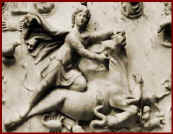
While serving in Persia, the Romans encountered the cult of Mithras, Sol Invictis, Mithras stabbing the Bull of Darkness.vanquisher of the Bull, and that religion became exceedingly popular among legionnaires of the Empire stationed everywhere.
They prayed, "Spirit of Spirit, if it be your will, lend me immortal life so that I may be reborn, and the sacred spirit breathe in me again."
Greek carving (3rd century CE)  of Mithras Tauroctonos.
Mithras vanquishing the Bull of Darkness with his dagger, though originally a Persian image, became characteristically Roman. 
Mithraism vied in popularity with Christianity to the extent that several of the important aspects of its mythology were assimilated to Christianity by the late 4th century.  One of these is the important date of 25th December, the winter solstice which marks the birth of the Lord of Light, who is essentially a solar deity.  It was customary to mark the day with gift-giving.  Mithras can also be said to have been born of a virgin, and to have lived among shepherds.   His priests were the Magi.
  • An excellent description of bullfighting and its lifestyle appears in a collection of articles by Susan Orlean about extraordinary people called The Bullfighter Checks Her Makeup.  The title chapter is about matadora Cristina Sanchez.  (Reprinted by Doubleday, 2001.) 

Shiva

Nandi means joyous.  Nandi the Bull is the vahana (vehicle) of Shiva. However in ancient times, there was worshipped the Lord of Joy (Nandikeshvara), who was depicted as a man with a bull's head.
The bull is also the emblem of Adinath, the first Jain tirthankara.
In South India, on the north shore of the Cauvery, is the Hindu temple called Vallalar Koil that is sacred to Shiva as Sri Vadhanyeshwar.  At this shrine, Parvati his consort is called Gnanambika (Wisdom Mother.)  At this place is the shrine of a yogi, Sri Medha Dakshinamurti.  He is depicted under a banyan tree but somewhat surprisingly he is seated on Nandi, Shiva's bull. 
The bull, a symbol of male sexuality, is the driving force of attainment in many symbolic systems.  Consider Zeus, sky god of the Greeks who, in the form of a white bull, unrelentingly pursues Europa.  It may be that the prototype of that myth is the Indian cosmogony in which the First Being, Purusha, out of loneliness, splits into two aspects, male and female.  The female, aware that the two are brother and sister, out of shame assumes the form of a cow and flees her brother's advances.  Accordingly, he becomes a bull, so she eludes him by becoming a mare.  No matter what form she assumes, he changes to correspond, and so all the various animals of creation are born.
Arrogance
According to legend, Vrishabha Deva (Nandi) was getting too proud of the fact that he was the one who carried the Great God.  Shiva wanted to teach him a lesson, so he placed a lock from his matted hair on the bull. Unable to bear the weight, Rishaba Deva felt humbled and realized his mistake. He prostrated before Lord Shiva begging his pardon.  Shiva not only forgave him, but also initiated him into the mysteries of Divine Wisdom.  Thereafter, when Shiva imbued the form of the yogi Dakshinamurti, Nandi also served as his mount.

Ox

If, as we have seen, the cow stands for wealth, then the ox stands for work.
Any castrated male animal of the cattle family, especially if it is to be used for hauling logs, a cart or a plow, can be called an ox.  The plural of ox is oxen, one of the few English words still in current use that retains the ancient ending in its plural form. 
A young ox is a bullock and that is how the mind is depicted in the first of
2009 ushers in the Year of the Female [Ch: yin] Earth "Ox," so let's face it, this is actually the Year of the Cow! 
The northern musk-ox, like oxen or yaks, are classified as Bovidae, but at least up to 1997,  it has been classified in the same sub-family as sheep and goats.  It likely received the "ox" part of its name due to its hefty and imposing appearance.   In folklore, it is often the general impression that matters, so since there is no apparent difference between the sexes except for the female's smaller size, she could satisfy our mental associations with the "ox" of East Asia's 12-animal calendar.  
 ~ 18th-century image < John Platts.  A Library of Wonders and Curiosities Found in Nature,  . . .   . 1884.

No Bull. Death is a Cow with Calf.
Aeons ago, during the time of Buddha Padmattara, a certain layman, seeing some monk being accorded a chief place in the sangha by that buddha, made the aspiration that he might achieve the same status under a future buddha.  After he had spent many intervening lives in the heavens, he became a monk under Buddha Kashyapa. Later, he finally took a human birth during the time of Buddha Shakyamuni.

Known as Bahia, after the land of his birth, he became a wealthy trader and managed to complete seven successful overseas voyages.  On his eighth trip, he was ship-wrecked though he did manage to reach shore where he emerged naked as the day he was born.  He made himself a garment of bark [perhaps as he had seen certain islanders do on his travels in the Pacific] and so he became known as Barkcloth-Bahiya.

He made it back to Sopara, the legendary port north of Bombay where people set sail for Shri Lanka and other exotic places in search of riches.  There, taking up a cocoanut shell, he wandered about for alms.  He was treated as a holy man, given homage and receiving the usual contributions of food, shelter, clothing and medicine.
Sceptics offered him various fine things to test him, but he realized what they were doing and did not give in.  That led to his being showered all the more with donations and respect so that he, himself, began to believe that he was one of the  arhats.

Just then, a devata who had once been a relative in a former existence, out of compassion for him and aware of the line of thinking that had arisen in his mind, went to where he was staying said, "Hold on there, Bahiya; you are neither an arhat nor have you even entered that path.  You don't even have the practice to become one!"

"Well, nagini, who in this world is one? Or who is even on the way?"

"Bahiya, there is a city in the north called Shravasti.  There there is one, a real self-awakened person -- a Buddha.  And he teaches the Dharma that leads to arhatship. "

Then Bahiya, chastened by his meeting with the spirit being, left Supparaka right then and, in the space of a day and a night, made it all the way to where the Blessed One was staying at Anathapindika's monastery in Jeta's Grove outside Shravasti.
At the time, a large number of monks were outside doing walking meditation.  He went over to them and said, "Where, venerable sirs, is the Buddha staying? We'd like to see him."

"He's gone into town for alms."

Then Bahiya hurriedly left the Grove and entering Shravasti, saw the Blessed One out "begging" for alms.  He seemed so calm and so calming, his senses and his mind at peace, tranquil and poised in the ultimate sense, accomplished, trained, composed and restrained.  Just like a Naga.
So seeing him, Bahiya went over and threw himself down prostrate at His feet.  He said, "Teach me the Dharma, Blessed One! Please, teach me, Tatagatha, something that will benefit me in the long run and make me happy."

The Buddha replied, "This is not the time, Bahiya. We are here in town for alms."

A second time, Bahiya said to the Buddha, "But anything could happen at any moment to you or to me. Teach me the Dharma, O Blessed One! Please, teach me, Tathagatha, what will help me and make me happy in the long run."

A second time, the Blessed One answered, "Not now, Bahiya.  We have come here for alms."

So a third time, Bahiya said to the Buddha, "But our lives could end here and now. Teach me the Dharma, Blessed One! Teach me the Dharma, Tathagata, so that I may be helped and be happy forever."

"OK, Bahiya. This is it:
When you see something, just see it.
When you hear something, just hear it.
When you feel something, then feel it.  And when you are aware of something, just know it.
That is how you should train yourself.   So that when for you there is only the seen in reference to what is seen, only the heard in reference to what is heard, only the sensed in reference to what is sensed, and only the cognized in reference to what you cognize, then Bahia, there will not be any distinctions any longer.
So that when you are not "thereby", you will not be 'therein.'  When you are not "therein", you will be neither 'here' nor 'there' nor in between. This, just this, is the end of stress."

Through hearing this brief explanation of the Dharma from the Blessed One, the mind of Bark-cloth Bahiya  right then and there was released from consequences [or karma] through lack of clinging/desire.  Having instructed Bark-cloth Bahiya with this brief explanation of the Dharma, the Blessed One left.

And not long after that, Bahiya -- attacked by a cow with her calf -- lost his life.
Then the Blessed One, having gone out to Shravasti, and then returning from his alms round and having eaten a meal together with a large number of monks, saw that Bahiya had died.
On seeing him, he said to the monks, "Take Bahiya's body up on a litter and carry it away and cremate it; then build him a memorial. Your companion in the holy life has died."

"As you say, lord," the monks replied. After doing what the Buddha had told them to, they went back to the Blessed One and, on arrival, having bowed down to him, sat to one side. As they were sitting there, they said to him, "Bahiya's body has been cremated, lord, and his memorial has been built.  What will happen to him? What is his future state?"

"Monks, Bark-cloth Bahia was wise. He practiced the Dharma in accordance with the Dharma and did not pester me with issues related to it.  Bark-cloth Bahiya has achieved nirvana - he has been released."

Then, realizing the significance of that, he exclaimed:
Where water, earth, fire, and wind have no footing:
There the stars do not shine, the sun is not visible,
the moon does not appear, darkness is not found.
And when a sage, a noble person, through sagacity
has known [this] for himself, then from form & formless,
from bliss & pain, he is freed.
                ~ Khuddaka, Udana 1-10
Much later, according to the Dhammapada (v. 101, or Thousands v. 2) when Buddha was telling his disciples that Bahia had attained release after hearing just one verse, a monk asked how it was possible for a single verse to lead to Nirvana.  The Buddha answered:
Better than a thousand verses comprising useless words, is one single beneficial line that through the hearing of it, one is pacified.
~ Tan Chade Meng

Bull of No-Death

To Hindus and Buddhists, the King of Dharma and Lord of Death are one and the same: Yama, here with his sister/consort Yami and their water buffalo are shown in a bronze image at the Patan Museum, Nepal.
One of the Tibetan Buddhist dharmapalas is a manifestation of Manjushri, the midnight blue Defeater-of-death, Yamantaka also called Yamari (Yama's enemy) or Vajrabhairava (absolutely terrifying) who may be depicted as riding or standing on a bull while trampling Yama, god of death, underfoot. 

The Golden Calf

In the most ancient Indian texts, the Vedas:
Wise poets have spun a seven-strand tale 
around this heavenly calf, the Sun.

~ Dirghatama Rishi, Rig Veda 1.164.5

In Genesis 32 we learn how Aaron the princely brother of Moses decided that it would benefit the wandering Israelites to have a visible, tangible representation.  He (24) . . . told them, 'Whoever has any gold jewelry, take it off.' and "Then they gave me the gold, and I threw it into the fire, and out came this calf!"   It is as if the bits of gold cohered of themselves to form the calf -- the ultimate symbol of prosperity.
Later (Deuteronomy 9: 21) we find that Moses " took that sinful thing of yours, the calf you had made, and burned it in the fire.  Then . . .  crushed it and ground it to powder as fine as dust and threw the dust into a stream that flowed down the mountain."
Of all the Israelites, the descendants of Levi were the only sept (sub-clan) that remained true to the-god-without-form, and so they had the duty and the honour of being attendants at the temple in Jerusalem where the sacred Ark of the Covenant was later installed.
White Buffalo-Calf Woman
The symbolic animal is correctly referred to as a bison, but we could say that a bison is a type of buffalo, just as a yak is.
At least a thousand years ago, the Lakota Sioux, a people of the American plains (who had migrated south from their Iroquoian homeland), say that at a time of extreme drought and lack of game, a female spirit (wakan) appeared to two brothers.  The one who reached out to touch her was incinerated.
HH Kusum Lingpa Rinpoche identified White Buffalo Woman as Yeshe Tsogyal.  He believes that she is the one who delivered the first pipe --  he considers it a ter -- to the first pipe guardian. (Chief Arvol Looking Horse is the current guardian of the Sacred Pipe of the Lakota.)
  • The selling of culture necessitates a coalition for the protection of ceremonies.
     ________________________________________________________________
Basques:  These distinctive people, who inhabit Western Spain, have a language (like Burushaski that is spoken in the Himalayas) that is one of the world's few unique tongues.  Geneticist Luiga Luca Cavalli-Sforza found Basques strikingly different from their neighbors as far as heredity.
Govinda: The Indian religious path that emphasizes devotion to deity is called bhakti, and one way to practice this is by singing bajan or hymns.  "Govinda" is probably one of the most famous of these, for the arrangement on an EP disc that also included the Krishna mantra by George Harrison of The Beatles (Apple Records, 1970) made the Top Ten on British record charts.
The traditional bhajan [song of praise]:
Govinda jaya jaya, Gopala jaya jaya,
Râdhâ-ramana Hari, Govinda jaya jaya.

Back ] Home ] Up ] Next ]
The Bear ] [ Cattle:  Cow, Bull & Calf ] Deer ] Dog ] Elephant ] Goat & Sheep ] Hare & Rabbit ] Horse ] Lion ] Monkey ] Pig, Sow & Boar ] Rhinoceros ] Serpent ] Birds ] Tortoise ] Fish ]
 

Copyright 1998-2012 Khandro.Net  All rights reserved. 
This comprehensive web site is designed with Firefox as browser but should be accessible in others.  However, if you eliminate underlining in your Preferences you might miss some of our 5, 000+ links. 

Taken from:
http://www.khandro.net/animal_cow_bull.htm