Thursday, July 25, 2013

Re-Orienting to Zion the History of Ancient Philosophy


 by
Damien F. Mackey


“Mount Zion, true pole of the earth …”.

Psalm 48:2

“I will rouse your sons, O Zion, against your sons, O Greece”.
Zechariah 9:13

Tertullian: "free Jerusalem from Athens and the church of Christ from the Academy of Plato."
(Tertullian, De praescriptione, vii).
 
This last comment, by Tertullian, will become a kind of mantra for this article, though not properly according to the context of Tertullian, but according to the context of our AMAIC historical revisions.
For, as one will read as the description of our site,
“Much of Western culture, mythology and religion has been appropriated from the cultures of the Fertile Crescent region, especially from the Hebrews (Jews)”.
This is a companion to our site,
whose description is the same, but with reference to Eastern culture, etc.
Now this description, as it applies to the west, basically encapsulates the phenomenon that is the history of ancient philosophy, that has been presented to us as being entirely Greco-Roman (Ionian-Italian), but which I intend to argue was actually Hebrew (Israelite/Jewish) and biblical.
Certainly the Fathers of the Church appreciated at least the seminal impact that the Hebrews had had upon Greco-Roman thinking, though without their having taken the extra step that I intend to take in this article, of actually recognising the most famous early western (supposedly) philosophers as being originally Hebrew.
To give just a few examples from the Fathers and the early eastern and western legends:
“According to Clement [of Alexandria], Plato plagiarized revelation from the Hebrews; this gave the Athenian's highest ideas a flavor of divine authority in the estimation of Clement”. (http://www.gospeltruth.net/gkphilo.htm).
“… Aristoxenus in his book the Life of Pythagoras, as well as Aristarchus and Theopompus say that [Pythagoras] came from Tyre, Neanthes from Syria or Tyre, so the majority agree that Pythagoras was of barbarian origin (Strom. I 62, 2-3).
Clement of Alexandria even believed that Sirach had influenced the Greek philosopher, Heraclitus (Strom. 2.5; Bright 1999:1064).
Tertullian: "… free Jerusalem from Athens and the church of Christ from the Academy of Plato." (De praescriptione, vii).
Eusebius of Caesarea believed that Plato had been enlightened by God and was in agreement with Moses. (http://www.gospeltruth.net/gkphilo.htm)
Aristobulus was among many philosophers of his day who argued that the essentials of Greek philosophy and metaphysics were derived from Jewish sources. Philosopher Numenius of Apamea echoes this position in his well known statement "What is Plato but Moses speaking Attic Greek?" (1.150.4) Aristobulus maintained, 150 years earlier than Philo, that not only the oldest Grecian poets, Homer, Hesiod, Orpheus, etc., but also the most celebrated Greek thinkers, especially Plato, had acquired most of their wisdom from Jewish sages and ancient Hebrew texts (Gfrorer i. p. 308, also ii. 111-118) (Eusebius citing Aristobulus and Numenius Ev ix. 6, xi. 10).
The Arabic-Christian legends identify [the biblical] Baruch with the eastern sage, Zoroaster, and give much information concerning him.
Saint Ambrose (Ep. 34) “suggested that Plato was educated in Hebraic letters in Egypt by Jeremiah”.
Bahá'u'lláh states that the Greek philosopher Empedocles "was a contemporary" of King David, "while Pythagoras lived in the days of Solomon" (Cole, p. 31; Tablets of Bahá'u'lláh Revealed after the Kitáb-i-Aqdas, 145).
Some of these situations (e.g. Sirach influencing Heraclitus - thought to be centuries before Sirach - and Plato meeting Jeremiah, who presumably lived about a century and a half before Plato) are chronologically impossible, of course, in the present context of ancient history. However, in my revised scheme of historical philosophy, they may not be.
Sirach is still yet, I believe, to be firmly dated.
In this article I am going to take four of the key early, supposedly “Ionian” Greek and Italian, philosophers of antiquity, Thales, Heraclitus and Pythagoras (Ionian), and Empedocles (Sicilian), all prior to Socrates (hence ‘pre-Socratics’), and reveal what I believe to be their biblical prototype - of whom I claim these four were merely ghostly replicas, chronologically, ethnically and geographically misplaced.
....

Tuesday, July 16, 2013

Sirach and Heraclitus


There are perhaps three areas of particular fascination for the AMAIC regarding philosophy – that is, over and above everything else that is right and good in that most important discipline.

Central to it all is:


1.The Philosophy of Jesus Christ - restoring Christian philosophy to its biblical roots, with Jesus Christ, Wisdom Incarnate, as the focal point. The Fathers of the Church rightly recognised the profound influence of Hebrew wisdom, the Bible, upon the Greco-Roman world. As‘Salvation is of the Jews’, so is Wisdom. “Jesus”, as we read above, “appealed to God’s previous revelation in the Hebrew Scriptures (Matt. 5:17–19; John 10:31) and issued authoritative revelations of His own as God Incarnate. … Jesus reasoned carefully about the things that matter most — a handy definition of philosophy. His teachings, in fact, cover the basic topics of philosophy. …. As an apologist for God’s truth, He defended the truth of the Hebrew Scriptures as well as His own teachings and actions”.

2.A Re-orientation of the History of Ancient Philosophy. This actually pre-supposes 1.and needs to be viewed in parallel fashion to the way that the ancient Scriptures pre-figure Jesus the Word, but are also brought to perfection in Him.

Whilst textbooks on the history of philosophy universally commence with the supposed Ionian Greeks, the AMAIC would urge for a complete re-orientation of influence by arguing that certain (if not all) of the key figures labelled ‘Greek’ (or Ionian) philosophers, ostensibly influenced by the Hebrews (as say the Fathers), were in actual fact Hebrew (Jewish) biblical characters who later became distorted and re-cast in Greco-Roman folklore. The Greco-Romans confused the ethnicity, geography and chronology of these original sages, who were essentially prophets and mystics, and down-graded them by turning them purely into natural philosophers.

It seems imperative that the common mystical element has to be re-considered, contrary to Mark Glouberman’s mistaken (we believe) view of “Western rationality’s trademark mastery over the natural world”, over the “earlier [religious] mode of thought” of the Hebrews. (“Jacob’s Ladder. Personality and Autonomy in the Hebrew Scriptures”, Mentalities/ Mentalités,13, 1-2, 1998, p. 9).
 

For studies more astute than Glouberman’s, whose opinion, sadly, the majority might share, would indicate that some of these ancient philosophers – now so cramped to merely natural philosophy andthe elements (earth, fire, water, etc.) – were actually men of great wisdom and enlightenment, religious and mystical. Nicolas Elias Leon Ruiz (Heraclitus and the Work of Awakening) has perceived this mystical quality in the case of the enigmatic but highly significant Heraclitus, supposedly a Greek of Ionian Ephesus. In his Abstract, Ruiz well explains why commentators have invariably found Heraclitus to be an ‘obscure’ thinker (https://docs.google.com/viewer?a=v&q=cache):

….

Heraclitus is universally regarded as one of the fathers of western philosophy.

However, the characterization of the nature of his contribution varies widely. To some he is an early example of rational, empirical, scientific inquiry into the physical world. To others he was primarily a brilliantly innovative metaphysician.

Still others prefer to see him as the distant ancestor of the great German dialecticians of the 19thcentury. In the 20th century, certain existential phenomenologists all but claimed him as one of their own.

Behind all of this stands a fundamental set of assumptions that is never questioned. Whatever else may be the case, we know that Heraclitus was, essentially, a rational human being like ourselves. He was a philosopher, concerned with explanation and exposition. He was a thinker, and his fragments encapsulate his thought.

It is because of this that Heraclitus has been completely misunderstood. We have no idea of who and what he was. We do not understand what he was saying. Perhaps the greatest irony is that Heraclitus himself, at the very outset of what he wrote, explicitly predicted that this would happen.

Everyone who writes about Heraclitus will make at least passing reference to his legendary obscurity. Some will talk about the oracular character of his writing. A few go so far as to say that his thought bears the traces of revelation, his expression, of prophecy. This is as far as it goes. The problem is that this rather metaphorical way of talking about Heraclitus misses the point entirely. His writing was not just “obscure,” it was esoteric.

Heraclitus did not merely employ an oracular mode of expression: he was an oracle. What he said was a revelation and he was its prophet. Heraclitus was far from the early rationalist or primitive scientist he has been made out to be. He was what we today would call a mystic.….
[End of quote]
Now it seems that Saint “Clement of Alexandria even believed that Sirach had influenced the Greek philosopher Heraclitus (Strom. 2.5; Bright 1999:1064)”. https://docs.google.com/viewer?a=v&q=cache:ABbefHere occurs that same sort of chronological ‘difficulty’ (in a textbook context) with a Father of the Church as also in the case of Saint Ambrose's conjecture (in De philosophia) that Plato had met Jeremiah in Egypt. Whilst, chronologically, this is an extraordinary statement by Saint Clement, considering that Sirach would be located centuries after Heraclitus, the presumed chronological problem may actually be due to the ignorance of the real identity of the supposedly ‘Greek’philosopher. What if Heraclitus, whose special element was fire, were in fact the same person as the Hebrew Sirach (also known as “Siracides”, hence Heraclitus?), who wrote of fire (Sirach 51:3, 4): “You liberated me … from the stifling heat which hemmed me in, from the heart of a fire which I had not kindled …”. The ancient concept of Divine Wisdom, as written of by Sirach, was supposedly absorbed by Heraclitus, who, we think, may have been but a pale Greek version of the biblical scribe.


3.The Philosophy of Modern Science. Whilst the real world (physis) was still generally the object of philosophical study for the ancients, modern scientists and philosophers have largely shifted the emphasis on to law and convention (nomos). Our inspiration in this area is Dr. Gavin Ardley, who wrote (“The Physics of Local Motion”, I): “… the system of physics inaugurated by Galileo and Newton is only prima facie physics in the proper sense of that science, namely, an inquiry into the physics or nature of things. According to this contention … physics since Galileo has been progressively detached from the family of the real sciences and no longer has any community with the head of the family, namely, metaphysics”.

Wednesday, July 3, 2013

Our Lady of Sheshan: Mother of China and All Asia


On June 28, the Vatican Information Service announced Pope Francis’s prayer intentions for July 2013. These are the prayer intentions that Catholics should keep in mind this month whenever we pray for the intentions of the Holy Father—as, for instance, when we pray the final prayers of the rosary.

Pope Francis’s general prayer intention for July 2013 is “That World Youth Day in Brazil may encourage all young Christians to become disciples and missionaries of the Gospel.” World Youth Day 2013 will take place in Rio de Janeiro, July 23-28, 2013. Pope Francis will be in attendance; it will be his first trip abroad as pope, and, of course, the first time that he has returned to his native continent of South America since his election.

In announcing his intention to take part in World Youth Day at his Palm Sunday Mass, Pope Francis urged young Catholics not to be “ashamed of the Cross,” and implored those traveling to Brazil to “Prepare well, prepare spiritually above all—in your communities, so that our gathering in Rio may be a sign of faith for the whole world.” But World Youth Day isn’t simply for those who can attend it; it is, as the Pope’s general prayer intention makes clear, intended to invigorate the faith of all Catholic youth. And so we can join our prayer to Pope Francis’s this month by invoking the patron saint of youth, St. Aloysius Gonzaga, especially through this Prayer to Saint Aloysius Gonzaga, Patron of Youth.

Pope Francis’s mission prayer intention for July 2013 is “That throughout Asia doors may open to messengers of the Gospel.” His predecessor, Pope Benedict XVI, was likewise concerned with the evangelization of Asia, and especially of China, where faithful Catholics have suffered for decades for their adherence to the Gospel and their unity with Rome. In May 2008, Pope Benedict composed a Prayer to Our Lady of Sheshan, invoking Our Lady, Help of Christians, to whom there is a well-known shrine in the city of Sheshan, China. The prayer calls upon Mary, “Mother of China and all Asia,” to intercede for those “who, amid their daily trials, continue to believe, to hope, to love,” that they “May they never be afraid to speak of Jesus to the world, and of the world to Jesus.” While Pope Benedict asked that this prayer be recited by all Catholics each year on May 24 (the Feast of Our Lady, Help of Christians), it is certainly appropriate to pray it this month, as we, like the Pope Emeritus, join our prayers to those of the current Holy Father.
….
Taken from:


Thursday, June 27, 2013

Archbishop Salvatore Cordileone Defending God’s View of Marriage

Archbishop Cordileone “Our Struggles Change but the Truth Does Not”


USA Today: Interview byRichard Wolf


To legalize marriage between two people of the same sex would enshrine in the law the principle that mothers and fathers are interchangeable or irrelevant.’
archbishop
San Francisco Archbishop Salvatore Cordileone chairs the United States Conference of Catholic Bishops’ Subcommittee for the Promotion and Defense of Marriage. Here are his views on the subject in response to questions from USA TODAY:
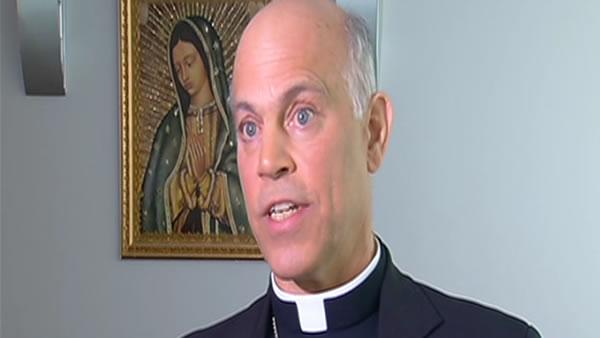

Archbishop Salvatore Cordileone


Q: What is the greatest threat posed by allowing gays and lesbians to marry?
A:The better question is: What is the great good in protecting the public understanding that to make a marriage you need a husband and a wife?
I can illustrate my point with a personal example. When I was Bishop of Oakland, I lived at a residence at the Cathedral, overlooking Lake Merritt. It’s very beautiful. But across the lake, as the streets go from 1st Avenue to the city limits at 100th Avenue, those 100 blocks consist entirely of inner city neighborhoods plagued by fatherlessness and all the suffering it produces: youth violence, poverty, drugs, crime, gangs, school dropouts, and incredibly high murder rates. Walk those blocks and you can see with your own eyes: A society that is careless about getting fathers and mothers together to raise their children in one loving family is causing enormous heartache.
To legalize marriage between two people of the same sex would enshrine in the law the principle that mothers and fathers are interchangeable or irrelevant, and that marriage is essentially an institution about adults, not children; marriage would mean nothing more than giving adults recognition and benefits in their most significant relationship.
How can we do this to our children?
Q: If the Supreme Court opens the floodgates to gay marriage in California (or beyond), what will be the result?
A: If the Supreme Court overturns Prop 8, this will not go down in history as the Loving v. Virginia but as the Roe v. Wade decision of our generation.
No matter what the Supreme Court rules, this debate is not over. Marriage is too important and the issues raised by treating same-gender unions as marriages are too fundamental to just go away. Just as Roe v. Wade did not end the conversation about abortion, so a ruling that tries to import same-sex marriage into our Constitution is not going to end the marriage debate, but intensify it.
We will have a bitterly polarized country divided on the marriage issue for years if not generations to come.
Q: Why is this of such importance to children?
A: Why has virtually every known civilization across time and history recognized the need to bring together men and women to make and raise the next generation together? Clearly something important is at stake, or human beings of such different cultures, histories and religions would not come up with the basic idea of marriage as a male-female union over and over again.
… When we as a culture abandon that idea and ideal, children suffer, communities suffer, women suffer, and men are dehumanized by being told they aren’t important to the project of family life.
Modern social science evidence generally supports the idea that the ideal for a child is a married mother and father. The scientific study of children raised by two men or two women is in its infancy … several recent studies … are painting a less sanguine portrait thatsome professional organizations have yet acknowledged about whether two dads can make up for the absence of a mom, or vice versa.
We all know heroic single mothers who do a great job raising their kids (just as there are gay people who take good care of their children). But the question of the definition of marriage is not about success or failure in parenting in any particular case.
The job of single mothers is hard precisely because we aren’t as a society raising boys to believe they need to become faithful husbands and fathers, men who care for and protect their children, and the mother of their children, in marriage. And we aren’t raising girls to be the kind of young women with the high standards and the self-worth to expect and appreciate such men, and not to settle for less.
Q: How would the allegation that opponents are bigoted lead to their rights being abridged?
A: Notice the first right being taken away: the right of 7 million Californians who devoted time and treasure to the democratic process, to vote for our shared vision of marriage. Taking away people’s right to vote on marriage is not in itself a small thing.
But the larger picture that’s becoming increasingly clear is that this is not just a debate about what two people do in their private life, it’s a debate about a new public norm: Either you support redefining marriage to include two people of the same sex or you stand accused by law and culture of bigotry and discrimination.
If you want to know what this new public legal and social norm stigmatizing traditional believers will mean for real people, ask David and Tanya Parker, who objected to their kindergarten son being taught about same sex marriage after the Massachusetts Supreme Court legalized it in that state and wanted to pull him out of class for that lesson. He was arrested and handcuffed for trying to protect his son’s education, and they were told they had no right to do so.
Ask the good people of Ocean Grove Methodist camp in New Jersey that had part of its tax-exempt status rescinded because they don’t allow same-sex civil union ceremonies on their grounds. Ask Tammy Schulz of Illinois, who adopted four children (including a sibling group) through Evangelical Child Family Services — which was shut down because it refuses to place children with same-sex couples. (The same thing has happened in Illinois, Boston and Washington, D.C., to Catholic Charities adoption services). … Ask the doctor in San Diego County who did not want to personally create a fatherless child through artificial insemination, and was punished by the courts…. Ask Amy Rudnicki who testified in the Colorado Legislature recently that if Catholic Charities is shut out of the adoption business by new legislation, her family will lose the child they expected to adopt this year. … Nobody is better off if religious adoption agencies are excluded from helping find good homes for abused and neglected children, but governments are doing this because the principle of “anti-discrimination” is trumping liberty and compassion. …
When people say that opposition to gay marriage is discriminatory, like opposition to interracial marriage, they cannot also say their views won’t hurt anybody else. They seek to create and enforce a new moral and legal norm that stigmatizes those who view marriage as the union of husband and wife. … It’s not kind, and it doesn’t seem to lead to a “live and let live” pluralism.
Q: You have spoken of gay marriage as a “natural impossibility.” But in terms of procreation, how does it differ from opposite-sex couples who are elderly or infertile?
A: Our bodies have meaning. The conjugal union of a man and a woman is not a factory to produce babies; marriage seeks to create a total community of love, a “one flesh” union of mind, heart and body that includes a willingness to care for any children their bodily union makes together.
Two men and two women can certainly have a close loving committed emotional relationship, but they can never ever join as one flesh in the unique way a husband and wife do.
Infertility is, as you point out, part of the natural life cycle of marriage (people age!), as well as a challenge and disappointment some husbands and wives have to go through. People who have been married for 50 years are no less married because they can no longer have children.
Adoption can be a wonderful happy ending for children who lack even one parent able or willing to care for them. But notice, when a man and woman cannot have children together, that’s an accident of circumstances, the exception to the rule. When a husband and wife adopt, they are mirroring the pattern set in nature itself. …
Treating same-sex relationships as marriage is the final severing by government of the natural link between marriage and the great task of bringing together male and female to make and raise the next generation together in love.
Q: Is it particularly difficult for you to play a leading role against gay marriage in a place like San Francisco? Does it change your relationship with gay congregants?
A: Truthfully, I am really excited to be in San Francisco. I remember the first time I saw the city as a boy when our family drove up from San Diego to meet my father who was unloading his tuna boat here. … To me San Francisco was and is The City! It represents vibrant, pulsating, creative, cosmopolitan life and I love it. Of course I realize many people in San Francisco disagree with the church’s teachings on marriage and sex, but there is also a very deeply embedded Catholic culture here with many people who understand and cherish the church’s teachings. My job as an archbishop is to teach the truths of our faith and the truths of the natural moral law, and whatever challenges that entails I embrace with enthusiasm.
We can learn to respect each other across differences and even to love one another. That’s my hope anyway. And my job description.
Q: Has it become more difficult to oppose gay marriage over the years? Does it seem the tide is turning against you?
A: There is a problem here – an injustice, really – in the way that some people are so often identified by what they are against. Opposition to same-sex marriage is a natural consequence of what we are for, i.e., preserving the traditional, natural understanding of marriage in the culture and in the law.
But of course people who are for the redefinition of marriage to include two men or two women are also against something: They are against protecting the social and legal understanding that marriage is the union of a husband and wife who can give children a mother and father.
So there are really two different ideas of marriage being debated in our society right now, and they cannot coexist: Marriage is either a conjugal union of a man and a woman designed to unite husband and wife to each other and to any children who may come from their union, or it is a relationship for the mutual benefit of adults which the state recognizes and to which it grants certain benefits. Whoever is for one, is opposed to the other. …
Those of us who favor preserving the traditional understanding of marriage do not do so because we want people who experience attraction to their same sex to suffer. We recognize and respect the equal human dignity of everyone. Everyone should be treated equally, but it is not discrimination to treat differently things that are different. Marriage really is unique for a reason.
Q: Do you have friends or family members who are gay? How do you balance your public policy positions with those relationships?
A: Of course! I am a Baby Boomer, and I grew up in Southern California. The larger question you raise about my relationships with people I care about is: How can we love each other across deep differences in moral views? The answer I have found is that when we want to stay in relationship, we can and do. Love finds a way. When we want to exclude or hate, we find each other’s views literally intolerable.
Of course, it helps that my friends know me, directly and unfiltered through any other source. When you know someone personally, it’s much harder to rely on stereotyped or media-created images. It’s a lot harder to be hateful or prejudiced against a person, or group of people, that one knows personally. When there is personal knowledge and human interaction, the barriers of prejudice and pre-conceived ideas come down.
Q: What are your main goals: Supreme Court, lower courts, state legislatures, public opinion, religious liberty?
A: My main goal is none of these. I’m a faith leader, and my main goal is to seek to create a Catholic community in San Francisco where people know what the church teaches and uses this knowledge to guide their own lives and get to heaven. I want to help people understand the truth of natural marriage and, for people of my own faith, the deeper, theological, even mystical meaning of marriage as designed by God.
Using words, though, is only one way of teaching. Usually one’s actions speak louder than words. So there is a place for public manifestations of principle. The civil rights marches of the ’60s are a good example of that. Yes, they were a way to agitate for long overdue political change, but they also had a teaching effect in that they got people to think about the injustices of racism.
Engaging with the broader culture is also part of my teaching role as an archbishop, and of course my right as U.S. citizen.
Q: Are you worried about the recent trend in courts and states going against you? How best to stop that trend?
A: The natural law has a power written on the human heart that doesn’t go away.
Notice how there is no controversy in this country now over the evil of Jim Crow laws. Shortly after the Civil Rights Act the cultural change was complete. This is because it was the right thing to do. The truth cannot be suppressed indefinitely.
Draw a contrast here with the pro-life movement: After the Roe decision, it was commonly thought that our society would soon easily accept the legitimacy of abortion. But what has happened? The pro-life movement is stronger now, 40 years later, than it ever has been. This is because of the truth: Abortion is the killing of an innocent human life. That is not a matter of opinion or religious belief; it is a simple fact that cannot be denied.
The same principle applies with marriage: It is simply a natural fact that you need a man and a woman to make a marriage and that a child’s heart longs for the love of both his or her mother and father. Even if the Supreme Court rules against this truth, the controversy will not die out, as it hasn’t on the abortion issue.
The problem is, the longer a society operates in denial of the truth, the greater is the harm that will be done. The examples of the racist policies and practices of the past in our own country make this clear, as does all the harm that abortion has done to women and all those in her network of relationships.
With marriage, we have to consider the harm that will be caused by enshrining in the law the principle that children do not need a mother and a father. The circumstances of our struggles change but the truth does not.

....

Taken from: http://www.courageouspriest.com/category/bishop-salvatore-cordileone

Tuesday, June 18, 2013

“Ginzberg furnishes substantial evidence that Mordecai and Haman were both Jews who knew each other well”.


Power struggle between Jews


Clever Queen Esther takes a chance and manages to create harmony.


EUGENE KAELLIS


Purim is based on the Book of Esther, the most esoteric book in the Hebrew Testament. Accepting a literal interpretation of the book is impossible. It is laden with evident exaggerations and inventions that defy what is known of Persian history and conventions. Its hidden meaning can be uncovered only by combining a knowledge of Persian practices during the Babylonian Captivity, the conquest of Babylon by Cyrus the Great, his Edict (sixth century BCE) and Ginzberg's Legends of the Jews which, despite its name, contains a great deal of relevant and credible history.

Using these sources, one can arrive at a plausible interpretation completely in accord with historically valid information. Esther, it turns out, describes an entirely intra-Jewish affair set in the Persian Empire, with the two major antagonists as factional leaders: Mordecai, whose followers advocate rebuilding the Jerusalem Temple, and Haman, also a Jew, whose assimilationist adherents oppose the project.

Ginzberg furnishes substantial evidence that Mordecai and Haman were both Jews who knew each other well: they were co-butlers at a royal feast and journeyed together to India to put down a rebellion against Persia. Moreover, Haman's mother had a Hebrew name and his descendants are said to have taught Torah in Akiva's academy.

The multi-ethnic Persian Empire had significant religious freedom and communal authority, as exemplified by the Edict of Cyrus, permitting Jews to return to Judah and rebuild their Temple, destroyed by the Babylonians, and allowing the inclusion of members of various ethnic and religious groups under Persian rule, offering them some representation and influence at the royal court. However, it is untrue that Mordecai or Esther achieved the high positions attributed to them in the book. Queens and chief ministers always had to have impeccably Persian ancestry. More likely, Mordecai was a spokesperson for much of the Jewish community and Esther, a harem consort.

In the Persian Empire the king's harem typically had ethnic "representatives." Vashti, Esther's predecessor, was a member of the Hamanite faction. In a typically irreverent manner, she had forced her Jewish handmaidens to violate the Sabbath. After Vashti's dismissal, widespread rebellion and Jewish inter-factional fighting flared up, calmed only by Mordecai's elevation and the appointment of Esther, who, in a measure of intrigue, initially conceals her ethnic and factional identification. Her original name was Hebrew, viz., Hadassah; Esther is Persian, derived from Astarte or Ishtar.

The book states that Mordecai first discovered a plot to kill Ahasuerus, the king. It is more likely that he was apprised by Esther who, being in the harem, a traditional centre of intrigue and espionage, would have picked up this intelligence. A more plausible explanation is that the incident was a conspiracy arranged by Mordecai, the two allegedly guilty harem eunuchs becoming dupes in a plot designed to be exposed in order to discredit the Hamanite faction and win favor for Mordecai and his followers.

Nevertheless, Haman initially gains the upper hand by convincing Ahasuerus that Mordecai's faction threatens the king's hegemony, an argument given credence by the plan of the pro-Temple faction to construct a wall around the rebuilt Temple, perhaps to defend against Persian armies after the Jews had declared their independence. Haman also probably bribes the king with promises of a share of the plunder expropriated from the wealth of the pro-Temple faction after its members are killed.

After Haman's appointment, when he and the king sat down for a drink, "Susa was perplexed," the text states, indicating that the Jews of Susa, a city with a large Mordecai-supporting faction, were outraged that someone they considered a heretic would henceforth officially advise the king regarding the Jewish community.

As Haman puts his plan in motion, Mordecai warns Esther, and the pro-Temple Jews demonstrate their solidarity with her. During the three days of fasting, while Esther prepares to petition the king, Mordecai is busy collecting a counter-bribe, referred to as "relief and deliverance ... from another quarter," which he had earlier promised Esther while trying to assuage her fears about her own safety following the disclosure of her true allegiance.

The Mordecai faction succeeds and the tolerant but venal king switches his support. Esther gathers information on Haman's collaborators and denounces him. In a staged event in the royal apartment, with the king's co-operation, she frames Haman on an assault charge, providing Ahasuerus with a face-saving device to explain the dismissal and subsequent execution of someone he had so recently elevated.

Ahasuerus, now convinced that the pro-Temple faction does not threaten him with its walled city plans, provides help from forces he had formerly promised to Haman, allowing the Mordecaite Jews to eliminate the Hamanites, but keeping his well-greased hands out of the more violent aspects of the conflict.

The book states repeatedly that the pro-Temple faction members kept no plunder derived from the defeat of their rivals, indicating that this benefit of their triumph went to Ahasuerus. The story goes on to declare that, with the victory of the Mordecai faction, "many people of the country declared themselves Jews, for the fear of the Jews had fallen upon them." Why would ordinary Persians or Babylonians, now part of the Persian Empire, fear Jews to the point of embracing a minority religion in their own country? It is more reasonable to assume that the now religiously enthusiastic Jews who had become fearful of Mordecai were assimilated Jews who had identified themselves as Persians and who had formerly allied themselves with the Hamanite faction or had previously faltered in their allegiance to the pro-Temple faction.

Purim is at once the least and the most profound of Jewish holidays. The Talmud tells us that even after the Messiah comes and the mandated holidays of Pesach, Shavuot and Sukkot are no longer celebrated, Purim will be retained. Why? Because the story reminds us that, even when obscured by bizarre circumstances, there is a continuous presence of God, often in the guise of "chance," which explains why Purim is known as the Feast of Lots.

The mood in the synagogue celebration of Purim is one of noisy revelry, even inebriation, and self-ridicule as if the participants somehow know that the book's story is a cover up for a series of dramatic and fateful events and they are winking at it and themselves.

Dr. Eugene Kaellis is a retired academic living in New Westminster.

....

Taken from: http://www.jewishindependent.ca/Archives/Mar05/archives05Mar18-07.html

Wednesday, June 12, 2013

Knowledge of Four Elements Pre-Dates Empedocles


Genesis 1:10 (BHS/WIVU)
וַיִּקְרָ֨א אֱלֹהִ֤ים׀ לַיַּבָּשָׁה֙ אֶ֔רֶץ וּלְמִקְוֵ֥ה הַמַּ֖יִם קָרָ֣א יַמִּ֑ים וַיַּ֥רְא אֱלֹהִ֖ים כִּי־טֽוֹב׃
wayiqra – elohim – layyabbashah – erets ulemiqweh – hammayim – qara – yammim – wayyareh – elohim – ki+tov
and (he) called – God – to the dry ground – earth and to collection – the waters – (he) called – seas – and (he) saw – God – for+good

The construction of this verse is familiar. See in particular this post on Genesis 1:4 regarding “seeing.”
Genesis 1:10 marks the last time in the creation narrative that God himself names things. Take a look at what he’s named: day & night (in 1:5), sky (in 1:8), earth and sea (here in 1:10). Are these meant to correspond to the four primal elements fire, air, earth, and water? Fire is perhaps a leap from day & night. But if the correspondence is intentional, God is shown to be the creator and fashioner of what was understood to be the substances from which everything else was formed until relatively recent history.
This is a pretty nifty observation, but it presents a small challenge to the historical-grammatical interpretation of Genesis 1. The problem is that the four primal elements idea is normally attributed to a Greek philosopher by the name of Empedocles who lived in the 5th century B.C. – about 1,000 years after Moses and the traditional date for the recording of Genesis. The Wellhausen hypothesis posits later dates for Genesis but is still 400 years before Empedocles.
We show our Western bias however when we focus on the Greeks. The Egyptians actually had a similar concept dating back to the late 3rd millennium B.C. (about 1,000 years before Moses and closer to the days of Abraham). The Egyptian idea was embodied in a group of deities called the Ogdoad, and the four primordial substances were darkness, air, the waters, and infinity/eternity.
All of this is to say that even from a purely secular standpoint it is not unreasonable to grant that the Greek primal elements concept existed in the Ancient Near East well before the Greeks. Is the periodic table a revolutionary modern invention or simply a late refinement in a long history of examining the structure of the universe? Of course, where Genesis 1 breaks with modern materialism is where it breaks with 3rd millennium B.C. Egyptian mythology. Those primal substances – whether they be the Ogdoad, or Empedocles’ four, or the 118 elements of the periodic table – did not always exist and should not be confused with the creator.
Here’s my translation: “And God called the dry ground ‘earth,’ and the collection of waters he called ‘seas’ and God saw that (this was) good.”
Extra credit: Note the first word of the second line transliterated ulemiqweh above. This is ule (“and to”) + miqweh (“collection”). In modern Hebrew pronunciation, miqweh becomes mikveh. This is the term for a ritual bath (see Leviticus 11:36), and the practice of immersing in a mikveh for ritual cleansing forms a basis for baptism in the New Testament. The baptisms that happen in churches around the world every week have a root in a word that goes back to the creation of the sea itself!

....

Taken from: http://revelationorbust.com/wordpress/?p=376#more-376