Wednesday, October 2, 2013

"… free Jerusalem from Athens and the church of Christ from the Academy of Plato." (Tertullian: De praescriptione, vii).


Of the “three areas of particular fascination for the AMAIC regarding philosophy” as outlined in the previous MATRIX, namely:
  1. The Philosophy of Jesus Christ - restoring Christian philosophy to its biblical roots, with Jesus Christ, Wisdom Incarnate, as the focal point. ….
  1. A Re-orientation of the History of Ancient Philosophy. This actually pre-supposes 1. and needs to be viewed in parallel fashion to the way that the ancient Scriptures pre-figure Jesus the Word, but are also brought to perfection in Him.
  1. The Philosophy of Modern Science. Whilst the real world (physis) was still generally the object of philosophical study for the ancients, modern scientists and philosophers have largely shifted the emphasis on to law and convention (nomos).
it will be 2. A Re-orientation of the History of Ancient Philosophy that will be discussed at length this time round. But this will be done largely in the Supplement attached to this MATRIX. Some have not found very convincing our earlier attempts to Hebraïse what our western culture has handed on to us as Greek wisdom (sophia). Thus a reader has written:

Hi Damien,

That email from Hugh [Owen] didn’t seem to contain anything you wouldn’t have heard of already so I assume you’ll have no trouble responding. I’d be interested in your answer even if no one else is.

Well thanks for that clarification on Sirach [“Was Sirach in the King’s Blazing Fiery Furnace?” See our: http://bookofesther-amaic.blogspot.com.au/2012/11/was-sirach-in-kings-blazing-fiery.html]. But you’ll still need solid evidence to back up the claim.

I didn’t find the other ones on Aristotle etc very convincing. It seems more like speculation.
….

Editor’s Comment: Those educated according to the western stream, myself included, have grown up inculcated with a certain rigorous mindsight on matters of philosophical influences.
It is the conviction that our philosophical roots are profoundly embedded in Greek thought. That our Christian philosophy, as perfected by the Angelic Doctor, Saint Thomas Aquinas, was heavily reliant upon the supposedly Macedonian Greek genius, Aristotle, with enormous contribution also from Socrates and Plato.
The other profound influence upon Thomism was, of course, the celebrated Doctor of the Church, Saint Augustine of Hippo, who was very much again of the Platonic mould.
This is the received wisdom.
So, naturally, when someone comes along and begins to question the basis of this whole edifice, he will at best be regarded as ‘not very convincing’, and at worst, as a complete nut.
At the risk of acquiring such a reputation, essentially the new line that is being taken by the AMAIC (but it is not so new because it was already glimpsed by the Church Fathers) is that:

With ‘salvation being of the Jews’ (John 4:22), so, too, was genuine culture and civilisation ‘of the Jews’, (this term to be taken as covering also Hebrews/Israelites). And especially was philosophy ‘of the Jews’, arising as it did from Hebrew wisdom (or hokmah).
Jesus Christ, “the Metaphysician par excellence” (St. Bonaventure), was the very Alpha and the Omega of this God-given wisdom, of our Christian philosophy.
The Greek ‘wisdom’ (sophia, from which we get the term, philosophy) was something of a third phase removed, watered down version of the original. Quite beautiful and inspired insofar as it had managed to maintain the original pure doctrine of the Hebrews, it was, for the most part, however, a horrible distortion of it, owing to the viciously pagan environment from which it re-emerged now so corrupted. It sorely needed a Thomistic purification to get it back nearer to the biblical original. Hence we would hasten to embrace, as our own, Tertullian’s plea:

"free Jerusalem from Athens and the church of Christ from the Academy of Plato." (De praescriptione, vii).
And Numenius of Apamea also made a strong point when he exclaimed:
“What is Plato, but Moses speaking in Attic Greek?”

But we take it even a step further than the Fathers insofar as we would re-identify the major, supposedly ‘Greek’, thinkers as biblical Hebrews (see Supplement below).

Nor is it only Hebrew philosophy that has been appropriated by the Greeks - and the Egyptians and Mesopotamians before them (there are plenty of articles showing Plato’s dependence on Egypt, for instance). So much of the Bible has found its way, quite distorted, into Greek mythology. The discovery of such a fact tends to be made naturally by those whose education has generously included both Western and ancient Near Eastern thought, such as Michael Astour with his famous Hellenosemitica; the clever professor Cyrus Gordon, keen solver of ancient riddles; and so on. Our good friend John R. Salverda, likewise, has a great knack for resurrecting the biblical stories out of their murky graves in Greek mythology. See e.g. his “Medusa” http://westerncivilisationamaic.blogspot.com.au/2012/03/medusa.html but also his many other articles at this particular AMAIC site.
Anyway, all of this spelled out in far more detail in the Supplement to this MATRIX:

Re-Orienting to Zion the History of Ancient Philosophy.
by
Damien F. Mackey
“Mount Zion, true pole of the earth …”.
Psalm 48:2
“I will rouse your sons, O Zion, against your sons, O Greece”.
Zechariah 9:13
Tertullian: "free Jerusalem from Athens and the church of Christ from the Academy of Plato."
(De praescriptione, vii).
This last saying, by Tertullian, will become as something of a golden thread for this article, though not properly according to the context of Tertullian, but according to the context of our AMAIC historical revisions.
For, as one will read as the description of our site,

“Much of Western culture, mythology and religion has been appropriated from the cultures of the Fertile Crescent region, especially from the Hebrews (Jews)”.
This is a companion to our site,

whose description is the same, but with reference to Far Eastern culture.
Now this description, with its application to the west, basically encapsulates the phenomenon that is the history of ancient philosophy, that has conventionally been presented to us as being entirely Greco-Roman (Ionian-Italian), but which I intend to argue was actually Hebrew (Israelite/Jewish) and biblical.
Certainly the Fathers of the Church appreciated at least the seminal impact that the Hebrews had had upon Greco-Roman thinking, though without their having taken the extra step that I intend to take in this article, of actually recognising the most famous early western (supposedly) philosophers as being originally Hebrew persons.
To give just a few examples from the Fathers and the early eastern and western legends:
“According to Clement [of Alexandria], Plato plagiarized revelation from the Hebrews; this gave the Athenian's highest ideas a flavor of divine authority in the estimation of Clement”. (http://www.gospeltruth.net/gkphilo.htm).
“… Aristoxenus in his book the Life of Pythagoras, as well as Aristarchus and Theopompus say that [Pythagoras] came from Tyre, Neanthes from Syria or Tyre, so the majority agree that Pythagoras was of barbarian origin (Strom. I 62, 2-3).
(http://www.bu.edu/wcp/Papers/Anci/AnciAfon.htm)
Clement of Alexandria even believed that Sirach had influenced the Greek philosopher, Heraclitus (Strom. 2.5; Bright 1999:1064).
(http://www.google.com.au/url?sa=t&rct=j&q=&esrc=s&frm=1&source=web&cd)
Tertullian: "… free Jerusalem from Athens and the church of Christ from the Academy of Plato." (De praescriptione, vii).

Eusebius of Caesarea believed that Plato had been enlightened by God and was in agreement with Moses. (http://www.gospeltruth.net/gkphilo.htm)
Aristobulus was among many philosophers of his day who argued that the essentials of Greek philosophy and metaphysics were derived from Jewish sources. Philosopher Numenius of Apamea echoes this position in his well known statement "What is Plato but Moses speaking Attic Greek?" (1.150.4)
Aristobulus maintained, 150 years earlier than Philo, that not only the oldest Grecian poets, Homer, Hesiod, Orpheus, etc., but also the most celebrated Greek thinkers, especially Plato, had acquired most of their wisdom from Jewish sages and ancient Hebrew texts (Gfrorer i. p. 308, also ii. 111-118) (Eusebius citing Aristobulus and Numenius Ev ix. 6, xi. 10).
The Arabic-Christian legends identify [the biblical] Baruch with the eastern sage, Zoroaster, and give much information concerning him.
(http://www.jewishencyclopedia.com/articles/2562-baruch)
Saint Ambrose (Ep. 34) “suggested that Plato was educated in Hebraic letters in Egypt by Jeremiah”.
Bahá'u'lláh states that the Greek philosopher Empedocles "was a contemporary" of King David, "while Pythagoras lived in the days of Solomon" (Cole, p. 31; Tablets of Bahá'u'lláh Revealed after the Kitáb-i-Aqdas, 145).
(http://www.holy-writings.com/?a=SHOWTEXT&d=%2F%2Fen%2FBahai+Faith)
Saint Jerome saw similarities between the Book of Tobit and Homer’s The Odyssey. “Martin Luther likewise observed similarities between Tobit and Greek comedy … but one is even more impressed by resemblances that the Book of Tobit bears to a work of Greek tragedy—the Antigone of Sophocles”.
(http://www.touchstonemag.com/archives/article.php?id=12-02-036-f#ixzz2f1euwlrb)

Some of these situations (e.g. Sirach influencing Heraclitus - thought to be centuries before Sirach - and Plato meeting Jeremiah, who presumably lived about a century and a half before Plato) are chronologically impossible, of course, in the present context of ancient history. However, in my revised scheme of historical philosophy, they may not necessarily be.
Sirach is still yet, I believe, to be firmly dated.
In this article I shall take four of the key early, supposedly “Ionian” Greek (or Sicilian), philosophers of antiquity, Thales, Heraclitus and Pythagoras (Ionian), and Empedocles (Sicilian Greek), all prior to Socrates (hence ‘pre-Socratics’), and reveal what I believe to be their biblical prototype - of whom I claim these four were merely ghostly replicas - chronologically, ethnically and geographically misplaced.
Thales is most important as presumably having begun it all. According to Bertrand Russell, "Western philosophy begins with Thales."….
And we read at: (http://www.philosophers.co.uk/thales-of-miletus.html):
Thales of Miletus (c. 624 BCE – c. 546 BCE) was an ancient (pre-Socratic) Greek philosopher who is often considered the first philosopher and the father of Western philosophy. His approach to philosophical questions of course cannot compare to modern or even later Greek philosophers, however, he is the first known person to use natural explanations for natural phenomena rather than turning to supernatural world and his example was followed by other Greek thinkers who would give rise to philosophy both as a discipline and science.
Heraclitus is considered by some to have been the founder of metaphysics.
Thus (http://philoctetes.free.fr/heraclitus.htm):
Heraclitus is in a real sense the founder of metaphysics.
Starting from the physical standpoint of the Ionian physicists, he accepted their general idea of the unity of nature, but entirely denied their theory of being. The fundamental uniform fact in nature is constant change (πάντα χωρεῖ καὶ οὐδὲν μένει); everything both is and is not at the same time. He thus arrives at the principle of Relativity; harmony and unity consist in diversity and multiplicity. The senses are "bad witnesses" (κακοὶ μάρτυρες); only the wise man can obtain knowledge.
Pythagoras was thought to be the one who coined the term ‘philosopher’.
Thus (http://www.sacred-texts.com/eso/sta/sta15.htm):
This most famous philosopher was born sometime between 600 and 590 B.C., and the length of his life has been estimated at nearly one hundred years. …. Pythagoras was said to have been the first man to call himself a philosopher; in fact, the world is indebted to him for the word philosopher. Before that time the wise men had called themselves sages, which was interpreted to mean those who know. Pythagoras was more modest. He coined the word philosopher, which he defined as one who is attempting to find out.
Empedocles was said to have first named the four elements (earth, air, fire and water).
Thus (http://en.wikipedia.org/wiki/Empedocles):
Empedocles … Greek: Ἐμπεδοκλῆς; Empedoklēs; Ancient Greek …c. 490–430 BC) was a Greek pre-Socratic philosopher and a citizen of Agrigentum, a Greek city in Sicily. Empedocles' philosophy is best known for being the originator of the cosmogenic theory of the four Classical elements.
Thus these were four very significant individuals in the received history of early philosophy!
Yet historians admit to knowing so little about them. That is apparent from these quotes, respectively, (mainly) from the above sites:
Thales: “Not much is known about the philosopher’s early life, not even his exact dates of birth and death”.
Heraclitus: “Little is known about his early life and education, but he regarded himself as self-taught and a pioneer of wisdom”.
Pythagoras: “The pre-Socratic Greek philosopher Pythagoras must have been one of the world’s greatest persons, but he wrote nothing, and it is hard to say how much of the doctrine we know as Pythagorean is due to the founder of the society and how much is later development. It is also hard to say how much of what we are told about the life of Pythagoras is trustworthy; for a mass of legend gathered around his name at an early date”. (Taken from: http://www.iep.utm.edu/pythagor/)
Empedocles: “Very little is known about his life”.

Given these stark admissions, it would not be surprising that the original version of each of these sages could have been lost in the mists of obscurity.
My purpose in this article will be to try to restore the original historical character in relation to these important four: Thales, Heraclitus, Pythagoras and Empedocles.
{l shall be leaving aside at this stage the more important ‘Socratics’, Socrates, Plato and Aristotle, whose true identities will really need to be established in the future}.
Thereby I hope to uncover the original artisans of wisdom, giving the precedence to Hebrew Hokmah (Wisdom) over Greek Sophia.

Why is it so important to “free Jerusalem from Athens”,
to borrow Tertullian’s phrase?
 
Firstly, because (my belief) the four aforementioned great philosophical sages were Hebrews rather than Greeks.
And, secondly, because genuine wisdom thinking and writings could not have been generated by a thing so corrupt and perverse as pagan Greco-Roman culture. To give just one potent example of its highly distorted nature, the shameful proclivities of Socrates himself
(http://www.jesus-is-savior.com/Evils%20in%20America/Sodomy/greek_homos.htm):
…. Philosophy was another area where the acceptance of homosexuality was obvious, and seemed to be representative of the thoughts of many people (or at least male thought) of the time. Most of the early philosophers seemed to thoroughly understand and discuss the actions of pederasty and homosexuality, and Socrates … even described himself as being “experienced in the pursuit of men.” According to the dialogues of Plato – a student of Socrates - pederasty and homosexuality were a part of everyday life, at least for aristocrats.
Two of Plato’ s works, The Phaedrus and The Symposium, paint a brilliant picture of what the attitude toward pederasty was at the time. In the opening pages of The Phaedrus, Phaedrus and Socrates are discussing a speech that Lysias – a popular orator of the day - has written; a speech that was “… designed to win the favor of a handsome boy….” Socrates seems to understand why one would write a speech on this subject, and even states that man “cannot have a less desirable protector or companion than the man who is in love with him.” The Symposium goes into even greater detail about pederasty.
The setting is a symposium – a type of dinner party that only included males as guests, and had entertainment, wine, and discussion of politics and philosophy – in which several men are gathered and all give speeches about why a love of boys is a good thing. Phaedrus - the first to give his speech - states, For I can’t say that there is a greater blessing right from boyhood than a good lover or a greater blessing for a lover than a darling [young boy]. What people who intend to lead their lives in a noble and beautiful manner need is not provided by family, public honors, wealth, or anything else, so well as by love. Pausanias - the second speaker - adds even more to this argument when he states Aphrodite only inspires love among men for young boys, and not women. Those inspired by Aphrodite are naturally drawn to the male because he is a stronger and more intelligent creature.
Socrates also comments on the importance of pederasty in his own life. He says, “My love for this fellow [Agathon- another member of the party who is a beautiful young boy] is not an insignificant affair.” Yet another member of the party, Alcibiades, also loves Agathon and tries to discredit Socrates when he says, “… Socrates is lovingly fixated on beautiful young men, is always around them – in a daze….” ….
[End of quote]
Gross impurity kills wisdom stone dead!
Obviously, a genuine Christian (or perennial) philosophy cannot properly be based upon (arise out of) such corrupt pagan thinking and ethics, no matter how much the latter might have been enlightened by biblical wisdom. Hence, my purpose of re-orientating the philosophia perennis back in line with Hebrew wisdom (hokmah), to Zion.
The question of who really were the original three sages who inspired the great philosophical triumvirate of Socrates, Plato and Aristotle, is a most fascinating one. And it is one that we hope to be able to answer with conviction in due course. As the reader commented (see MATRIX, p. 8), our previous effort in this direction was not “very convincing. It seems more like speculation”. But it was merely a first tentative step out onto an entirely new path.
To achieve this satisfactorily should be made easier, at least chronologically, once we have secured the true identities of Thales, Heraclitus, Pythagoras and Empedocles, who apparently preceded the three ‘Socratics’ in time.
Now, here is how I suspect our four pre-Socratics stand in relation to real history (for I have already done some previous work on this very subject):
Thales is, as I have argued in various articles now, the biblical Joseph of the Book of Genesis. See e.g. Joseph as Thales: Not an "Hellenic Gotterdamerung" but Israelite Wisdom. http://www.academia.edu/3690014/Joseph_as_Thales_Not_an_Hellenic_Gotterdamerung_but_Israelite_Wisdom His name ‘Thales” apparently derives from the sage Ptah-hotep in Egypt, who, like Joseph, lived to be 110 years of age, and who is thought to have inspired some of the biblical Proverbs. Joseph (Ptah-hotep) is likewise the great Imhotep, who even became deified and ‘sanctified’, later, in Ptolemaïc times.
Traditions are completely unreliable and “conflicting” in regard to Greek versions of Thales
(http://en.wikipedia.org/wiki/Thales):
Diogenes Laertius states that ("according to Herodotus and Douris and Democritus") Thales' parents were Examyes and Cleobuline, then traces the family line back to Cadmus, a prince of Tyre. Diogenes then delivers conflicting reports: one that Thales married and either fathered a son (Cybisthus or Cybisthon) or adopted his nephew of the same name; the second that he never married, telling his mother as a young man that it was too early to marry, and as an older man that it was too late. Plutarch had earlier told this version: Solon visited Thales and asked him why he remained single; Thales answered that he did not like the idea of having to worry about children. Nevertheless, several years later, anxious for family, he adopted his nephew Cybisthus. …
Unfortunately there is a complete absence of primary evidence for Thales, for (http://www.scholardarity.com/?page_id=2318): “No writing of his has come down to us; we have no primary sources”.
It is even considered likely that he did not write anything at all. And this is where the problem lies. The real existence of Thales as an Ionian Greek of the C6th BC is wide open to doubt. By the time of the Greeks, the original sage, the biblical Joseph (Ptah-hotep of Egypt) - as I believe - had mythologically drifted from Palestine to Ionia, from being a Hebrew to an Ionian Greek, and had been slid down the centuries to the tune of more than a millennium.
As I wrote (Joseph as Thales):
…. To Thales is attributed a prediction in astronomy that was quite impossible for an Ionian Greek - or anyone else - to have estimated so precisely in the C6th BC. He is said to have predicted a solar eclipse that occurred on 28 May 585 BC during a battle between Cyaxares the Mede and Alyattes of Lydia …. This supposed incident has an especial appeal to the modern rationalist mind because it - thought to have been achieved by a Greek, and 'marking the birthday of western science' - was therefore a triumph of the rational over the religious. According to Glouberman, for instance, it was "… a Hellenic Götterdämerung, the demise of an earlier mode of thought" …. Oh really? Well, it never actually happened. O. Neugebauer …, astronomer and orientalist, has completely knocked on the head any idea that Thales could possibly have foretold such an eclipse.
Heraclitus, who Saint Clement of Alexandria thought had been influenced by the biblical Sirach (i.e. Ecclesiasticus), may even originally have been this very Sirach. Thus I wrote (http://historyancientphilsophy.wordpress.com/2013/07/17/amaic-philosophy-areas-of-special-interest/)
Here occurs that same sort of chronological ‘difficulty’ (in a textbook context) with a Father of the Church as also in the case of Saint Ambrose’s conjecture (in De philosophia) that Plato had met Jeremiah in Egypt. Whilst, chronologically, this is an extraordinary statement by Saint Clement, considering that Sirach would be located centuries after Heraclitus, the presumed chronological problem may actually be due to the ignorance of the real identity of the supposedly ‘Greek’ philosopher. What if Heraclitus, whose special element was fire, were in fact the same person as the Hebrew Sirach (also known as “Siracides”, hence Heraclitus?), who wrote of fire (Sirach 51:3, 4): “You liberated me … from the stifling heat which hemmed me in, from the heart of a fire which I had not kindled …”. The ancient concept of Divine Wisdom, as written of by Sirach, was supposedly absorbed by Heraclitus, who, I think, may have been but a pale Greek version of the biblical scribe.
Pythagoras, based on traditions of the great antiquity of his doctrines; the possibility that he may even have hailed from Syria (Tyre) and was hence a barbarian (that is, a non-Greek); his being circumcised; his concerns with dietary laws; his abstention from illicit sex; and the very Egyptian looking first syllable in his name, Pyth (= Ptah?); was probably once again the great Ptah-hotep, or Imhotep, of Egypt, who I am saying was the biblical Joseph.
We have already considered the lack of sure knowledge about him. Here is another sample (http://plato.stanford.edu/entries/pythagoras/):
Pythagoras … spent his early years on the island of Samos, off the coast of modern Turkey. At the age of forty, however, he emigrated to the city of Croton in southern Italy and most of his philosophical activity occurred there. Pythagoras wrote nothing, nor were there any detailed accounts of his thought written by contemporaries. By the first centuries [BC], moreover, it became fashionable to present Pythagoras in a largely unhistorical fashion as a semi-divine figure, who originated all that was true in the Greek philosophical tradition, including many of Plato's and Aristotle's mature ideas. A number of treatises were forged in the name of Pythagoras and other Pythagoreans in order to support this view.
Likewise, did the genius Imhotep (Joseph) become “a semi-divine figure”.
(http://www.notablebiographies.com/Ho-Jo/Imhotep.html):
Imhotep was an ancient Egyptian genius who achieved great success in a wide variety of fields. Inventor of the pyramid, author of ancient wisdom, architect, high priest, physician, astronomer, and writer, Imhotep's many talents and vast acquired knowledge had such an effect on the Egyptian people that he became one of only a handful of individuals of nonroyal birth to be deified, or promoted to the status of a god.
Imhotep is sometimes referred to as “the Egyptian god of medicine and healing”. (http://www.landofpyramids.org/imhotep.htm). It is not surprising to find, then, that (http://www.ict.griffith.edu.au/~johnt/1004ICT/lectures/lecture02/Sleepwalkers-pp26-42.html): “The Pythagoreans were, among other things, healers; we are told that 'they used medicine to purge the body, and music to purge the soul'.”
Here are some relevant views of Pythagoras that might be reminiscent of the biblical Joseph (http://www.bu.edu/wcp/Papers/Anci/AnciAfon.htm):
Clement of Alexandria … is not only a good source of the Pythagorean doctrines, which enhance our knowledge of the Pythagorean tradition.
….

What did Clement know about Pythagoras and the Pythagorean Tradition?
Pythagoras in Clement's eyes was an ancient sage and religious reformer, a God-inspired transmitter of the spiritual tradition, which itself ascends to the most antique times.

Pythagoras from Samos, - says Clement, - was a son of Mnesiarchus, as Hippobotus says. But Aristoxenus in his book the Life of Pythagoras, as well as Aristarchus and Theopompus say that he came from Tyre, Neanthes from Syria or Tyre, so the majority agree that Pythagoras was of barbarian origin (Strom. I 62, 2-3).
He was a student of Pherecydes … and his floruit falls on the time of dictatorship of Polycrates, around the sixty-second Olympiad [ci. 532-529 BC]. …. But the real teacher of his was certain Sonchis, the highest prophet of the Egyptians. …. Pythagoras traveled a lot and even underwent circumcision in order to enter in the Egyptian shrines to learn their philosophy.
….
Clement is inclined to think that Pythagoras composed some writings himself, but gave them out as if they contained ancient wisdom, revealed to him.
….
Pythagoras in no means was a mere transmitter, he himself was a sage, prophet and the founder of a philosophic school: The great Pythagoras applied himself ceaselessly to acquiring knowledge of the future (Strom. I 133, 2). …. Imagine, now, that we are students at Clement's Catechetical School and listen to his lectures. What shall we learn about Pythagoras (given that Clement is the only source of our knowledge)?
Clement would tell us that Pythagoras was a perfect example of righteousness ….
Pythagoras instructed to clean one's body and soul before entering the road by means of strictly drawn dietary regulations. …. One of the reasons for this is that the burden of food prevents soul from 'rising to higher levels of reality' …. Maintaining self-control and a right balance in everything is therefore absolutely necessary for everybody entering the path of knowledge:
'A false balance (zuga) do/lia) is an abomination in the Lord's eye, but a just weight is acceptable to him.' (Prov. 11.1) It is on the basis of this that Pythagoras warns people 'Step not over a balance (zugo)n mh) u(perbai/nein)'. ….
Gross impurity kills wisdom stone dead!
Saint Clement continues:
It is said that the Pythagoreans abstain from sex. [Joseph and the wife of Potiphar?] My own view, on the contrary, is that they married to produce children, and kept sexual pleasure under control thereafter. …. This is why they place a mystic on eating beans, not because they lead to belching, indigestion, and bad dreams, or because a bean has the shape of a human head, as in the line To eat beans is like eating your parents' heads (Orphica, fr. 291 Kern), - but rather because eating beans produces sterility in women. …. Pythagoras advised us to take more pleasure in the Muses than in the Sirens, teaching the practice of all form of wisdom without pleasure. ….
The goal of the Pythagoreans consists therefor not in abstaining from doing certain important things, but rather in practicing of abstinentia from harmful and useless things in order to attain to a better performance in those which are really vital. As in the case with marriage (above), Clement generally disagrees with those who put too much force on self-restriction. He has a good reason for doing this, as we shall see later whilst analyzing Clement's critique of some Gnostic ideas that are closely connected with the Pythagorean problematic. Pythagorean abstinentia should be based on reason and judgment rather than tradition or a rite. Koinwni/a kai) sugge/neia unites not only all mankind, but also all living beings with the gods. …. This alone is a sufficient reason for abstinence from flesh meat. ….
Empedocles, though considered to have lived in the C5th BC and to have nonetheless been the first to have named the four elements, was lagging way behind the Book of Genesis in this supposed achievement of his.
Thus we read at (http://revelationorbust.com/wordpress/?p=376#more-376):
Genesis 1:10
….
וַיִּקְרָ֨א אֱלֹהִ֤ים׀ לַיַּבָּשָׁה֙ אֶ֔רֶץ וּלְמִקְוֵ֥ה הַמַּ֖יִם קָרָ֣א יַמִּ֑ים וַיַּ֥רְא אֱלֹהִ֖ים כִּי־טֽוֹב׃
wayiqra – elohim – layyabbashah – erets ulemiqweh – hammayim – qara – yammim – wayyareh – elohim – ki+tov
and (he) called – God – to the dry ground – earth and to collection – the waters – (he) called – seas – and (he) saw – God – for+good
The construction of this verse is familiar. See in particular this post on Genesis 1:4 regarding “seeing.”
Genesis 1:10 marks the last time in the creation narrative that God himself names things. Take a look at what he’s named: day and night (in 1:5), sky (in 1:8), earth and sea (here in 1:10). Are these meant to correspond to the four primal elements fire, air, earth, and water? Fire is perhaps a leap from day and night. But if the correspondence is intentional, God is shown to be the creator and fashioner of what was understood to be the substances from which everything else was formed until relatively recent history.
This is a pretty nifty observation, but it presents a small challenge to the historical-grammatical interpretation of Genesis 1.
The problem is that the four primal elements idea is normally attributed to a Greek philosopher by the name of Empedocles who lived in the 5th century B.C. – about 1,000 years after Moses and the traditional date for the recording of Genesis. The Wellhausen hypothesis posits later dates for Genesis but is still 400 years before Empedocles.
We show our Western bias however when we focus on the Greeks. The Egyptians actually had a similar concept …. The Egyptian idea was embodied in a group of deities called the Ogdoad, and the four primordial substances were darkness, air, the waters, and infinity/eternity.
All of this is to say that even from a purely secular standpoint it is not unreasonable to grant that the Greek primal elements concept existed in the Ancient Near East well before the Greeks. ….
[End of quote]
Love him or hate him, Sigmund Freud was well on the right track at least when he considered Empedocles to have been a ‘reincarnation of Moses’.
See: http://moseseditor.blogspot.com.au/2013/07/taken-from-httpbooks.html
I think Empedocles’ archetypal personage was indeed Moses. For instance:
(http://ejmmm2007.blogspot.com.au/2009/01/moses-magician.html): “… there arose in antiquity an interpretation of Moses as a scholar/magician in the classical mould of Pythagoras … and Empedocles”.
(http://www.sacred-texts.com/bib/cmt/gill/deu033.htm):
Deuteronomy 33:25: “Thy shoes shall be iron and brass”.
…. Either they should have such an abundance of these metals, that they could if they would have made their shoes of them; but that is not usual; though it is said of Empedocles (g) the philosopher, that he wore shoes of brass”. ….
Moses had to remove his sandals on the fiery mountain (Exodus 3:5): “Do not come any closer,” God said. “Take off your sandals, for the place where you are standing is holy ground.” From the following quote we learn about Empedocles’ sandal on the fiery mountain.
(http://www.wondersandmarvels.com/2013/06/who-were-the-first-recreational-mountain-climbers.html)
Moses climbed Mount Sinai to receive the Ten Commandments and ascended Mount Nebo (Jordan) to gaze on the land he would never reach. …. Empedocles, the ancient Greek philosopher, climbed the active volcano Mount Etna on Sicily and leaped into the flaming crater ….
According to legend, he intended to become an immortal god; the volcano ejected one of his sandals turned to bronze by the heat.
(http://publishing.cdlib.org/ucpressebooks/view?docId=ft4m3nb2jk&chunk.id=d0e5110)
“The character of Empedocles [Hölderlin’s The Death of Empedocles] is in some ways a synthesis of Moses and Aaron: his wisdom and mystical powers of leadership both separate him from the people and lead them to offer him the title of King. The contradiction in this dilemma, however, leads him to spurn the people for their lack of comprehension and ultimately to his own destruction—the plunge into the volcano rather than life in exile”.
How did all of this happen?
We well know that when a story is related to someone else and then passed on from one to another it soon becomes quite changed and different amongst even those living in close time and proximity. How much more (a fortiori) would change occur when incidents and teachings pertaining to ancient peoples were passed down through the centuries and also across the continents!
As I wrote in (http://brightmorningstar.blog.com/2011/09/14/jesus-as-a-jewish-philosopher/):
…. The Hebrew wisdom would have filtered through to the Greeks last, only after having passed through pagan Canaanite-Phoenicia (entrepôts such as Ugarit, Byblos and Tyre) in the west, or Babylon in the east, then on to the Ionian Greeks in the north, or south, to Alexandria, and lastly to the mainland Greeks. It later evolved into the more systematised form of philosophy that we know today, though not necessarily even then at the hands of Greeks. For example, the Maccabean Jewish priest, Aristobulus (2 Maccabees 1:10), was supposed to have written a book on philosophy, arguing, for the benefit of the Macedonian ‘Greeks’ – most notably king Ptolemy himself – “that the essentials of Greek philosophy and metaphysics were derived from Jewish sources. Aristobulus maintained that not only the oldest [supposedly] Grecian poets, Homer, Hesiod, Orpheus, etc., but also the most celebrated Greek thinkers, especially Plato … had acquired most of their wisdom from Jewish sages and ancient Hebrew texts”.
….
We westerners have, in our education, been well and truly brainwashed with the notion of ‘Greek genius’:
http://www.gnosticmedia.com/will-durant-the-story-of-philosophy-plato/
….
The subject of Persian or Babylonian influences had been a contentious one in the earlier part of the twentieth century. The subject currently continues to receive attention from several leading scholars, including Walter Burkert, and M.L. West. On the whole, however, the idea has yet to penetrate into mainstream circles, because of a xenophobia which insists on the unique “genius” of the Greeks. ….
Thus we get Pope Francis (probably actually reflecting the thought of his heavily westernized predecessor, Benedict XVI) in his encyclical, “Lumen Fidei”, attributing to Saint Augustine an absorption of Greek philosophy and Neoplatonism:
….
33. In the life of Saint Augustine we find a significant example of this process whereby reason, with its desire for truth and clarity, was integrated into the horizon of faith and thus gained new understanding. Augustine accepted the Greek philosophy of light, with its insistence on the importance of sight. His encounter with Neoplatonism introduced him to the paradigm of the light which, descending from on high to illumine all reality, is a symbol of God. Augustine thus came to appreciate God’s transcendence and discovered that all things have a certain transparency, that they can reflect God’s goodness. This realization liberated him from his earlier Manichaeism, which had led him to think that good and evil were in constant conflict, confused and intertwined. The realization that God is light provided Augustine with a new direction in life and enabled him to acknowledge his sinfulness and to turn towards the good.
….

For multiple examples of how the Greeks appropriated Hebrew and other Near Eastern and Mesopotamian culture, visit our Lost Cultural Foundations of Western Civilisation site. There one can read also the contributions of John R. Salverda such as:

Jerusalem’s History as Athenian Myth
http://westerncivilisationamaic.blogspot.com.au/2012/02/taken-from-httpforums.html

Europa Lost
http://westerncivilisationamaic.blogspot.com.au/2012/02/europe-is-named-after-descendant-of-ios.html

John R. Salverda’s Additions to Sisyphus as Joseph
http://westerncivilisationamaic.blogspot.com.au/2012/02/john-r-salverdas-additions-to-sisyphus.html

Scandinavian Legends and the Book of Genesis
http://westerncivilisationamaic.blogspot.com.au/2012/01/scandinavian-legends-and-book-of.html

Greek Sisyphus and the Patriarch Joseph
http://westerncivilisationamaic.blogspot.com.au/2012/01/greek-sisyphus-and-patriarch-joseph.html

Salverda suggests idea of Amazons came from prophetess Miriam and her followers
http://westerncivilisationamaic.blogspot.com.au/2012/01/salverda-suggests-idea-of-amazons-came.html

Pelops as King Ahab
http://westerncivilisationamaic.blogspot.com.au/2012/01/pelops-as-king-ahab.html
….
and more.
All this to be considered, though, with the following disclaimer:
[The AMAIC considers the Middle East – West comparisons of John R. Salverda as interesting, with some of them we think being very likely. But we do not necessarily agree with all of the details and identifications].
Conclusion

The Greeks tend to put a whole different slant on eastern thought.
In a hairdresser’s recently I was served by a young male who claimed to be from the city of Babylon, and a Greek (the owner) who listened intently to our conversation about Babylon. How the city has been damaged in recent wars and had much of its wonderful art destroyed.
“Art is the face of the people”, the Babylonian said ruefully.

He also asked:
“Do you know what ‘Babylon’ actually means?”
“Yes, ‘gate of God’.” [Bab-ilu]
“That’s right”.
Then the Greek proudly added his version.
“In Greece, ‘Babylonia’ means ‘to talk too much’.”

Therein, perhaps, lies our problem.

Tuesday, October 1, 2013

Joseph, son of Jacob (Israel), was Imhotep, of Egyptian History


Taken from: http://theegyptianidentityofjoseph.wordpress.com/2012/02/20/joseph-son-of-jacob-israel-was-imhotep-of-egyptian-history/

....

· Barriers to equating Joseph with Imhotep, The Egyptian Identity of Joseph son of Jacob, Who was Imhotep


Authors

Joseph, son of Jacob (Israel), was Imhotep, of Egyptian History


Egyptian History is consistent with the Bible

Joseph was the 11th son of Jacob, the Patriarch of Israel. Joseph was 30 years old when he became the sage or visier to Pharaoh and lead Egypt through seven years of famine. The Pharaohs became wealthy and powerful because of Joseph. Joseph brought up all the land of Egypt (except for that of the priest’s) and reduced the Egyptian people to servitude. He married the daughter of the High Priest in Heliopolis (Capital city ‘On’). He lived to the age of 110 and ensured the survival of the Israelites.

Egyptian history records a visier to Pharaoh Djoser of the third dynasty by the name of Imhotep who lived for 110 years and saved Egypt from a seven year famine and made Egypt very wealthy. He is said to have designed the first pyramid, been the first to used columns in architecture, performed operations and established the practice of embalming. He wrote many literary works and was the first to use papyrus.
Could Joseph and Imhotep have been the same person?

Joseph and Imhotep were the same person


Introduction

This article looks at the person of Joseph, son of Jacob, in the Bible, and whether or not there is any non-Biblical Egyptian historical or archeological evidence of his existence.
Joseph is responsible for saving Egypt from a seven year famine and may have built the massive underground silos that can be found in many cities of Egypt. [1] [2] [3] In particular, he may have built the silos associated with the first pyramid built in Egypt (The Step Pyramid which is part of the Djoser Pyramid complex at Saqqara, designed by Imhotep). [4] [5] [6] [7]
There are many similarities between the profile of Joseph and Imhotep. [8] [9] [10] [5] Imhotep is also credited with saving Egypt from a seven year famine after hearing of the Pharaoh’s dream. Imhotep, like Joseph, was a commoner with some divine connection and was placed second in charge of Egypt by the King (Netjerikhet). [8]
Joseph brought up all the land for Pharaoh by selling the grain he stored during the seven years that preceded the famine [11] ; a feat that could only have been performed once, early in Egypt’s history, and explains how the Pharaohs became so powerful and able to built the pyramids.
Given that Joseph was one of the Patriarchs of Israel, and figures very early in the Biblical record, less than 1000 years after the flood of Noah, it is quite possible that he may have figured in the early parts of Egyptian history, namely the Third Dynasty of Pharaoh Djoser. [9] [12] [13]
Until recently, the most compelling argument against Joseph and Imhotep being the same person, has been the discrepancy between the estimated times during which they lived. [4] [14]
In the last 50 years, evidence has accumulated to suggest that Egyptian dynasties may overlap and may not date back as far as was once thought. [15] [16] [17] [18] Egyptian records are not chronological. [12] Furthermore, the pyramids were probably constructed much later that many historians have estimated. [19]
If this “modern alignment” of the Egyptian dynasties is correct, it is highly likely that Joseph and Imhotep were the same person [20] [21] [22] [23] [18] and Egyptian History would be consistent with the Bible.
If it can be generally accepted that Joseph and Imhotep were the same person, this would give historians an anchor in history in order to further correlate the history of Egypt, Israel and Mesopotamia.

Biblical References to Joseph

References to Joseph can be found in the Book of Genesis in the Holy Bible, the Torah and The Koran.
These are the Holy scriptures of the Christian faith, Judaism and Islam respectively.
The story of Jospeh is told in Genesis Chapters 37-50.
Genesis is the first book of the Bible and no Biblical scholars would dispute the historical nature of this part of the Book.
Any suggestion that Joseph was a symbolic, mythical or a fictional character would be deeply offensive to these religions.

  • Biblical Genealogy

After the Flood [24] and the dispersion of Babel [25] , people spread out over all the Earth.
Terah set out from Ur of the Chaldeans with his Son Abraham to go to Canaan but stopped at Haran. [26]
This is where Abraham was called by God. God promised to make him into a great nation and to bless all nations through him. [27]
God made a covenant with Abraham and promised him the land of Canaan which his descendants would take possession of after serving as slaves in a foreign land (Egypt) for 400 years (4 generations). [28]
Abraham was to become the father of many nations centered around the middle east as we know it today.
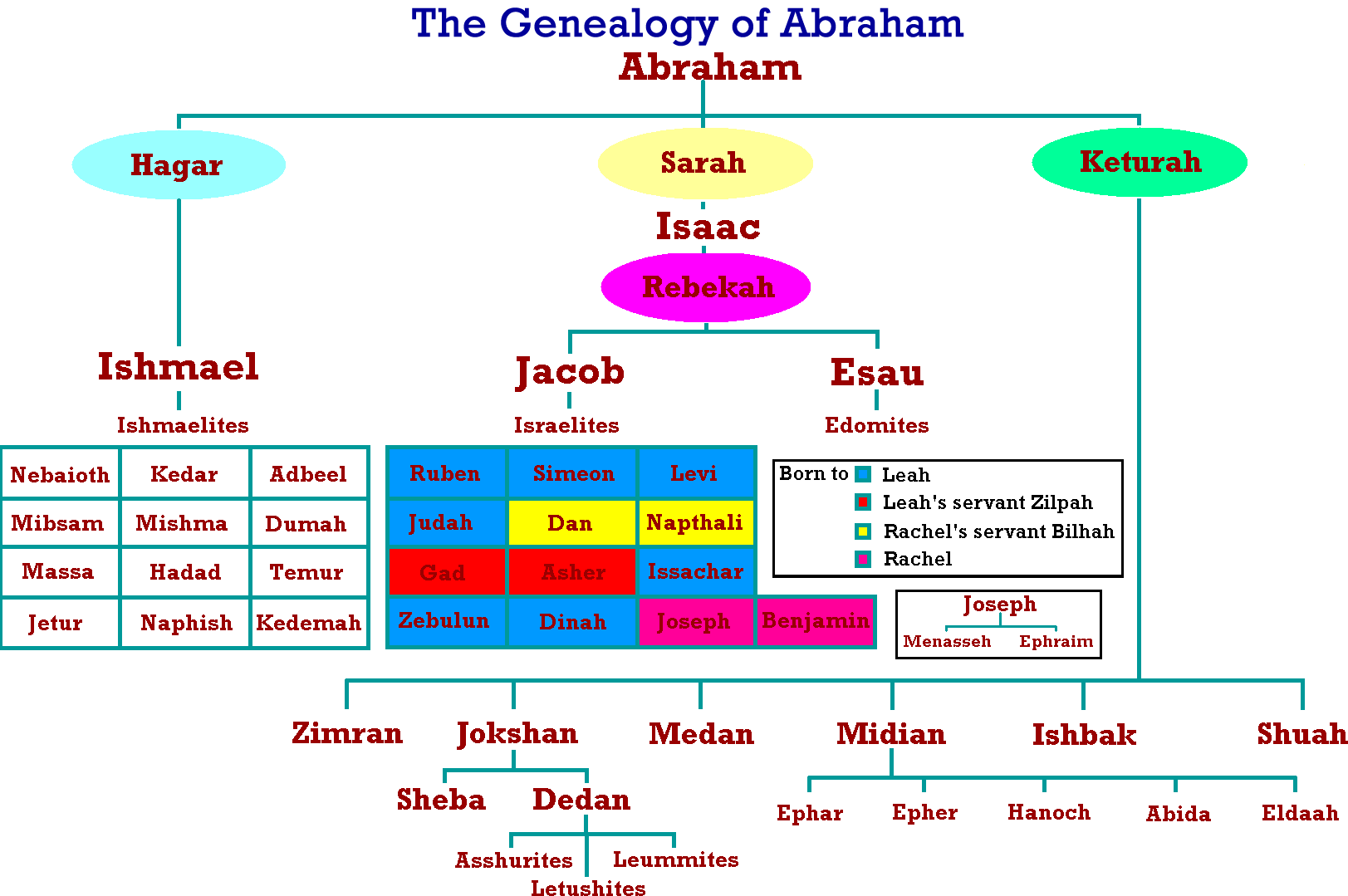
He had Ishmael (Ishmaelites) to Hagar, his wife’s maid servant. [29] Ishmael became the Patriach of the Islamic religion.
Then at the age of 100 Abraham had Issac to his wife Sarai. [30]
It was to be thru Issac that God would fulfill his promise to Abraham and so Ishmael was sent away. [31]
Issac married Rebeka who bore Esau (the Edomites) and Jacob (the Israelites). Abraham had a third wife Keturah who bore many children who were sent to the middle east and became fathers of nations there too. [32]
Jacob eventually bore 12 sons and a daughter. The eleventh son was Joseph. Joseph was the first son of Rachael (Jacob’s second wife). [33] Jacob had an encounter with God one night and was renamed Israel. [34] His descendants (the Jews) became the Nation of Israel (from which comes Judaism) out of which came Christ (Christianity) with whom God would fulfill his promise to Abraham. [35]
Genealogy of Noah (according to the Bible)

Genealogy of Noah (according to the Bible)

Genealogy of Abraham (according to the Bible)

Genealogy of Abraham (according to the Bible)


  • Biblical History

In the Biblical account, (Genesis 37-50) Joseph was the first born Son of Rachael (Jacob’s second wife). Jacob (Israel) favored Joseph over his other children. Joseph had a dream that one day he would rule over his brothers. His brothers became jealous of him and so sold him to slave traders who took him to Egypt. [36] He was subsequently sold to Potiphar in Egypt as a slave and was subsequently wrongfuly imprisoned.
It was in prison where he came to the attention of Pharaoh through his cupbearer who informed Pharaoh of Joseph’s ability to interpret dreams by the power of God. Pharaoh needed counsel about his own dreams and was not able to find anybody from his own kingdom to help.
Joseph was able to tell Pharaoh the meaning of his dreams which fortold of a coming famine lasting seven years but preceded by seven years of abundance. Pharaoh made Joseph second in charge over his all his kingdom. During the seven years of abundance, Joseph was able to build silos in every city and store enough grain to feed the Nation during the seven years of famine that followed. [37]

  • Joseph’s achievements in Egypt

When Joseph was 30 yrs old, Pharaoh put him in charge of the whole land of Egypt. Pharaoh gave Joseph his signet ring, dressed him in fine linen and put a gold chain around his neck. He was given a chariot to ride around Egypt as second in command. Joseph’s name was changed to Zapheneth Paneah and he was given a wife Asenath (Daughter of Potiphera, priest of On). [1]
During the seven years of abundance, Joseph stored up huge quantities of grain in each city from the fields surrounding them. [2]
He had two sons to Asenath, Mannaseh & Ephraim. [38]
Joseph saved Egypt and Caanan by selling the people grain during the 7 year famine. When the people had run out of money, Joseph brought their livestock. When they had run out of livestock he brought the land titles. [3]
Joseph brought up all the land in Egypt for Pharaoh. The priests did not have to sell their land as Pharaoh gave them a supply of food. [11]
Joseph’s family were saved. [39] Jacob (Israel) and his eleven other sons along with their wives and servants were invited by Pharaoh to come and live in Egypt. [40] They settled in Rameses and became numerous in number. [41]
Jacob died and was afforded an Egyptian burial [42] after blessing his children and those of Joseph. [43] [44] Joseph reassures his brothers after Jacobs death. [45] Eventually Joseph dies at the age of 110 and is given an Egyptian style burial aswell. [46]
After 430 years passed, the Israelites numbered over 2 million. They were eventually lead out of Egypt by Moses through the Red Sea (the exodus). [47]

Is Joseph likely to have figured in Egyptian records?

If Joseph was placed second in charge of Egypt by Pharaoh, there should be some note of this in Egyptian records. [1]
Joseph helped to save Egypt and the surrounding nations from a famine lasting seven years. [2]
Joseph would have had to construct massive grain silos for storing grain in many Egyptian cities and indeed, massive silos can be found in many historical significant Egyptian cities today (eg Saqqara).
Joseph married the daugher of one of the High Priests in Egypt. [1] He saved his country from a seven year famine and brought up all the land of Egypt except for that of the priests who did not need to sell their land because Pharaoh supplied them with food. The people became loyal subjects of Pharaoh because of what Joseph had done. [3]
Joseph was, therefore, responsible for making the Pharaoh’s wealthy and powerful. [11]
Joseph served the Pharaohs from the age of thirty. [1] He died at the age of 110 years of age and was given a Royal Egyptian burial. [46] It is quite possible that he may have been involved with the design of the first and maybe the second pyramid.
His family, the descendants of Jacob (Israel), produced mud bricks and became numerous in number in the 430 years that they lived in Egypt. There were over 600 thousand adult males (not counting women and children) who were lead out of Egypt by Moses during a time of great disaster in Egypt. [47]
With a list of accomplishments like this, it would be hard to conceive that Joseph would not be mentioned in Egyptian heiroglyphics or memorialized some other way.

Where does Joseph fit into Egyptian History?

Estimates of dates have long been the common denominator used by archaeologists and historians alike when trying to piece together ancient history.
Various teams of archaeologist have used a number of different dating methods to estimate how old a particular artifact is. For example, the type of pottery that is predominant in a layer can be used to date the layer.
Assumptions behind various dating techniques are not alway right. This can sometimes lead to artifacts being incorrectly dated by as much as 1000 to 2000 years.
If history is pieced together based only upon the estimated dates of particular dynasties, the results can be quite erroneous and it will be little wonder why Egyptian and Hebrew history does not fit together and why no Egyptian equivalent of Joseph has been found using the dates traditionally ascribed to various Egyptian dynasties.
An increasing number of historians are now calling into question the dates of Egyptian dynasties. In particular, Sweeney [15] [21] [19] [48] , Velikovski [49] [50] [51] , Fry [52] [12] [53] [16] [54] [55] [56] [57] [58] [59] [20] , Reilly [13] [17] [60] [22] Ashton & Down [18] .
Using their revised dating system, the historical records of Israel and Egypt fit together much better and it is possible to identify likely correlates and contemporaries of important Biblical Characters.
Conventional wisdom which has been very reliant on dating methods has been unable to find any evidence that the Patriarchs of Israel lived in Egypt and have not found any possible candidates for Joseph because they are looking for evidence of him in the Hyksos dynasty which is estimated to have been around 1700BC according to conventional chronology. As a result, conventional wisdom states that Joseph and other Biblical figures were minor figures in Egypt that were not note worthy enough to have been memorialized in the heiroglyphic records and other monuments that have been uncovered.
Modern thinking using the revised chronology results in much clearer picture with the history Israel and Egypt lining up and matching archaeological records. Abraham is considered to be a contemporary of Menes. Imhotep is considered to be the Joseph of the Bible and Djoser is considered to be the Pharaoh that he served [13] [17] [21] [15] [52] [54] .
This would fit with the theory that Amenemhet III was the Pharaoh of Moses who oppressed the Israelites making them make mud bricks [18] . Also of note is that the pyramid of Amenemhet III was made of mud bricks containing straw. [18] Amenemhet III was the 6th Pharaoh of the 12th dynasty and lived 450 to 500 years after Pharaoh Djoser in the 3rd dynasty. [18] He had only daughters who had a son (Amenemhet IV) who disappeared before he could become King. It has been suggested that Amenemhet IV was Moses. [18]
The Exodus took place during the Reign of Neferhotep I during the 13th dynasty in 1445BC. He was the only Pharaoh of that dynasty [18]
The Hyksos (15th & 16th dynasties) which were contemporary with Joshua and the Judges, came to an end when King Saul destroyed the Amalekites (Hyksos) [18] [61]
Dynasty 17 was contemporary with dynasty 16. [18]
Amenhotep I and Thutmosis I of the 18th dynasty were contemporaries of David. [18] Hatshepsut was the Queen of Sheba who visited Solomon. [62] [63] Thutmosis III came to power during the reign of Jereboam and became the greatest Pharaoh of Egypt. [18]
Modern’ Chronology (Ashton & Down 2006) [18]
DateDynastyEgyptContemporary_in_Israel
2080BC1stMenesAbraham
1900BC3rdDjoser_+_ImhotepJoseph
1531BC12thAmenemhet_III (6th_Pharaoh)Moses
1445BC13thNeferhotep IThe Exodus (Moses)
1405 -1021BC15th_&_16thHyksosJoshua to Saul
1018BC18thAmenhotep I & Thutmosis IKing David
950BC18thHatshepsut [Queen of Sheba]Solomon
929BC18thThutmosis IIIJereboam

Why is it so hard to piece together Egyptian records?

The Egyptians suffered great losses at the time of the Exodus and may not have wanted to remember what Joseph and his family had achieved during their 400 year stay in Egypt. This may be one reason why it is very difficult to find historical information about the exploits of the Israelites in Egypt.
This may also been the reason that the second pyramid designed by Imhotep was not completed.
Another reason why it is difficult to find historical information is because much of it was lost or destroyed by various seiges, conquests, natural distasters and even erosion over the centuries.
Egyptian records are written as qlyphs (pictures) in stone. They have a number of limitations – you need to know ‘the code’ ie what they mean. Pronunciation is not indicated as with Greek and English and there is no time stamp. The art of interpreting them (heiroglyphics)has been somewhat lost.

Similarities between Joseph and Imhotep

Imhotep – Egyptian records
Joseph – Bible
  • Imhotep is appointed Administrator by Pharaoh Djoser during the periods of seven years famine and seven years of bountiful harvests [8]
  • Joseph is appointed Administrator to Pharaoh for the seven years of plenty then of famine
  • Minister to the King of Lower Egypt [8]
  • Pharaoh .. made him ruler over all the land of Egypt
  • Administrator of the Great Palace [8]
  • Thou shalt be over my house
  • Not of royal blood; attained position by ability [8]
  • From another nation and religion, not of royal blood, attained position by ability
  • Not appointed by Pharaoh Djoser until he had reigned for some time [8]
  • Appointed well after Pharaoh ruled Egypt
  • Given the status of “son” to Pharaoh [8]
  • Granted the status of “son” to Pharaoh
  • High Priest in Heliopolis [8]
  • Married to Asenath, daughter of Poti-Pherah, High Priest in Heliopolis – by custom, would succeed father-in-law
  • Builder and architect [8]
  • Builder of grain storehouses such as at Sakkara step-pyramid
  • Exalted by Pharaoh Djoser as of godly character [8]
  • And Pharaoh said, ‘a man in whom the spirit of God is!’
  • “I need advice from God” [8]
  • Noted as saying, “It is not in me; God shall give Pharaoh an answer”
  • Had great medical skill – was compared to the Greek God of Healing [8]
  • Had doctors under his authority – worked by miracles, dreams and signs from God
  • Decided the tax rate during the seven years of famine; also not to apply to priests [8]
  • Decided the tax rate during the seven years of famine; also not to apply to priests
  • Realizes when he is dying – dies at age 110 [8]
  • Realizes when he is dying – dies at age 110

Who was Imhotep?

Imhotep was a most interesting figure in the Egyptian culture, his name means “the one who comes in peace”. He served Djoser, the third dynasty king, he was the vizier to the pharaoh and they say that he was the high priest to the sun god Ra. [64]
Imhotep is attributed with being the first person in history to be an acting physician, he was also the first architect, he was a poet and also a philosopher. After his death he was given the status of a deity, he was only one of a very few commoners to ever be given that kind of an honor.
[64]
He is thought to be the architect of the first Pyramid; the step pyramid at Saqqara. [64]
He is also credited with the use of columns in architecture. [64]
He is known as the founder of Egyptian medicine, and he is famous for not incorporating magic into his medical treatments, he diagnosed and treated over two hundred diseases, he extracted medicine from plants and he is also known to have performed operations and dentist work. He knew the circulation of the blood system and he knew where each vital organ was placed and what its uses were. [64]
He became the god of medicine and healing, when the Greeks invaded Egypt they worshiped him and built him temples because they saw in him their own god of healing named Asclepius. [64]
Imhotep was also the first person known to use the papyrus scroll. He may have actually invented it! [64]
Among other things Imhotep is also attributed to the prediction and prevention of a seven year famine that came upon the land, he predicted the famine from a dream the pharaoh Djoser had, in this dream the god of the Nile spoke to the pharaoh, and Imhotep was the only one that could interpret the dream. [64]

Could Joseph and Imhotep have been the same person?

The Roman-Jewish historian, Josephus, quotes the writings of Manetho, Egyptian historian: “During [the] reign of .. Pharaoh Djoser, 3rd Egyptian dynasty, lived Imhotep .. [with a] reputation among Egyptians like the Greek God of medicine – [Manetho even wondered] whether Imhotep could have been an actual person .. [because he had] “so many outstanding qualities and talents .. a very special person [who] appears in the history of Egypt.” On the foundations of the Step Pyramid in Sakkara was carved the name of Pharaoh Djoser and “.. Imhotep, Chancellor of the King of Lower Egypt, Chief under the King, Administrator of the Great Palace, Hereditary Lord, High Priest of Heliopolis, Imhotep the Builder..”. [8] [65]
Joseph arrived in Egypt as a young man and married Asenath, the daughter of Potipherah, the priest of On. [1]
This information precludes the theory that Joseph lived during Hyksos rule in Egypt. On or An was the ancient capital of Heliopolis (As-t Tem). Some claim that Egyptians also believed in One Great God who was never represented in their art work. Only his attributes, functions as Creator, Teacher and Healer were known as the neter or neteru. The symbolism surrounding Egyptian deities then is different from this One Great God, in whose image man was made, in that it scales our world and the universe to our dimensions so man can grasp it. The Egyptian name for this `One Great God’ is neter, probably an echo or more distant memory of the biblical Creator God of Abraham, Issac and Jacob. [66]
Both Imhotep and Joseph imposed a 20% (one fifth) tax on the people with the exemption of the priests. [54]
Moeller refers to an inscription on the island of Sihiel, near the first cataract of the Nile, which actually links Imhotep to the key biblical element of the Joseph story – telling of Pharaoh Djoser in the 18th year of his reign. The inscription states “seven meagre years and seven rich years”. Commenting on the inscription, Moeller writes, “Pharaoh Djoser asks Imhotep to help him with the coming seven years of famine. All the biblical components of the story are there, and there is a similar inscription on the island of Philae in the Nile.” (This is exactly as in the Bible with Joseph, except for listing the “meagre” years before the years of plenty. Note: The famine years were, of course, the event of significance, saving everyone from starvation and bringing in much wealth to Egypt – it is noted that the manuscript was written a thousand years after the occurrences.) [67] [8]
Pharaoh renamed Joseph ‘Zapeneth Peneah’ [1] which means “master of the school of learning” [66] or “Man to whom secrets are revealed” [54] .
It is also interesting to note that circumcision was widely practiced among Egyptians from the third dynasty onward. Although Abraham did visit Egypt, it seems more likely that this practice was introduced by Joseph-Imhotep in the third dynasty. [54]
Egyptian records show that before Imhotep, the bodies of Egyptian royalty were not embalmed. Instead, they were entombed in early Egyptian structures called mastabas, (or mastabahs), oblong structures with flat roofs and sloping sides built over the opening of a mummy chamber or burial pit . [54]
Djoser appears to be the first king to have be embalmed, [54] Jacob (Israel) was embalmed by Joseph and buried in a coffin and Joesph himself was embalmed and given a royal Egyptian burial. [46] [42] The Biblical account suggests that only Joseph’s bones were preserved as was the practice in the early dynasties of the Old Kingdom. Preservation of the whole body was not practiced until the Era of King Tut (New Kingdom). [54]
Extremely noteworthy regarding Imhotep-Joseph is that the mummified bodies of neither have ever been found. The known facts regarding the burials of Imhotep and Joseph also strongly support the thesis that they were the same person: [8]
Both died at age 110. [8] [46]
Imhotep’s coffin in Sakkara – with innumeral Ibis birds mummified in the adjoining galleries (Imhotep was called “Ibis” because of his reputation for healing – a large number of Ibis birds were sacrificed to him at his funeral in Sakkara); many clay vessels bearing the seal of Pharaoh Djoser were near the coffin; and the coffin is oriented to the North, not East, and is empty. [8]
Joseph would have been buried at Sakkara, his coffin orientated to the North – indicating he did not believe in the gods of the Egyptians (who were buried facing East, the rising sun); the coffin would also be empty as Joseph’s bones would have been taken by Moses with the Hebrews during the Exodus. [8] [46]

Could Pharaoh Djoser (King Netjerikhet) be the Pharaoh of Joseph?

The ‘correct alignment’ of Israel’s and Egypt’s history will allow contemporary fragments of information to be linked together to build up a clear picture of ancient history. Combining the records of Egypt, Israel and Mesopotamia will help to fill in the gaps in each nations’ record.
Evidence is now accumulating to suggest that Egyptian dynasties may overlap and may not date back as far as was once thought. [15] [16] [17] [18] [66]
Dynasty 2 is considered contemporary with dynasty 3. [18] There was no first intermediate period. The dark ages of the first intermediate period have been confused with the dark ages of the second intermediate period. [18]
Dynasties 7-10 have been identified with 15-16 and Dynasty 17 was contemporary with dynasty 16. [18]
Egyptian history, therefore, does not date back as far as was once thought (3000BC – 5000BC) as per the Conventional Chronology. [18] [50] [51] [49] [21] [13] [17] [52] [12] [53] [16] [54] [66]
The first Egyptian dynasty is now considered to have started around 2100BC and the Great Flood is considered to have been around 2300-2400BC. [18]
The Exodus occured just after the end of the 12th dynasty in 1445BC. [66] [18]
Any Egyptian dates before the 12th dynasty are considered quite speculative and are only approximations [18]
This ‘Modern Alignment’ of the Dynasties fits the Biblical account and also the records of Mesopotamia.
The ‘Modern Alignment’ of the Dynasties provides the answers to the major objection to Joseph and Imhotep being the same person (namely the mismatching dates) and by the same token makes it highly likely that Pharaoh Djoser was the Pharaoh of Joseph.
While Sweeney points out that Abraham was a contemporary of Menes who were patriarchs of their respective civilizations some time after a catestrophic destruction [21] , he has probably over corrected the dates which are far too short even for Biblical events.
If it is agreed that Joseph was Imhotep and he served Pharaoh Djoser (Zozer) of the Third dynasty, it does not follow that the identity of Moses and the Pharaoh’s he was contemporary with will be agreed as there is not universal agreement about which dynasties to identify and which dynasties ran in parallel. [58] [66] [19] [18] [17]
Conventional’ Chronology [21]
DateEgyptIsrael
3000BCMenes (First dynasty displays strong mesopotamian influence)Djoser and Imhotep (Famine crisis solved when Imhotep interprets Djoser’s dream)
2000BCFirst Intermediate period(Age of disturbance in nature and general lawlessness)Abraham (migrates from mesopotamia and introduces some of the basic civiliation to Egypt)Joseph (Famine crisis in Egypt solved when Joseph interprets Pharaoh’s dream)
1000BCMoses leads the Israelites to freedom amidst violent upheavals of nature
Revised’ Chronology (Sweeney 1997) [21]
DateEgyptIsraelMesopotamia
1300+BCEarly_Badarian‘Ubaid
1300BCCatestrophic_DestructionCatestrophic_DestructionCatestrophic_Destruction
1200BCLate_Bedarian_and_GerzeanKhirbet_KerakJamdat_Nasr(Early_Literacy)
1100-
1000BC
Destruction episodeDestruction episodeDestruction episode
1000BCMenes (Early Dynastic Age)Abraham(Early Dynastic Age)
900BCDjoser and ImhotepJoseph
800BCDestruction episodeDestruction episodeDestruction episode
800BCPyramid AgeAge of the JudgesAkkadian Age
700BCHyksos epochSaulSargon I
‘Modern’ Chronology (Ashton & Down 2006) [18]
Date Dynasty Egyptian_PharaohContemporary_in_Israel
2080BC1stMenesAbraham
1900BC3rdDjoser_+_ImhotepJoseph
1531BC12thAmenemhet_III (6th_Pharaoh)Moses
1445BC13thNeferhotep IThe Exodus (Moses)
1405 -1021BC15th_&_16thHyksosJoshua to Saul
1018BC18thAmenhotep I & Thutmosis IKing David
950BC18thHatshepsut [Queen of Sheba]Solomon
929BC18thThutmosis IIIJereboam

What implications does this have for Egyptian History?

If the ‘modern alignment’ of the Egyptian Dynasties is correct, Joseph can be identified with Imhotep and Egyptian history will be consistent with the Bible.
Pharaoh recognised Joseph’s divine inspiration and appointed him to be in charge of Egypt. Joseph built silos to store grain and so saved Egypt from a seven year famine. He acquired all the land of Egypt (other than the priest’s) for Pharaoh by selling grain. The Pharaohs became wealthy and powerful and the people of Egypt became his subjects. Joseph’s family was invited to live in Egypt (Rameses). [3] [11]
Joseph, therefore, saved his family and protected the Israelites as they grew to become a nation in Egypt. [45]
Djoser was the second Pharaoh of the 3rd dynasty of Egypt and came about three or four generations after Menes who was the Pharaoh of the 1st dynasty of Egypt and a contemporary of Abraham. [18] [21] [15]
Joseph came three generations after Abraham and was contemporary with Djoser (1900BC) . After his death he was deified because of his achievements. As King Netjeriket of the third Egyptian dynasty was also known by the name ‘Pharaoh Djoser’, it is possible that this name means ‘Pharaoh of Joseph’.
The Israelites stayed in Egypt 430 years. This takes us to the end of the 12th and beginning of the 13th dynasty which is when the Exodus occurred. (1445BC) [18]
It is unlikely that Joseph was some inconspicuous person in the 18th dynasty of Hyksos as is commonly held by people who adhere to the ‘conventional alignment’ of Egyptian dynasties.
What’s more, if the ‘modern alignment’ is correct, the Hebrew influence of Egyptian culture will be re-established. The first pyramid would have been designed by a Hebrew. The Hebrew God can be credited for saving Egypt from a seven year famine and giving the Pharaoh’s their power, wealth and the means to build the other pyramids. The designer of the first pyramid will, once again, be seen to be a servant of the God of Abraham, Issac and Jacob, even though the pyramids later became objects of pagan worship and Imhotep was deified long after his death by the Greeks.
When the Israelites left Egypt, Joseph’s association with the God of Abraham, Isaac and Jacob was forgotten and the pyramids became symbols of pagan gods.
With the aid of hind sight it can be seen how the designer of the first pyramid, the savior of the Egyptian people and the man responsible for the Pharaoh’s power, known as Imhotep, would be deified some 1400 years after his death once his connection with the God of Abraham, Issac and Jacob had been lost and forgotten.
The first pyramids, which were made of cut limestone, were built by the Egyptian people who had sold their land to Pharaoh and become his subjects.
After Joseph’s death, the Israelites were given the task of making mud bricks. [68] [69] Interestingly, the core of the Pyramid of Amenemhet III is made of mud bricks containing straw. [18] Amenemhet III was the 6th Pharaoh of the 12th Egyptian dynasty which preceeded the Exodus in 1445BC. [18]
Moses was forced to flee Egypt and go to Midian after killing an Israelite official. During that period, the Pharaoh died. [70] When he returned to Egypt, there was a new Pharaoh in power (possibly Neferhotep I of the 13th Dynasty). [18]
The Hyksos dynasties (14th & 15th dynasties) started after the Exodus, spanned the period of the Judges and was finally ended by Saul when he defeated the Amelekites. [18] [61]

What implications does this have for Israel and Christianity?

If Joseph was Imhotep, then Bible History is consistent with Egyptian history.
This will mean that there is archaeological evidence that the Patriarchs of Israel lived in Egypt.
Archaeological evidence for Israel in Arabia ⁄ Midian (Jabel el Lawz) in combination with the above would corroborate the Biblical account of the Exodus.
Joseph saved his family and protected the Israelites and allowed them to multiply in numbers so that they could fulfill what God had planned; namely to return to the land of Canaan and to take possession of it after spending 430 years in Egypt and 40 years in the Wilderness. [28]

What implications does this have for Literature, Medicine and Architecture?

If Joseph was Imhotep, this would make Joseph the father of medicine, the first architect to build with stone and use columns and the inventor of the papyrice and the first to use it (to write medical and non-medical literary works). [71] [72] [73] [74] [6] [75]
He probably served more than one pharaoh and appears to have designed at least two pyramids and several buildings that utilize columns. He was given the name Pathotep by a later pharaoh that he served. [54]
Imhotep may have invented the embalming techniques used to preserve the bodies of Egyptian Pharaohs. He became the first pathologist. He was known as the ‘Son of Ptah’ (or son of Path). [54] Hundreds of years after his death, he became deified and was known as the god Path. [54]
Not only was Pathotep’s name derived from that of the god Path, but our modern word, ‘Pathology’, was also derived from and bears his name. [54]

Summary: Joseph and Imhotep are the same person

There is such a strong match between the profile of Joseph and Imhotep that many historians, theologians and archaeologists have suggested that they are one in the same person.
There were only so many non royal, second in charge visiers who saved Egypt from a 7 year famine by interpreting Pharaohs dreams (with the power of God), imposed a 20% tax, brought up all the land of Egypt for Pharaoh (except for that of the priests), lived to the age of 110 and were embalmed when they died. – Imhotep & Joseph
Imhotep was also the High Priest of Heliopolis. Jospeh married the daughter of the high priest of On (the capital of Heliopolis) !
Until recently, the main case for not believing Joseph and Imhotep to be the same person, has been the considerable discrepancy between the estimated dates of their existance by as much as 1000 years!
Egyptian records are far from complete. They are not chronological and the exact way that fragments fit together is by no means certain.
In the Last 50 years, historians have realized that several Egyptian dynasties have been counted twice and some ran in parallel. The result is that Egyptian history can be substantially contracted, therefore eliminating the discrepancy in the estimated dates of Joseph and Imhotep.
This modern understanding of the Egyptian dynasties means that Joseph almost certainly was Imhotep and Egyptian History is consistent with the Bible.
If it can be generally accepted that Joseph and Imhotep were the same person, this would give historians an anchor in history in order to further correlate the history of Egypt, Israel and Mesopotamia.

Suggested Reading

1. J. Ashton & D. Down, Unwrapping the pharaohs. how Egyptian archaeology confirms the Biblical timeline, New Leaf Publishing Group (Master books), 2006. ISBN 978-0-89051-468-9 ISBN 0-89051-468-2 http://masterbooks.net
2. H. Bible, “Jacob bore 12 sons,” Genesis chapter 29-32,
3. H. Bible—”Keturah’s children sent away to Middle East,” Genesis 25:1-4,
4. H. Bible—”Abrahams children to be reckoned through Isaac,” Genesis 21:12,
5. H. Bible—”Ishmael sent away – Isaac the child of promise,” Genesis 21:8-13,
6. H. Bible—”Isaac born to Sarai,” Genesis Chapter 21,
7. H. Bible—”Ishmael born to Hagar,” Genesis Chapter 16,
8. H. Bible—”God’s covenant with Abraham,” Genesis Chapters 15 & 17,
9. H. Bible—”Call of Abraham,” Genesis Chapter 12,
10. H. Bible—”Terah sets out from Ur,” Genesis 11:27-32,
11. H. Bible—”The dispersion after Babel,” Genesis Chapter 11,
12. H. Bible—”The Flood,” Genesis Chapter 6,
13. H. Bible—”The Biblical account of Jospeh,” Genesis chapter 37-50,
14. H. Bible—”Jacob renamed Israel,” Genesis 32:22-32,
15. H. Bible—”Jacob favours Joseph,” Genesis chapter 37,
16. H. Bible—”Joseph sold into slavery and taken to Egypt,” Genesis 37:12-36,
17. H. Bible—”Joseph falsely accused and imprisoned in Egypt,” Genesis 39:1-23,
18. H. Bible—”Joseph able to interpret dreams,” Genesis 40:1-23,
19. H. Bible—”Joseph recognised by Pharaoh,” Genesis 41:1-40,
20. H. Bible—”The Exodus,” Exodus 12:31-42,
21. H. Bible—”Joseph reassures his brothers afer Jacob’s death,” Genesis 50:15-21,
22. H. Bible—”Jacob dies,” Genesis 49:29 -50:14,
23. H. Bible—”Jacob blesses his sons,” Genesis chapter 49,
24. H. Bible—”Jacob blesses Joseph’s children,” Genesis chapter 48,
25. H. Bible—”Pharaoh gives Jacob the land of Goshen,” Genesis Chapter 45,
26. H. Bible—”Joseph’s brothers go to Egypt to buy grain,” Genesis Chapters 42-44,
27. H. Bible—”Death of Joseph,” Genesis 50:22-26,
28. H. Bible—”Jacob moves to Egypt and settles in Rameses,” Genesis Chapter 46:1-47:12,
29. H. Bible—”Joseph buys up all the land of Egypt for Pharaoh,” Genesis 47:18-22,
30. H. Bible—”Joseph saves Egypt by selling grain,” Genesis 47:13-17,
31. H. Bible—”Joseph has two sons; Ephraim and Mannaseh,” Genesis 41:50-52,
32. H. Bible—”Joseph stores up huge quantities of grain in Egyptian cities,” Genesis 41:47-49,
33. H. Bible—”Pharaoh puts joseph in charge of all Egypt,” Genesis chapter 41:41-46,
34. H. Bible—”The Queen of Sheba visits Solomon,” 1Chron 9:1-12,
35. H. Bible—”The Queen of Sheba visits Solomon,” 1Kings 10:1-13,
36. H. Bible—”Saul destroys the Amalekites,” 1Samuel 15:2-9,
37. H. Bible__”Moses flees to Midian and Pharaoh eventually dies” Exodus 2:11-25,
38. H. Bible, “The Israelites oppressed,” Exodus 1:1-22,
39. H. Bible—”Pharaoh makes Israelites find own straw to make mud bricks,” Exodus 5:1-21,
40. “The Wall Chart of World History – From earliest times to the present” 1998 Bracken Books ISBN 1-86256-306-3

References:

1. H. Bible, “Pharaoh puts Joseph in charge of all Egypt,” Genesis chapter 41:41-46,
2. H. Bible—”Joseph stores up huge quantities of grain in Egyptian cities,” Genesis 41:47-49,
3. H. Bible—”Joseph saves Egypt by selling grain,” Genesis 47:13-17,
4. NationMaster.com, “Statemaster – Encyclopedia: Imhotep,” , statemaster.com, 2009.
6. M. Millmore, “The Step Pyramid at Saqqara,” , http://www.eyelid.co.uk, 2008.
9. E. Sweeney, “Were Joseph and Imhotep of Egypt The same man?,” THE GENESIS OF ISRAEL AND EGYPT, B. E. Sweeny (Editor), 2001.
10. B. Rhodes, “Joseph and Imhotep,” , http://the-red-thread.net/, 2009.
11. H. Bible, “Joseph buys up all the land of Egypt for Pharaoh,” Genesis 47:18-22,
12. D. Fry, “Hebrew sages of ancient Egypt – time calibrators,” Hebrew Sages of Ancient Egypt II, 2004.
13. J. Reilly, “Displaced dynasties,” Dysplaced Dynasties, 2009.
14. G. Byers, “Israel in Egypt,” , http://www.biblearchaeology.org, 2008.
17. J. Reilly, “The exodus and beyond chapter 3: Joseph & Moses,” The Exodus and Beyond, 2009.
19. E. Sweeney, The pyramid age, ages in alignment series, Algora Publishing, 2007.
21. E. Sweeney, The Genesis of Israel and Egypt, Janus Publishing Company Limited, 1997. ISBN 978-1857563504
23. R. Wyatt, “Joseph was Imhotep of Egypt,” , Wyatt Archaelogical Research, 1994.
24. H. Bible, “The Flood,” Genesis Chapter 6,
25. H. Bible—”The dispersion after Babel,” Genesis Chapter 11,
26. H. Bible—”Terah sets out from Ur,” Genesis 11:27-32,
27. H. Bible—”Call of Abraham,” Genesis Chapter 12,
28. H. Bible—”God’s covenant with Abraham,” Genesis Chapters 15 & 17,
29. H. Bible—”Ishmael born to Hagar,” Genesis Chapter 16,
30. H. Bible—”Isaac born to Sarai,” Genesis Chapter 21,
31. H. Bible—”Ishmael sent away – Isaac the child of promise,” Genesis 21:8-13,
32. H. Bible—”Keturah’s children sent away to Middle East,” Genesis 25:1-4,
33. H. Bible—”Jacob bore 12 sons,” Genesis chapter 29-32,
34. H. Bible—”Jacob renamed Israel,” Genesis 32:22-32,
35. H. Bible—”Abrahams children to be reckoned through Isaac,” Genesis 21:12,
36. H. Bible—”Jacob favours Joseph,” Genesis chapter 37,
37. H. Bible—”The Biblical account of Jospeh,” Genesis chapter 37-50,
38. H. Bible—”Joseph has two sons; Ephraim and Mannaseh,” Genesis 41:50-52,
39. H. Bible—”Joseph’s brothers go to Egypt to buy grain,” Genesis Chapters 42-44,
40. H. Bible—”Jacob moves to Egypt and settles in Rameses,” Genesis Chapter 46:1-47:12,
41. H. Bible—”Pharaoh gives Jacob the land of Goshen,” Genesis Chapter 45,
42. H. Bible—”Jacob dies,” Genesis 49:29 -50:14,
43. H. Bible—”Jacob blesses Joseph’s children,” Genesis chapter 48,
44. H. Bible—”Jacob blesses his sons,” Genesis chapter 49,
45. H. Bible—”Joseph reassures his brothers afer Jacob’s death,” Genesis 50:15-21,
46. H. Bible—”Death of Joseph,” Genesis 50:22-26,
47. H. Bible—”The Exodus,” Exodus 12:31-42, .
48. Empire of Thebes or Ages In chaos revisited (ages in alignment), Algora Publishing, 2006.
49. I. Velikovski, Worlds in collision, London and New York, 1950.
50. I. Velikovski—Ages in chaos, London and New York, 1953.
51. I. Velikovski—Earth in upheaval, 1956.
52. D. Fry, “Hebrew sages of ancient Egypt II,” 2009.
53. D. Fry—”Hebrew sages of ancient Egypt II The birth of Egypt,” Hebrew Sages of Ancient Egypt II, 2004.
57. D. Fry—”Hebrew sages of ancient Egypt – Egypts weather changes,” Hebrew Sages of Ancient Egypt, 2009.
60. J. Reilly—”The Exodus and beyond chapter 2: The Patriarchal Age,” The Exodus and Beyond, 2009.
61. H. Bible, “Saul destroys the Amalekites,” 1Samuel 15:2-9,
62. H. Bible, “The queen of Sheba visits Solomon,” 1Kings 10:1-13,
63. H. Bible—”The queen of Sheba visits Solomon,” 1Chron 9:1-12,
65. W. Whiston, The works of Josephus complete and unabridged, New Updated Edition, Hendrikson Publishers, 1987. ISBN 0-913573-86-8 ISBN 1-56563-167-6
67. L. Moeller, The case for the Exodus, .
68. H. Bible, “The Israelites oppressed,” Exodus 1:1-22,
70. H. Bible, “Moses flees to Midian and Pharaoh eventually dies,” Exodus 2:11-25,
72. Britannica, “Imhotep,” , http://www.britannica.com, 2009.
73. R. Strachan, “Imhotep,” , http://www.mnsu.edu/emuseum/, 2005.
74. K. Matthews, “Imhotep,” , http://www.greatbuildings.com, 2008.
75. Wikipedia, “Imhotep,” , http://en.wikipedia.org, 2009.