Tuesday, July 30, 2019

Koran: Mecca has likely been substituted for Beersheba


 The Jericho River History Quiz -- page
A funny thing happened
on the way to Mecca


Part Two:
Mecca has likely been substituted for Beersheba


by

Damien F. Mackey


“Apparently drawing from early Jewish scriptural interpretations known as Targumim, Muslim interpreters linked the building of the sanctuary in Mecca with the account in
Gen 21 of digging a well in Beersheba—the place where, according to the Targumim, Abraham also built a shrine”.


The Qur’an (Koran) can, at times, present its reader with some appallingly bad geography; with unashamedly anachronistic history; and with endless biblical and Jewish appropriations.
For example, in my article:

Durie's Verdict: No Mohammed


I quoted the Rev. Mark Durie to this effect: “Another issue is the observation in Q37:137–38 that the Qur'an’s audience can pass by the remains of Lūṭ’s [Lot's] people in the morning and by night. The Biblical account of the destruction of Sodom and Gomorrah is associated with the region around the Dead Sea...”.
Geographical swing and a miss!
A vast geographical distance separates Lot’s place of abode from that of the early Moslems.


Moreover, whilst Abram (Abraham), considered to be the very father of the Islamic religion, lived in a most ancient time that has been properly (so I believe) located archaeologically to the Late Chalcolithic/Early Bronze phase (c. 3500 BC, conventional dating), the site of Mecca, to where Abraham is supposed to have gone, is, in archaeological terms, extremely young.
As I wrote in Part One:

…. I, whilst indeed accepting at least the religious and the evangelical aspects of things in relation to Islam, find, nevertheless, that there are immense problems with the conventional view of Islam as an historical phenomenon. There are many articles currently surfacing that support a view that the historical claims of Islam are quite false and inaccurate, with no underlying archaeology to support them.
‘A funny thing has happened on the way to Mecca’ – for it is most curious that, according to this recent scholarship:

·         “Archaeology of Mecca – the History of Mecca”. There is no archaeological evidence that suggests that Mecca is an ancient town that existed before the Christian era, or even that it existed before about the 4th century A.D. ….

·         “Did Abraham Build the Kaaba?” The body of this paper will deal primarily with places and destinations, not theology or personality. I will examine the Biblical accounts of Abraham in the natural and sequential order in which they are preserved in the Bible, while I examine and compare a small sampling of the similarities and differences in the Quran and other Islamic sources. In doing so, I’ll point out the several fatal contradictions in the Islamic perspective and leave the reader to determine whether the Islamic version is truth to be believed or fable created to connect a pagan Arabian shrine to the Biblical patriarch of the Israelites. I will cover the ancient evidence and promptly dismember Islamic dogma as inauthentic and based on inadequate grounds. ….
[End of quotes]

Brannon Wheeler thinks that (and I would have to agree with him here) Moslem interpreters appropriated the biblical (the Jewish) story of Abraham at Beersheba and shifted it to Mecca: https://www.bibleodyssey.org/en/people/related-articles/abraham-and-islam

Abraham and Islam by Brannon Wheeler


Muslims understand Islam to be the religion of Abraham. The biblical figure of Abraham is mentioned by name in the Qur’an 69 times—more than any other person except for Moses (137 times). Muslim interpreters of the Qur’an provide additional details linking the passages in the Qur’an to the stories of Abraham known from the Bible and from Jewish and Christian interpretation.

The Qur'an is familiar with some of the biblical stories about Abraham, including his journey to the promised land (Qur’an 21:71-73), the annunciation of Isaac (Qur’an 11:69-74, Qur’an 15:51-56, Qur’an 51:24-30), God's command for Abraham to sacrifice his son (Qur’an 37:99-113), the sacrifice of the birds (Qur’an 2:260), and Abraham's interaction with Lot and the angels (Qur’an 11:74-83, Qur’an 29:28-35, Qur’an 51:31-37).

In the Qur’an, God calls upon people to "follow the religion of Abraham" (Qur’an 3:95). Abraham is the "model" of obedience to God (Qur’an 16:120) and the "friend of God," and no one can be "better in religion" (Qur’an 4:125) than those who follow him.

The Bible begins the narrative of Abraham's life with his call by God in Gen 12, but the Qur’an begins earlier, with the story of Abraham smashing the idols of his father. A number of close parallels exist between Jewish versions of this story (found in rabbinic literature) and the details provided by Muslim interpreters, including Abraham's discovery of monotheism (Qur’an 6:74-87, Qur’an 41:37), his scheme to disprove idolatry (Qur’an 19:41-50, Qur’an 21:51-70), and his escape from the fiery furnace into which he was cast as punishment by the Babylonian king Nimrod (Qur’an 37:83-99, Qur’an 29:16-27).

Abraham is credited with establishing both the sanctuary in Mecca known as the Kaaba and the practice of Islamic pilgrimage (Haj) to that site (Qur’an 22:26-27, Qur’an 3:96-97, Qur’an 2:125-129).
Apparently drawing from early Jewish scriptural interpretations known as Targumim, Muslim interpreters linked the building of the sanctuary in Mecca with the account in Gen 21 of digging a well in Beersheba—the place where, according to the Targumim, Abraham also built a shrine.

The Qur’an does not identify the name of the son whom Abraham is commanded to sacrifice (see Gen 22), and the earliest Muslim interpreters were divided over whether it was Isaac or Ishmael. In the context of the larger narrative linking Abraham with Mecca, later Muslim traditions clearly identify the son to be sacrificed as Ishmael, the ancestor of the prophet Muhammad. Muslim interpreters also differ from the biblical account in making explicit that Abraham attempted to sacrifice his son, trying a number of times to slit his son's throat. ….


 

Friday, July 26, 2019

Those Confounding Confucius Institutes


Sydney University’s descent into a very dark ignorance
 

Part Two:
Those Confounding Confucius Institutes


“Over 400 Chinese government-backed Confucius Institutes are making an insidious attempt to restrict academic freedom by silencing debate on human rights and other sensitive issues, and whitewash its atrocious human rights records in Tibet and China”.


The University of Sydney’s wilful abandonment of all past wisdom, love and truth, etc., in its grand project of utter folly, ‘Unlearn’, was the subject matter of Part One:
https://www.academia.edu/34776797/Sydney_University_s_descent_into_a_very_dark_ignorance That University has, as do many others, a Confucius Institute. It is not ‘Turning Japanese’, as the song goes, but Turning Chinese – and being dictated to by a crazy, authoritarian Beijing.
This is all quite fitting, of course, as part of its reckless descent into a dark, slavish ignorance.
 
 
Confucius Institute threatens academic freedom and free speech. It is controlled by the Chinese Government, and a central part of its soft power plan to improve the global view of China’s authoritarian system. Confucius Institutes aim to censor and silence discussions on important political and human rights issues like Tibet, East Turkestan, Taiwan, Falun Gong and Tiananmen Square.
What are Confucius Institutes?
Confucius Institutes are educational programs backed by China’s Ministry of Education partnerships in educational institutions outside China. Their stated aim is to promote Chinese language and culture in our schools and universities.
 
What is the threat of the Confucius Institutes?
Chinese government censorship and propaganda on topics such as Tibet, Taiwan and Tiananmen are reaching our students in high schools and universities all over the world.
 
The truth about the Confucius Institutes is that they are China’s soft power push inside our schools.
Over 400 Chinese government-backed Confucius Institutes are making an insidious attempt to restrict academic freedom by silencing debate on human rights and other sensitive issues, and whitewash its atrocious human rights records in Tibet and China.
 
What can I do?
Students, academics, parents, politicians and people of conscience around the around the world have already spoken up. Join them and take action: Say No to China’s Confucius Institutes! ….
 
 
And Alexander Dukalskis has written tellingly on the Confucius Institutes:
 
 
In recent years, China has fostered academic links with Western universities by funding Confucius Institutes and sending its students to study abroad.
As the recent uproar over the decision of Cambridge University Press to censor a list of journal articles for the Chinese market has highlighted, it also exerts growing influence in academic publishing. Alexander Dukalskis (University College Dublin) argues that the so-called ‘1% argument’ for censorship is disingenuous, and Confucius Institute activity should be strictly restricted to language instruction. Students and academics must be able to scrutinise China freely.
….
 
The Chinese Communist Party’s (CCP) real and potential influence over higher education outside its borders came to the public’s attention last month when The Economist featured CCP “sharp power” influence – including in higher education – on its cover. Its briefing article drew its terminology from a report by the US-based National Endowment for Democracy. The Woodrow Wilson Center published a detailed report about the CCP’s effort to curry political influence abroad, including in academia. Observers are increasingly paying attention to CCP influence in areas of publishing, student exchange, classroom instruction, and research.
I have a special interest in these topics as the author of a book and academic articles about how authoritarian governments control public discourse domestically. The CCP’s export of some of these practices is concerning. I purposely use the descriptor “CCP” because in China the state is subordinate to the party. So when we talk about the Chinese state or Chinese government, what we are really talking about is the CCP.
In August, Cambridge University Press (CUP) acceded to a request by China’s import agency to censor a list of articles from its journal China Quarterly. CUP initially complied until an open letter by the editor of the journal caught the attention of academics and journalists, who then led an outcry on social media. CUP eventually agreed to not pre-emptively censor its articles, but many were startled by how quickly and easily such a prestigious press agreed to censor on behalf of an authoritarian government.
The rationale, of course, is that CUP and other presses like it wish to protect access to the Chinese market. They argue that if they censor a small portion of their offerings, then the vast majority can be accessed in China, thereby salvaging links between foreign and Chinese academics. This is the 1% argument: only 1% is censored but 99% can be accessed, so really this is not such a big problem.
This is disingenuous, for two reasons. First, it ignores that censorship is even more insidious and powerful when people do not know they are subject to it. By selectively pruning offerings for the Chinese market, presses lead readers to believe that the post-censorship catalogue represents the full picture of foreign perspectives on China.  Editing out so-called “sensitive” topics like the Tiananmen Square repression of 1989, the Great Leap Forward, the Cultural Revolution, and studies of Tibet, Xinjiang, and Taiwan gives the false impression that the CCP view on these issues is the only legitimate one and that foreign academia agrees.
Second, the 1% argument obscures the likely financial motives behind such censorship decisions.  In CUP’s case the CCP threatened to halt the press’ best-selling English language curriculum.  SpringerNature now not only censors some of its offerings in the journals International Politics and the Journal of Chinese Political Science but has also signed a letter of intent with the People’s Publishing House apparently to publish propagandistic works by CCP leader Xi Jinping.
It is difficult to avoid the conclusion that financial motives play a major role in these sorts of decisions.
Of course publishing is not the only higher education target of the CCP. Hundreds of thousands of Chinese students study abroad each year, which is a source of funds for universities in the West. In my admittedly anecdotal and limited experience, these students are most often a joy to work with because they are smart, curious and have interesting perspectives.
However, they are also subject to surveillance and mobilisation by the officially-sponsored Chinese Students and Scholars Association (CSSA). Western universities have been mostly silent about the CSSA, which is understandable. The CSSA presents itself as a means of helping Chinese students settle in abroad, so university leaders may feel there is little they can do.  However, some troubling examples suggest that it also plays a more assertive role in policing public discourse. This includes instances of policing what lecturers say in the classroom.
Indeed, one function of the CCP’s strategy to control public discourse about China in foreign universities is precisely to influence classroom instruction. Hundreds of Confucius Institutes teach Chinese language and culture at Western universities and schools.
Confucius Institutes present themselves as politically innocuous, but it does not take long for instruction in Chinese “culture” to morph into China “studies”, with all the off-limits topics that this implies for the CCP. It is worth remembering that the parent institution of Confucius Institutes is Hanban, which is a department of the Chinese Ministry of Education, itself ultimately under the purview of the CCP’s Central Propaganda Department. Indeed, high-level CCP officials have often been quite blunt about the Confucius Institutes being a part of the party’s foreign propaganda effort.
Here again, part of the motivation for welcoming Confucius Institutes on campus in the first place is financial. Typically Confucius Institutes come with financial subsidies from Hanban (and thus ultimately the CCP). Additionally, university administrators may see the prospect of tighter links with the CCP as facilitating the recruitment of fee-paying Chinese students.  The upshot is that universities outsource their Chinese language instruction while Confucius Institute officials sometimes get a seat at the table in discussions about the curriculum in which those language or culture offerings are embedded.
The CCP also attempts to sway the tenor of research about China. Projects like the Institute for China-America Studies or the CCP-linked endowed professorship in China Studies at Johns Hopkins University are prominent examples. The overall aim is to influence the way that China is researched, discussed, and presented.
Ultimately, what is to be done? First, leaders of universities and publishing houses need to firmly and publicly stand up for academic freedom. They should say early, often and publicly that the university places free inquiry at the centre of its engagement with China. If this offends CCP partners, then so be it.
Second, universities should re-evaluate their relationships with Confucius Institutes, particularly given the CCP’s more aggressive turn under Xi Jinping. Confucius Institute contracts sometimes have clauses that call for re-evaluation every so often and universities should take advantage of these opportunities. Ideally, universities would use such clauses to terminate their relationships with CIs and CI-affiliated “research” institutes. 
Short of that, they could press for terms relating to academic freedom to be included and for the activities of CIs to be strictly restricted to language instruction.
Third, individual academics should consider boycotting peer review and submission for presses that censor their catalogues for the Chinese market. Publishing houses rely on the mostly free labour of academics to generate their products. Scholars therefore have some leverage to influence the situation. In a petition that is still open, more than 1,000 have already signed up to boycott reviewing for publications that censor their content for the CCP.
It is incumbent on university leaders, publishing houses, individual academics, and the general public to preserve free inquiry when it comes to China. This is of pressing importance because as a rising economic and military power, China will only play a more important role in the world. It is up to all of us to ensure that this role can be scrutinised freely and fairly. ….
 

Thursday, July 4, 2019

‘Handbag’ carriers from Göbekli Tepe to Mexico


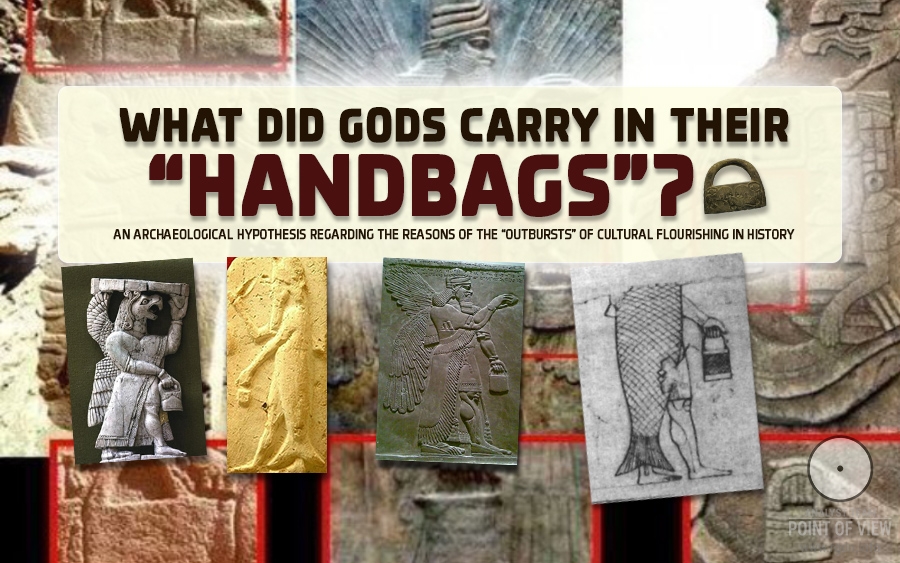
What did Gods carry in their “handbags”?


by
 
Damien F. Mackey


“I add “Assyrian Apkallu” to the search parameters and even more images flood my screen. Often they show bearded men holding bags or buckets which closely resemble those depicted on the Göbekli Tepe pillar and the one held by the Mexican “Man in Serpent” figure”.
 
Graham Hancock


Knowing that Graham Hancock is never dull reading, and also that his recent (2015) book, Magicians of the Gods: The Forgotten Wisdom of Earth's Lost Civilisation, has quite a lot to say about Göbekli Tepe, a site whose findings I think are devastating for the evolutionary explanation of origins:
 
Göbekli Tepe dating plain wrong
 
 
then it was inevitable that I should, when I saw the book in a library, take it home to read.
A few things struck me early. Most especially, those ubiquitous ‘handbags’ of the gods.
What did they mean?
That question has been posed, too, by dmatherly at the colourful Graham Hancock site
 

What function do ancient depictions of so-called hand bags have?...From the Olmec to Sumerian/Assyrian and even on a stela at Gobekli Tepe are these found..
 
 
Graham Hancock himself, when in situ at Göbekli Tepe, had speculated about these objects.
He writes about it in his book:
 
While I’m online I run some searches for images of the Seven Sages. I don’t get many hits at first, but the moment I change the search terms to “Apkallu” and “Seven Apkallu” I open a colossal archive of images from all over the internet, many of them reliefs from Assyria, a culture that thrived in Mesopotamia from approximately 2500 BC to about 600 BC. I add “Assyrian Apkallu” to the search parameters and even more images flood my screen. Often they show bearded men holding bags or buckets which closely resemble those depicted on the Göbekli Tepe pillar and the one held by the Mexican “Man in Serpent” figure. It’s not just the curved handles of these containers, or their shape—where the resemblance is much closer than on the original Oannes relief I reproduced in Fingerprints of the Gods. Even more striking is the peculiar and distinctive way that the figures from both Mesopotamia and Mexico hold these containers with the fingers of the hands turned inward and the thumb crooked forward over the handle.
There’s something else as well. A good number of the images show not a man but a therianthrope —a birdman with a hooked beak exactly like the hooked beak of the therianthrope on the Göbekli Tepe pillar. What makes the resemblance even closer is that in the Mesopotamian reliefs the birdman is holding the container in one hand and a cone-shaped object in the other. The shape is a little different but a comparison with the disc cradled above the wing of the Göbekli Tepe birdman is hard to resist.
I can’t prove anything yet. It could, of course, all be coincidence, or I could be imagining links that aren’t there. But my curiosity is aroused by the similar containers on different continents and in different epochs and so I jot down a series of questions that can form the frame of a loose hypothesis for future testing. For instance, could these containers (whether they are bags or buckets) be the symbols of office of an initiatic brotherhood—far traveled and deeply ancient, with roots reaching back into the remotest prehistory? I feel that this possibility, extraordinary though it may seem on the face of things, is worth looking into and is strengthened by the distinctive hand postures. Might these not have served the same sort of function as Masonic handshakes today—providing an instant means of identifying who is an “insider” and who is not?
 
[End of quote]
 
Striking cultural, architectural, and many other similarities amongst cultures spread as far and wide as Mesopotamia, Armenia (modern Turkey), Africa and the New World (e.g. Mexico), and significantly differing as to their eras, do not favour the evolutionary view of origins in isolation. How to explain this Göbekli Tepe–Australian Aboriginal connection, for instance?:
 

Also grabbing my attention in Hancock’s book were the ancient references to the Flood by Nebuchednezzar I and Ashurbanipal, especially given my identification of both of these names with Nebuchednezzar ‘the Great’ (so-called II) - three name for the one king. See e.g. my article:
 
Nebuchednezzar - mad, bad, then great
 
 
From these ancient quotes we learn that (also not favouring the evolutionary view) there was “the flood”, despite Mesopotamia often experiencing floods; that a “seed [was] preserved” from this flood, and that “writings” existed before the flood. Hancock writes:
 
In due course, later kings would speak of their link to the antediluvian world. In the late first millenium BC, Nebuchadnezzar I of Babylon described himself as a “seed preserved from before the flood”88 while Ashurbanipal, who ruled the central Mesopotamian empire of Assyria in the seventh century BC, boasted: “I learned the craft of Adapa, the sage, which is the secret knowledge … I am well acquainted with the signs of heaven and earth … I am enjoying the writings on stones from before the flood.”89


Friday, June 7, 2019

Until which “coming” would Apostle John live?


Image result for the apocalypse of john


Beyond the “Second Coming”
 

Part Two:
Until which “coming” would Apostle John live?


by
 
Damien F. Mackey


Peter turned and saw that the disciple whom Jesus loved was following them.
(This was the one who had leaned back against Jesus at the supper and had said,
‘Lord, who is going to betray you?’)
When Peter saw him, he asked, ‘Lord, what about him?’
Jesus answered, ‘If I want him to remain alive until I return,
what is that to you? You must follow me’.”
 
John 21:20-22


The Apostles of Jesus Christ were the types who were never going ‘to die wondering’.
Philip, for instance (John 14:8): ‘Master, show us the Father; then we shall be content’.
And Thomas (20:25): ‘Unless I see the nail marks in his hands and put my finger where the nails were, and put my hand into his side, I will not believe’.
Now Peter: ‘Lord, what about him [John]?’
 
Jesus often met such questions with a mild rebuke.
In the case of Philip (John 14:9-11):
 
Have I been with you so long, and yet you have not known Me, Philip? He who has seen Me has seen the Father; so how can you say, ‘Show us the Father’? Do you not believe that I am in the Father, and the Father in Me? The words that I speak to you I do not speak on My own authority; but the Father who dwells in Me does the works. Believe Me that I am in the Father and the Father in Me, or else believe Me for the sake of the works themselves’.
 
In the case of ‘Doubting Thomas’ (20:27): ‘Put your finger here; see my hands. Reach out your hand and put it into my side. Stop doubting and believe’.
In the case of Peter: ‘What is that to you?’, etc.
 
But there may now arise a modern question: If, as most Christians seem to believe, Jesus has not yet come as He spoke of to his disciples - {and as they (e.g. Sts. John, Paul) wrote of with phrases like “soon”, or even “very soon”} - in what Christians term (wrongly, I think) the “second coming”, then how is it that the risen Jesus can say that He wanted John ‘to remain alive until I return’?
This statement, by the way, is perfectly in accord with what the pre-Resurrection Jesus had told his followers (Matthew 16:28): ‘Truly I tell you, some who are standing here will not taste death until they see the Son of Man coming in His kingdom’.
Apparently, while Peter was not going to be one of these, John was.
Had Jesus Christ, who had risen from the dead by his own power, by the power of his Father (John 10:17-18): ‘The reason my Father loves me is that I lay down my life—only to take it up again. No one takes it from me, but I lay it down of my own accord. I have authority to lay it down and authority to take it up again. This command I received from my Father’, all of a sudden, despite his now being in a higher (transformed) state of being, become confused about when He would actually come again?
No, the fact is that there was a “coming” before the final coming, as I estimated in Part One: https://www.academia.edu/29837194/Beyond_the_Second_Coming_ thus:
 
As the Americans say, Let’s do the math.
 
First: “In the Gospel the Lord shows us that His first coming was in humility, as a Servant, to free the world from sin”. http://www.ewtn.com.au/devotionals/mercy/coming.htm
 
Second: His soon-to-take-place “coming” as gleaned from the quotes above, follows that one. And it is this particular “coming” that I would designate the “Second Coming”.
 
Last: There is yet to be a Final Coming, as indicated by the Catechism: “God's triumph over the revolt of evil will take the form of the last judgment after the final cosmic upheaval of this passing world” (No. 667). The Last Judgment.
 
Peter’s lifetime approximated to only the First of these.
John would live on until the Second.
We still await the Final coming of Jesus Christ.

Monday, June 3, 2019

When China Massacred Its Own People


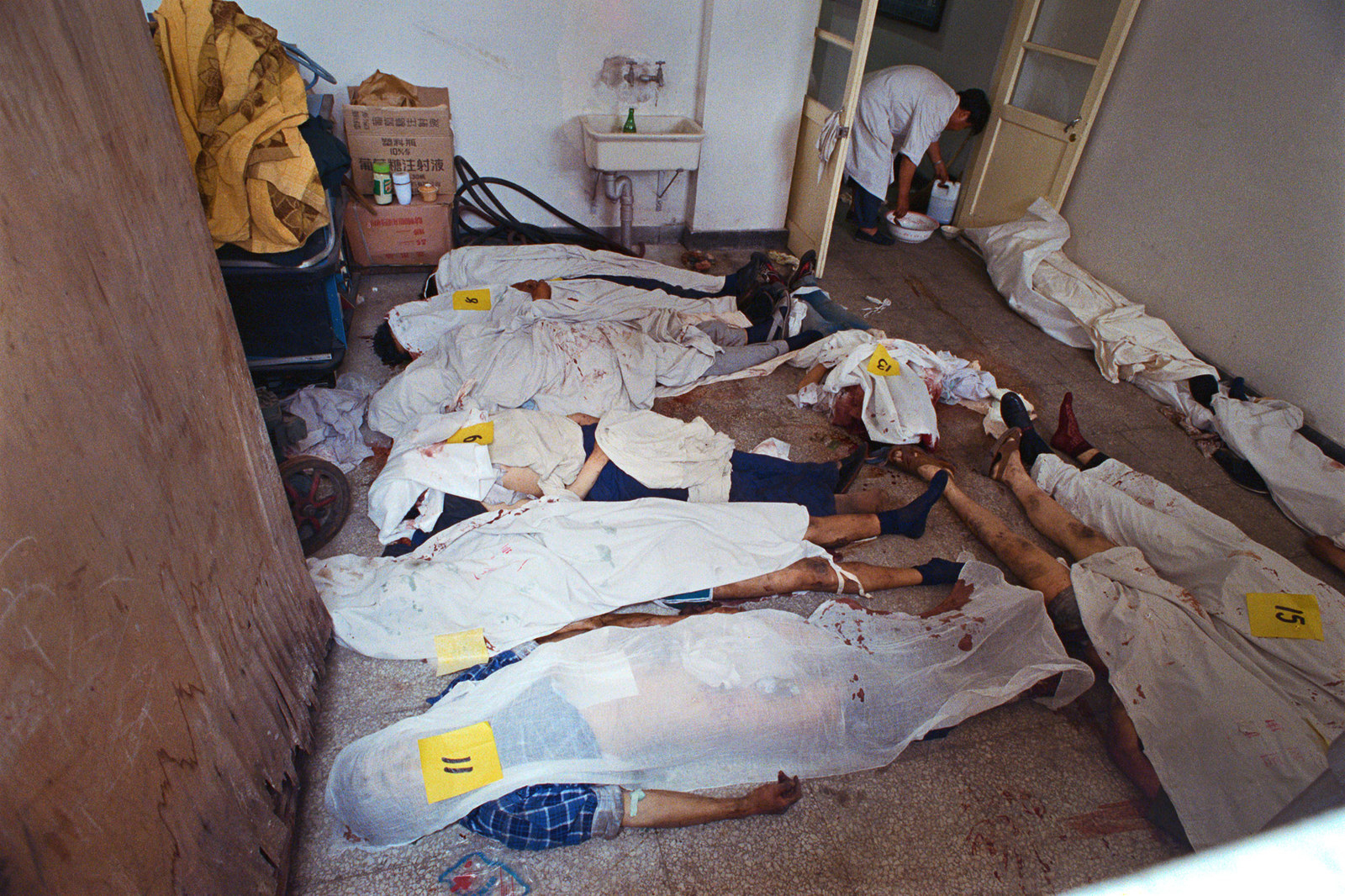
Killed demonstrators are gathered in a makeshift morgue on June 4, 1989.
David Turnley / Getty Images
Killed demonstrators are gathered in a makeshift morgue on June 4, 1989.


Nicholas Kristof
Opinion Columnist
Thirty years ago in the spring of 1989, as the world’s most populous country teetered on the edge of freedom, I received a late-night phone call in my apartment in Beijing: The Chinese Army was invading its own capital.

Students and workers had made roads impassable by setting up barricades to block the army, so I jumped on my bicycle and pedaled furiously toward the gunfire. I reached Tiananmen Square shortly before the army, and then I watched as soldiers fired their automatic weapons directly at the crowd that I was in.


I was then the Beijing bureau chief of The Times, and I ran around that evening, the notebook clutched in my hand stained with the sweat of fear, to document horrors that remain seared into my memory. You never forget watching young people, some of the nation’s best and brightest, full of passion and idealism, stand up to machine guns — and then in an instant crumple bloody and lifeless on the ground.


Until that evening, millions of Chinese had marched freely for seven weeks in hundreds of cities across the country, denouncing corruption and seeking greater democracy. Sculptors had created a huge “Goddess of Democracy,” a Chinese version of the Statue of Liberty. Hope filled the air.


Then came the soldiers, firing not only on the crowds but even on families watching in horror from balconies. Troops fired at ambulances rescuing the wounded. Winter fell on China, and in political terms it hasn’t left.


It is indisputably true that China has dazzled economically, and critics like me should be humbled that life expectancy is today longer in Beijing (82 years) than in Washington, D.C. (77 years). The 10 percent most disadvantaged Shanghai 15-year-olds score better in math than the 10 percent most privileged 15-year-olds in America.


China is not like the old Soviet Union, which both impoverished and repressed people. Rather, China has saved lives, built universities at a rate of one a week and lifted more people out of poverty than any other country in human history — but it is deeply human, as one protester put it in 1989, to seek not just rice but also rights.


My memories of the massacre in Beijing are not only of government savagery but also of unparalleled courage on the part of the most humble citizens. I will never forget the rickshaw drivers, for whenever there was a pause in the gunfire, they would pedal their three-wheeled bicycle carts out toward the troops to pick up the wounded and rush them to the nearest hospital.

I particularly recall one burly rickshaw driver. He had a couple of bleeding people on the back of his cart and was pedaling furiously, his legs straining. He saw me and swerved toward me so that I could bear witness to his government’s brutality. As he passed, he pleaded with me: Tell the world!


https://www.nytimes.com/2019/06/01/opinion/sunday/tiananmen-square-protest.html