Monday, October 15, 2012

Egyptian Ma'at and Vedic Rita


See also post: Egyptian Ma'at Akin to Hebrew Hokmah (Wisdom):
http://easterncivilisationamaic.blogspot.com.au/2012/08/egyptian-maat-akin-to-hebrew-hokmah.html


Taken from: http://www.hinduwisdom.info/India_and_Egypt.htm#Cultural


Contacts with Egypt

....


Difficult as it is to pin point exactly when communication between Egypt and India commenced, it is nevertheless intriguing to note the remarkable parallels which go as far back as the second millennium BC, if not earlier, between the concept of the Egyptian maat and the Vedic rita - the divine order of nature or creation, as opposed to the chaos of falsehood. According to both the Egyptian and Indian traditions, it was the principal duty of the king to establish order in place of disorder or chaos. Other interesting points of similarity between the two ancient cultures were the deification of the forces of nature, faith in magical chants, deep-rooted mysticism, and an emphasis on symbolic expression. There is a close proximity between Hindu mythology and Egyptian mythology and rituals. "The Book of Dead" and Garuda Purana are similar. Both are recited at the time of death. Their gods and goddesses are also similar. The brightest evidence of India's direct relations with Egypt is, however, preserved in the Mauryan Emperor Ashok's thirteenth rock edict, inscribed in the early decades of the third century B. C. In it, Emperor Ashoka refers to his contacts with Ptolemy II Philadelphus of Egypt (285-246 BC), in connection with the expansion of his policy of the propagation of the Law of Righteousness (dharma). In the Ashokan records of Ptolemy II is referred to as Turamaya. There can be little doubts that official embassies were exchanged between the Mauryan court and that of Ptolemy II. Pliny names the Egyptian ambassador of Ptolemy II to India as Dionysius. (source: Intercourse between India and the Western World - By H. G. Rawlinson p. 92).
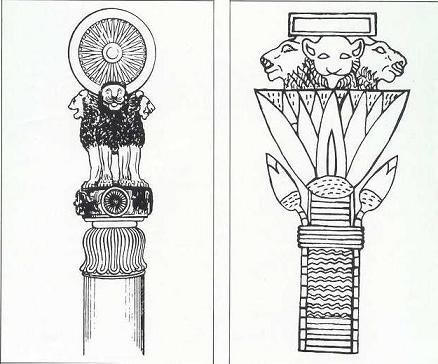
Forms of the Djed column - Egypt Pharaonic Age


Ashokan pillar with lion capital. India. Lotus pillar surmounted with lion heads Egypt. Pharanoic Age.

(image source: India and Egypt - edited by Saryu Doshi p. 66).
*** Ashoka, in his second rock edict, refers to the philanthropic activities undertaken by himself. He records that he had made arrangements for the medical treatment of men and animals in the territories of his own empire as well as in the region ruled by Antiochus Theos II of Syria (260-246 BC) and its neighboring kingdoms, which also included Egypt. With the growth of India's links with the West, there was brisk communication in the area of trade with the Hellenistic world including Egypt, and it is believed that Indian traders reached the land of the Pharaohs. A Hellenistic writer, Agatharchides, the learned tutor of Ptolemy Soter II informs one about a colony of Indians on the island close to the mouth of the Red Sea, named Socotra, which in Sanskrit would be Sukhottara-dvipa (island of great joy). Socotra, must have functioned as one of many intermediary ports between Egypt and India. Interestingly, it is stated that the Egyptian ruler Ptolemy IV, Philopator, lined a part of his yacht with Indian stones. The presence of Indians in Egypt in the third century BC has been attested by Athenaeus who observes that the processions of Ptolemy II Philadelphus also included women, cows, and hunting dogs from India. (source: India and Egypt: Influences and Interactions - edited by Saryu Doshi). Historians have long known that Egypt and India traded by land and sea during the Roman era, in part because of texts detailing the commercial exchange of luxury goods, including fabrics, spices and wine. Among their finds at the site near Egypt's border with Sudan: more than 16 pounds (7 kilograms) of black peppercorns, the largest stash of the prized Indian spice ever recovered from a Roman archaeological site. Ships would sail between Berenike and India during the summer, when monsoon winds were strongest, Wendrich said. From Berenike, camel caravans probably carried the goods 240 miles (386 kilometers) west to the Nile, where they were shipped by boat to the Mediterranean port of Alexandria, she said. From there, they could have moved by ship through the rest of the Roman world. Mediterranean goods, including wine from the Greek island of Kos and fine tableware, moved in the opposite direction. This Indian cotton textile was excavated from a Roman trash dump in the ancient Egyptian town of Berenike. Local Ababda nomads dig in one of the streets in Berenike, which holds an array of artifacts that scientists say reveals an "impressive" sea trade between the Roman Empire and India.
 
....

Thursday, October 11, 2012

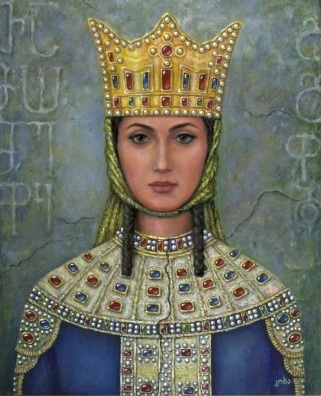
Who was Queen Tamar (or Tamara) of Georgia?


AMAIC: Good question, considering our identification of (i) biblical Tamar with Abishag/Hatshepsut, 'Queen of the South'; (ii) the fact that both queen Hatshepsut and Georgian queen Tamar were 'king'; (iii) the alliance of both with a David; and (iv) the Georgian's relics being perhaps in Jerusalem.


Best Answer - Chosen by Asker

Tamar Bagrationi was Queen of the kingdom of Georgia from 1184-1213. She ruled during what is generally regarded as Georgia's "golden age" and gained a reputation as an outstandingly successful ruler, dubbed "King of Kings and Queen of Queens" by her subjects.

She was born in 1160, the daughter of King Giorgi III (1156-1184) and Queen Burdukhan of Georgia. The king proclaimed that he would share the throne with his daughter from the day she turned twelve. The father and daughter ruled the country together for five years. After King George’s death in 1184, Queen Tamara was enthroned as ruler of all Georgia at the age of eighteen. She is called “King” in the Georgian language because her father had no male heir and so she ruled as a monarch and not as a consort.

She was a pious individual, an after her coronation, she convoked a local council to correct problems in church life. When the bishops had assembled from all parts of her kingdom, she called upon them to establish righteousness and stop any abuses.

Tamar's first husband was the Russian prince Yuri (known in Georgia as Giorgi) Bogolyubski (in 1185-1186). She had no children by Yuri. His marriage to Tamara exposed many of the coarser sides of his character. He was often drunk and inclined toward immoral deeds. In the end, Tamar’s court banished him to Constantinople, along with a generous allowance. Then she selected her second husband herself. He was the Ossetian prince David Soslan of the Georgian Bagrationi family, whom she married in 1188.

Tamar played an active military role as the commander of an army. In 1193 the Georgian army marched to Bardav. Following its triumphant return, a new campaign was undertaken against Erzerum. The army under Tamar and David attacked the Seljuks (Turks) wintering on the banks of the river Arax.

The Atabag of Azerbaijan Abu-Bakr was given command of the army of the coalition of Georgia's Muslim opponents. A battle was fought near Shamkhor in 1195 which ended in a Georgian victory. Numerous prisoners and huge amounts of booty were seized, including the Khalif's standard, which Tamar donated to the Icon of Our Lady of Khakhuli. The Georgians took the city of Shamkhori and the adjoining regions, and the occupied lands were turned over to the Shirvan-Shah on terms of vassalage. From Shamkhori the Georgian army marched to Gandza.

The Georgian victories alarmed the Muslim rulers of Georgia's neighbours, particularly Rukn ad-Din, Sultan of the Seljuk state in Asia Minor. The Sultan prepared for war in order to break the might of Christian Georgia and fought a major battle near Basiani in 1203. Despite the huge size of the Seljuk army - said to number more than 400,000 troops - the Georgian army under Tamar and David won a famous victory.

Under Tamar's rule, Georgia became the strongest power in the Near East and expanded its territorial influence considerably around the shores of the Black Sea. In 1204, Tamar became the main founder of the Kingdom of Trabizond on the southern shore of the Black Sea (now the Turkish province of Trabzon). This Kingdom was populated mainly by Lazi (Chani) Georgian tribes. In 1206, Tamar's army occupied the city of Kars.

Like other medieval monarchs, Tamar played an active role in promoting her country's religion and culture, sponsoring the construction of numerous Georgian Orthodox churches. The poet Shota Rustaveli commemorated Tamar in his epic poem The Knight in the Panther's Skin, in which her coronation gave Rustaveli the historical background for his sublime description of the coronation of Tinatin.

Queen Tamara carried out a regular, secret observance of a strict ascetic regime – fasting, a stone bed, and litanies chanted in bare feet, which finally took a toll on her health. The queen died in 1213 and was subsequently canonized by the Georgian Orthodox and Apostolic Church. The burial place of Queen Tamara has remained a mystery to this day. Some sources claim that her tomb is in Gelati, in a branch of burial vaults belonging to the Bagrationi dynasty, while others argue that her holy relics are preserved in a vault at the Holy Cross Monastery in Jerusalem.


Wednesday, October 3, 2012

Marriage Breakdown: Greatest Threat To Civilisation


MARRIAGE may help prevent cancer, is the best chance of fulfillment in life and divorcing parents should get better assistance to reconcile, says the MP who could become Australia's next Families Minister.

Senior Liberal MP Kevin Andrews has rated the breakdown of marriage and the family a greater threat to the Western world than climate change, the financial crisis and radical Islam.
The Opposition families spokesman is today launching his book, Maybe 'I do' - Modern Marriage and the Pursuit of Happiness, which says more needs to be done to protect and support marriage and family because "stable families are also the bedrock of successful societies".
The book is based on thousands of social science studies that detail the importance of marriage for adults, children and society, and proposes policy responses.
Mr Andrews argues it is the Government's business to promote marriage, which is the "best source of physical and mental health, emotional stability, and prosperity for adults and children. It is also the best bet for attaining happiness and fulfilment".
Married men and women lead more healthy lives than unmarried and are more likely to be richer, own a home and be successful in employment, the provocative book says.
"Marriage seems to protect from contracting cancer and offers a better chance of survival after diagnosis."
It argues growing up with married parents gives kids the best chance of learning "virtues, based on respect for human life and dignity".
"The recent retreat from marriage that was meant to free individuals from economic and emotional constraints has failed many people."
The ideal of "marital permanence" needs to be entrenched in a national family and marriage policy, affirming marriage as the best environment for raising children, the Catholic MP and married father-of-five writes.
While not advocating people stay in destructive marriages, research shows up to 37 per cent of couples regret divorcing, the book says.
It says studies have found couples who cohabit before marriage appear to have higher risks of divorce.
And it encourages young people to think about what they want in a relationship and the consequences of multiple partners.
"By moving from one relationship to another, many young people may be undermining their understanding of how to live a committed, faithful relationship," Mr Andrews writes.

elissa.doherty@news.com.au

....

Taken from: http://www.heraldsun.com.au/news/victoria/liberal-mp-kevin-andrews-book-says-marriage-best-for-you-and-the-kids/story-e6frf7kx-1226487704486


Wednesday, September 26, 2012

Melchizedek Not An ‘Enlightened Pagan’


Bible Critics Can Overstate Idea Of ‘Enlightened Pagan’

 
by

Damien F. Mackey


“Salvation is of the Jews” (John 4:22)


“I will arouse your sons, O Zion, against your sons, O Greece” (Zechariah 9:13)


PART ONE


Here it will be argued that - contrary to what is often believed about the following biblical characters - none of these can really accurately be designated as an ‘enlightened pagan’:


1.      MELCHIZEDEK

2.      RAHAB (in genealogy of David and Jesus)

3.      RUTH

4.      ACHIOR (in my Catholic Bible, Book of Judith)

5.      JOB

6.      (Probably also) the Magi.


Let us consider why.


1.      MELCHIZEDEK was not an enlightened Canaanite priest-king. Melchizedek was the great Shem, son of Noah. This is apparently a Jewish tradition and I have long accepted it. Now, this is all explained very well in a recent article that I have posted at: http://amaic-abraham.blogspot.com.au/2012/09/melchizedek-was-shem-son-of-noah.html


Regarding 2, 3 and 4, for Rahab (as specified above), Ruth and Achior to have been former Gentile pagans, Canaanite in the first case (2.) and Moabites in the other two instances (3. and 4.), then this would have meant a serious flouting of Mosaic law and prohibitions: Deuteronomy 7 in the case of Rahab (see article posted at: http://amaic-kingdavid.blogspot.com.au/2012/09/the-genealogical-rachab-was-not.html), and Deuteronomy 23:3 for the presumed Moabites (see article posted at: http://amaic-kingdavid.blogspot.com.au/2012/09/ruth-was-israelite.html).


2.      RAHAB. The Canaanite harlot, Rahab, whose ‘faith’ both Paul (Hebrews 11:31) and James (2:25) praised incidentally (like Jesus with the Roman centurion, Luke 7:1-10), was not she who became the ancestress of David and Jesus, despite what is universally taught. The true situation, as well explained in the above-mentioned “Rachab” article, is that Rahab the harlot is to be distinguished from the Israelite woman, Rachab (note different spelling), whose name is to be found in the Davidic genealogical list.


3.      RUTH. I have long believed, too, that Ruth of the Judges era could not plausibly have been a Moabitess for reasons already explained (Deuteronomy 23:3), but considered especially in my extensive research on the identity of Achior, presumably a Moabite, in the Book of Judith (see 4. next). I discussed Achior at length in Volume Two of my university thesis, A Revised History of the Era of King Hezekiah of Judah and its Background (accessible at: http://hdl.handle.net/2123/5973). Whilst Ruth, a woman, apparently gets away with it, Achior, a male, does not (see 4. next). Then necessity of Ruth’s being an Israelite is well argued in the above-mentioned “Ruth” article.


4.      ACHIOR. I argued at length in the above-mentioned university thesis that Achior was not a Moabite at all but a Naphtalian Israelite. He was Ahikar (var. Achior, Vulgate), the nephew of Tobit (Book of Tobit 1:22). The mistaken notion that Achior was a Moabite leader is perhaps the primary reason why the Jews have not accepted the Book of Judith as part of the scriptural canon. I live in the hope that this can one day be rectified.   


5.      JOB I have firmly identified as Tobit’s very son, Tobias. See our site, “Holy Job Was An Israelite”, http://bookofjob-amaic.blogspot.com.au/ Thus the righteous Job was, not an enlightened Edomite (and not an Arabian sheikh), but a sage of Israel.


6.      THE MAGI. There is some tradition that has them descending from the family of Job. I would suspect that the “east” in which the Magi dwelt was, not Persia by any means, but the same approximate “east” wherein Job dwelt, in the land of Uz, in Transjordanian Bashan. See our Jobian articles at site, “Holy Job Was An Israelite”. 


PART TWO


Our {AMAIC} appreciation of the cultural, sapiential and spiritual supremacy of the holy people of Israel (the sincere Yahwists) has led to further important Israelitic identifications of certain famous historical characters (even dynasties), such as:


-          the gifted Senenmut (Senmut) of 18th dynasty Egyptian history, consort of Hatshepsut, with King Solomon. See our site: http://amaic-kingdavid.blogspot.com.au/ Hatshepsut herself rightly being identified by Dr. Immanuel Velikovsky (Ages in Chaos, I) with the biblical Queen [of] Sheba. See our site: http://hatshepsut-amaic.blogspot.com.au/

-          King Hammurabi the Lawgiver as King Solomon again, this time in his guise as ruler of Babylon. See our site: http://amaic-kingdavid.blogspot.com.au/


And, selectively following Dr. E. Metzler, “Conflict of Laws in the Israelite Dynasty of Egypt” (http://moziani.tripod.com/dynasty/ammm_2_1.htm), I have accepted his identification of Egypt’s 18th dynasty as Israelite, with the mighty Thutmoside pharaohs as Davidide.

The El Amarna dynasty was, I believe, a Baalistic Israelite resurgence under King Ahab (Akhnaton) and his wicked Phoenician wife, Queen Nefertiti (Jezebel). See e.g. our: http://queennefertiti-amaic.blogspot.com.au/

General Jehu is the ambiguous Horemheb, making the 19th dynasty that he (Horemheb) initiated, as Syro-(Israelite?).

And I further suspect that Egypt’s 20th dynasty was Judaean again, with pharaoh Ramses III as the mighty King Amaziah of Judah. See our: http://ramsesiii-amaic.blogspot.com.au/


To conclude


Whilst there are indeed to be found in the Scriptures some highly ‘enlightened pagans’ or Gentiles of ‘faith’, such as Rahab the harlot and the Roman centurion, the Old Testament ones at least would not have been allowed into the Yahwistic fold according to the very strict Laws of Moses.


Tuesday, September 25, 2012

Melchizedek Was Shem Son of Noah


The Identity of Melchizedek

by

Bill Lavers


So many have sought the identity of Melchizedek, yet nothing of a definitive nature has ever been forthcoming from their deliberations. The reason for their failure - their stumbling block may be a more apt way of putting it - has always been that single verse to be found in the seventh chapter of the Book of Hebrews, namely, verse 3, which says of him that he was: “Without father, without mother, without descent, having neither beginning of days, nor end of life; but made like unto the Son of God; abiding a priest continually.”

____________ _ ____________


Before we consider the reason why the author of Hebrews made this seemingly sweeping statement about Melchizedek, I want you to take particular note that, in the three verses where he is spoken of in Genesis 14, verses 18 to 20, nothing whatever is said that would intimate that he was anything more than a normal human being. Yes, he was a king; but so was David. He was also the priest of the Most High God; yet, in Psalm 82:6, God refers to His people as children of the Most High, and adds in verse 7: “but ye shall die like men.”

Where, then, did the author of Hebrews get the idea that Melchizedek was anything more than a mortal man - if, indeed, that is what he was seeking to convey? The only other place in the Old Testament where Melchizedek is mentioned is in Psalm 110:4; but, again, there is nothing in that verse that would depict him as being an immortal being, although some might argue otherwise, in view of the reference God made to the age-abiding nature of Christ’s affirmed priesthood: “Thou art a priest for ever after the order of Melchizedek.”

God was there simply expressing the unique nature of Melchizedek’s priesthood - that it did not pass to another as did that of Aaron. In like manner, therefore, the priesthood He was conferring on Christ, being in resurrection life and glory, would never be taken from him, that it would remain his unique status in the Father’s eyes. There can be no doubt that the author of Hebrews understood this to be the meaning and intent of the Father’s words by what he says in Hebrews 7:20-25. Here is what we are told in that passage of scripture, as recorded in The Jerusalem Bible.

“What is more, this was not done without the taking of an oath. The others, indeed, were made priests without an oath; but he with an oath sworn by the one who declared to him: The Lord has sworn an oath which he will never retract: you are a priest, and for ever. And it follows that it is a greater covenant for which Jesus has become our guarantee. Then there used to be a great number of those other priests, because death put an end to each one of them; but this one, because he remains for ever, can never lose his priesthood. It follows, then, that his power to save is utterly certain, since he is living for ever to intercede for all who come to God through him.”

In no way was God confirming some type of immortal status upon Melchizedek in Psalm 110:4; and certainly not with the meaning that we have so erroneously and so foolishly assigned to the words of the author of Hebrews 7:3. Had that been the case, then God would have been placing Melchizedek on a par with Himself, proclaiming him as an ever existent being, having neither a beginning nor an end of life. Why, even Christ was born from a mother’s womb.


Hebrews 7:3


How, then, are we to understand Hebrews 7:3? Before I ventured on writing this paper, I browsed through a number of Bible Commentaries and Bible Dictionaries to find out which, if any, actually backed up what I believed to be the answer to the problem, and gave a simple and perfectly rational approach by which the solution could best be explained and most easily understood. The one I found which best met these criteria was the Dictionary of the Bible, edited by James Hastings, under the article, Epistle to the Hebrews in the second volume of the set. The following, therefore, is basically a brief summary of that part of the article having particular relevance to our subject.

The article shows that the answer we are seeking actually becomes abundantly clear when we simply consider the intention that the author had in mind when he wrote those first three verses of chapter 7. Notice that he was giving a summary of the facts about Melchizedek as they were stated in Genesis 14:18-20, adding a brief commentary to point out their religious significance, and extracting from those facts exactly what were the determining marks of the Melchizedek order. To make the facts serve his purpose, the writer found it necessary to attach importance, not merely to what is said of Melchizedek, but to what is not said - to the silences as well as the utterances of history. He was also giving ideal meaning to the names occurring in the story.

By this means, he attains what he set out to do. He defines and clarifies the typology of the Melchizedek priesthood. Look at those first three verses and read them with this in mind. You will see that he brings five distinct types to our attention. Taking them in the order of presentation, we are shown that the Melchizedek priesthood is, first, a royal priesthood, Melchizedek having kingly status. Secondly it is a righteous priesthood; he is said to have been king of righteousness in verse 2. Thirdly, and again emphasized in verse 2, his priesthood promoted and exercised peace; he was “also king of Salem, which is king of peace.” Fourthly, and I want you to notice this carefully, his priesthood was a personal, not an inherited dignity, because, as far as the record was concerned, he was without father and without mother; and only in that sense. Fifth, and lastly, it is an eternal priesthood; without beginning of days or end of life - again, so far as the record is concerned.

By making this ingenious commentary on the narrative in Genesis, the author is trying to fix the characters of an ideal priesthood. He is portraying to the minds of his readers the highest conceivable type of priesthood: that the priest must be really, not ritually, holy; one whose priestly ministry is a course of gracious condescension - a royal priest. He must also be one who, by his personal worth and official acts, can establish a reign of righteousness, peace, and perfect fellowship between man and God. Finally, he must be one who ever lives, whose priesthood does not pass from him to another, thereby giving an absolute guarantee for the preservation and maintenance of peace.


Order of Melchizedek

This was the perfect type of priesthood - after the order of Melchizedek - that the Most High God was conferring on Christ. As the author seeks to assure his readers in the last two verses of the sixth chapter of his epistle: “Here we have an anchor for our soul, as sure as it is firm, and reaching right through beyond the veil where Jesus has entered before us and on our behalf, to become a high priest of the order of Melchizedek, and for ever” (Jerusalem Bible).

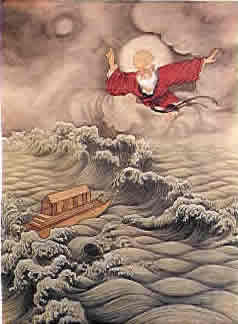
With these facts in mind, therefore, allowing us to accept Melchizedek as a mortal human being, his identity need no longer remain an enigma. There really was only one renowned and august personage in that period of Old Testament history who could have held that divinely appointed office of authority. That person was Shem, one of Noah’s three sons who were born prior to the great Noachian Deluge and came through the Flood with their wives and their parents - the only eight souls saved from that old world.

Shem was 98 years of age when God brought the great flood upon the earth. He was not the eldest of Noah’s sons, as one would assume from the order in which they are each presented in Genesis 5:32; and the boys were certainly not triplets, all born together when Noah was five hundred years old. That was obviously the age of Noah when the first child was born, that son being Japheth. This is clear from Genesis 10:21, which specifically says that Japheth was the elder - and he was the elder by at least two years where Shem was concerned, as can easily be understood from what we are told in Genesis 10:1.

I don’t want to spend an unnecessary amount of time on the boys’ ages; but they do reveal an interesting trait that we find time and again in the scriptural record, that the one on whom the greatest blessings fell was often the youngest. I have no way of proving directly from the scriptures that Ham was Noah’s second son, thereby making Shem the third and last in the birth process, but Jewish tradition certainly holds this to be true. In volume 5 of The Anchor Bible Dictionary, page 1195, under the sub-heading Jewish Tradition, we are told this:

“The Tannaitic and Amoraitic teachers considered Shem, Shem the Great, as he is called by some, Noah’s youngest son. They say that in the Bible he is mentioned first among the members of his family because he was the most righteous, wisest, and most important son, not because he was the oldest”


Generations of Shem


In that most important genealogical table, entitled The Generations of Shem, which begins with verse 10 in the eleventh chapter of Genesis, we are given the name and age of each of the patriarchs in the righteous line of descent from Shem. You will find those same patriarchs listed in Luke’s genealogical record of Christ’s ancestry from Adam. In Genesis 11, you will notice a break at the end of verse 26. It is interesting that, at that point in the patriarchal line of descent from Shem, we now find The Generations of Terah taking precedence. It is as though God is here saying: “I now want you to take particular note of the lineal relation of Shem to Abraham.”

There is an interesting note on this which is given in The New Bible Commentary Revised, page 92. The short account opens by saying that “Man’s kingship under God had found expression in Noah’s kingdom in the ark. Now the kingdom of God is given to Abram to be possessed in God’s promises, by faith.” In other words, from the time of Noah, God had given His kingdom inheritance into the charge of Shem and his patriarchal line, because it was through Shem that the righteousness of Noah, in God’s eyes, found its full expression.

Each of those ancient patriarchs, then, under the overall leadership and divinely directed and inspired guidance of their forefather, Shem, were responsible, before God, for governing that area of the world that God was later to give as an inheritance to Abraham and his seed. One might wonder, then, why the break in Shem’s genealogical record was made with Terah, and not with Terah’s son Abram. Isn’t it interesting, by the way, to see that Terah, like Noah, had three sons, named as Abram, Nahor, and Haran in verse 27, and that, like Shem, it was the youngest of the three, Abram, in whom the righteous line was destined to continue.

But to get back to the theme of our discussion; why do we find the break in Shem’s genealogical record made with Terah and not with Abram, or Abraham as he was later to be called. Again, we find the answer in The New Bible Commentary Revised that I quoted from above. “The appearance of Terah’s (not Abram’s) name in the 11:27a heading accords with the Genesis framework’s concern with the genealogical origins of the twelve tribes of Israel, for they stemmed from Terah not only through Abram but through Sarai (20:12) and through Rebekah, Leah, and Rachel of the lineage of Nahor, son of Terah.”

The answer to so many questions is so clearly answered in those genealogical records given us in Genesis if we only have the eyes to see what God is trying to show us there; and, most important from our present perspective is the answer to Melchizedek’s identity. From what we have already considered, who was better qualified to have held that most majestic office than Shem, the first patriarchal descendant of Noah in the righteous line of descent.

We have now seen that Shem was the lineal ancestor of the Jewish people. He lived for the first 98 years of his life in the pre-Flood world. Not only did he witness the build up of the evil that led to the total corruption of that ancient society before God, filling it with such violence that God had no alternative but to completely destroy it, but, having that same righteous mind that God saw in his father Noah, he would have had an abhorrence of all manner of ungodliness. He had seen and experienced the terrible end-result of unmitigated sin and evil, and there can be little doubt that he was determined to do all he could, led and directed by the power of God in that new world, to preach and teach the righteousness of God to his descendants.

He had been blessed by God, together with his father and brothers, and heard God’s blessed pronouncement, to be fruitful, and multiply, and replenish the earth (Gen.9:1). He had also heard God establishing His covenant, not only with Noah, himself and his brothers, but with their seed after them. Furthermore, that covenant he knew to be all-inclusive, to the extent that it was made with every living creature that would come to exist on that new earth (9:10).

Shem had no illusions as to his God-given responsibilities, for Noah had conferred them on him with the words: “Blessed be the Lord God of Shem” as recorded in Genesis 9:26. The blessing was Shem’s identification with God’s covenant name, Yahweh, as was to be seen later in the Abrahamic covenant.

600 Years Old


From the opening two verses of Shem’s genealogical record in Genesis 11, you will see that Shem lived to be 600 years old, which means he outlived all in his patriarchal line, with but one exception, down to and including Terah, the father of Abraham. The one exception was Eber, whose death followed 29 years after that of Shem. But then, Eber was the third generation patriarchal descendant of Shem, Shem being already 165 years of age when Eber was born.

The important point I want to make here, however, is that Shem lived on into the lifetimes of both Abraham and Isaac. He was 450 years of age when Abraham was born, and 550 years old at the birth of Isaac. In fact, he died just 10 years before Jacob was born. As far as Abraham was concerned, he outlived Shem by only 25 years. That means that Shem would have known Abraham – and, indeed, would undoubtedly have had a long and paternal-like relationship with him, probably from the time that Abraham first came into the land of Canaan at age 75.

Of course, being the most renowned and, probably, the most revered figure on earth at that time, I am sure that Abraham would also have known Shem quite early in his life, throughout those first 75 years he had lived, first in Ur of the Chaldees, and then, of course, in Haran up until the death of his father Terah. At least, if he had not known him personally, which I doubt, he would certainly have known him by repute.

How natural, then, it would have been for Abraham to have given to this ancient and most esteemed personage, now revealed to us as Melchizedek, king of Salem and priest of the Most High God, the tithes of all when he returned from Hobah, having brought Lot and all those who had been taken captive with him, back to the safety of their own land once again (Gen.14:14-20).

It is so clear from that important passage of scripture contained in verses 18 to 20, that Melchizedek was very well acquainted with Abraham, and was thoroughly informed as to the unique role that God had called and chosen him to perform in His great plan of salvation for mankind. Just give a moment’s thought to the manner of his address to Abraham in the last two verses of that passage in particular: “And he blessed him, and said, ‘Blessed be Abram of the Most High God, possessor of heaven and earth: and blessed be the Most High God, who hath delivered thine enemies into thy hand…’”

As God’s highest representative on the earth at that time, I, personally, feel sure that Shem would have been fully informed of all that God intended to do through Abraham; and, what is more, all that He intended for that very same city that was later to be known as Jerusalem. We have only to look at Isaiah 22:11, and realise that it was undoubtedly Shem, king of Salem, and priest of the Most High God, who is there spoken of as the maker of the ancient pool at the Gihon spring. But that is a continuation of the story that must be reserved for another time.

Copyright 2002 - Bill Lavers


Under new listings

Monday, September 17, 2012

Abba or Allah


Dr. Scott Hahn

In this informative talk, Dr. Scott Hahn explores some of the most important beliefs that distinguish Christianity from Islam. He explains that while both religions trace themselves back to Abraham, the differences, including our understanding of God as Father, are not insignificant. With charity, balance and candor, Dr. Hahn shows us how Islam presents the most formidable challenge to Christianity in the Third millennium.
...
 
Taken from:


Other Recommended Titles:

The Healing Power of Confession

The Healing Power of Confession


Dr. Scott Hahn presents the historical and biblical origins of the Sacrament of Penance (Reconciliation). He provides an important guide for new Catholics, a source of renewal for "old hands", and a challenge to all of us to deepen our relationship with Christ through regular use of the Sacrament of Penance.

This is an outstanding talk on Confession that cuts to the heart of this great Sacrament of Mercy. Father Joseph - Baltic, CT

Contraception: Cracking the Myths

Contraception: Cracking the Myths


In this new revised edition of Professor Janet Smith's groundbreaking expose on the effects of the pill on modern society, she presents a God-centered view of sexuality that can bring married couples a joy that they could have never imagined. Backed by statistics and armed with decades of research, Prof. Smith shows the crippling effect of the contraceptive culture on our relationship with God, our romantic relationships and marriages, the culture at large and our physical and mental health.


Check out the accompanying PowerPoint presentation here.

“A must have! It should be required listening material for those who are called to educate and lead in this Millennium.” Imee - Cypress, CA

Seven Deadly Sins - Seven Lively Virtues

Seven Deadly Sins - Seven Lively Virtues


Join noted Professor of Theology and author, Fr. Robert Barron, in this revealing presentation as he sheds light on the Seven Deadly Sins - those great spiritual blocks that inhibit our relationship with God and others - and the antidote to them, the Seven Lively Virtues! Fr. Barron uses Dante's DIVINE COMEDY to expose these sinful patterns in our lives and show how they are effectively counteracted by the cultivation of virtue through the development of the gifts of the Holy Spirit. This fascinating journey shows the path that God has designed to lead us to health, happiness and holiness.

Absolutely wonderful! I love how Fr. Barron gives practical ways to use the information he’s presenting. Nancy - Warroad, MN

The Lamb's Supper

The Lamb's Supper


Based on his best-selling book, Dr. Scott Hahn reveals the early Christians? key to understanding the Mass: the Book of Revelation. With its bizarre imagery, mystic visions of Heaven, and end-times prophecies, it mirrors the sacrifice and celebration of the Holy Eucharist. See the Mass with new eyes, pray the Liturgy with a renewed heart, and enter into the Mass more fully and enthusiastically!

Excellent! It is hard to express the spiritual impact this CD has had on me. I don't believe I will ever celebrate the Eucharist the same way again! Floy - Manchester, KY

Jesus and the Jewish Roots of the Eucharist

Jesus and the Jewish Roots of the Eucharist


Dr. Brant Pitre uses the Hebrew Scriptures and Jewish tradition to frame the actions of Jesus at the Last Supper, and to provide a fresh look at the heart of Catholic practice — the Eucharist. By taking us back to the Jewish roots of our faith, Dr. Pitre gives us a powerful lens through which to see anew the bread of the presence, the manna, the Last Supper, and ultimately the meaning of the Eucharist.

Click Here For Free Study Guide

Amazing teaching on the Eucharist!! Such fullness; so rich in history... The more I learn, the more I love our Faith! Lydia - Windham, NH

Discovering the Biblical Significance of Mary

Discovering the Biblical Significance of Mary


In one of the most inspiring CDs we have ever offered on the Virgin Mary, Dr. Scott Hahn reveals incredible insights on the Biblical basis for the Catholic teachings regarding Mary as the Ark of the New Covenant. This presentation will help shatter many misconceptions and clearly demonstrate how Catholic teachings are unmistakably rooted in Sacred Scripture. Following the presentation is a bonus segment from a prior talk by Dr. Hahn, "Why Do We Have a Pope?"

Wow! This is by far one of the most inspiring CDs I have heard so far! I can't say enough about it! William - Spring Hill, FL

How to Get the Most Out of Mass

How to Get the Most Out of Mass


Dr. Scott Hahn takes us through the awesome grandeur of the Holy Sacrifice of the Mass, from the entrance song to the dismissal. With great clarity, he takes us through a basic outline of the structure of the Mass, explaining how the Sacred Liturgy transforms the ordinary into the extraordinary and the earthly into the heavenly. A must-have for every Catholic and non-Catholic who wants to know what the Mass is all about.

Your whys and wherefores will be answered! Carrie - Columbus, OH

Becoming The-Best-Version-of-Yourself

Becoming The-Best-Version-of-Yourself


Matthew Kelly possesses a powerful ability to combine the ageless tool of storytelling with a profound understanding of today's culture and the common yearnings of the human heart. He shows us how to see the challenges in our everyday lives in a new light. He will help elevate and energize you to pursue the highest values of the human spirit and become the best version of yourself.

OUTSTANDING!!! This timely presentation was filled with truth & presented in a way that was easy to identify with and understand. Anne - Youngstown, OH

The Virgin Mary Revealed Through Scripture

The Virgin Mary Revealed Through Scripture


Once a Protestant minister, Dr. Scott Hahn was a militant opponent of the Catholic Church. Now one of the foremost Catholic theologians in the world, he responds to key misunderstandings about the Virgin Mary. This captivating presentation explains the biblical and historical basis for the Church's teachings that the Virgin Mary is the New Eve and the Queen of Heaven.

I learn more every time I listen to this CD! I really liked the explanations of the Old Testament being fulfilled in the New Testament. Debra - Germantown, WI

The Dead Sea Scrolls

The Dead Sea Scrolls


Dr. John Bergsma is an Associate Professor of Theology at Franciscan University of Steubenville, and was a Protestant pastor for four years before converting to the Catholic Church. In this enlightening talk, Dr. Bergsma shows how our respect for the traditional canon of Scripture, as well as our understanding of the Catholic Faith, can be greatly enhanced by the Dead Sea Scrolls- the greatest archaeological discovery of all time.

CLICK HERE FOR A FREE OUTLINE

Absolutely fascinating! Nancy - Warroad, MN